. 2018 Jan 30;18(1):4.
doi: 10.1186/s12896-018-0419-0.

Optimized DNA electroporation for primary human T cell engineering

Affiliations

Optimized DNA electroporation for primary human T cell engineering

Zhang Zhang et al. BMC Biotechnol. .

Abstract

Background: Effective gene-delivery systems for primary human T cell engineering are useful tools for both basic research and clinical immunotherapy applications. Pseudovirus-based systems and electro-transfection are the most popular strategies for genetic material transduction. Compared with viral-particle-mediated approaches, electro-transfection is theoretically safer, because it does not promote transgene integration into the host genome. Additionally, the simplicity and speed of the procedure increases the attractiveness of electroporation. Here, we developed and optimized an electro-transfection method for the production of engineered chimeric antigen receptor (CAR)-T cells.

Results: Stimulation of T cells had the greatest effect on their transfection, with stimulation of cells for up to 3 days substantially improving transfection efficiency. Additionally, the strength of the external electric field, input cell number, and the initial amount of DNA significantly affected transfection performance. The voltage applied during electroporation affected plasmid permeation and was negatively correlated with the number of viable cells after electroporation. Moreover, higher plasmid concentration increased the proportion of positively transfected cells, but decreased cell viability, and for single-activated cells, higher cell density enhanced their viability. We evaluated the effects of two clinically relevant factors, serum supplementation in the culture medium and cryopreservation immediately after the isolation of peripheral blood lymphocytes. Our findings showed that our protocol performed well using xeno-free cultured, fresh T cells, with application resulting in a lower but acceptable transfection efficiency of cells cultured with fetal bovine serum or thawed cells. Furthermore, we described an optimized procedure to generate CAR-T cells within 6 days and that exhibited cytotoxicity toward targeted cells.

Conclusions: Our investigation of DNA electro-transfection for the use in human primary T cell engineering established and validated an optimized method for the construction of functional CAR-T cells.

Keywords: Chimeric antigen receptor modified T cells; Electroporation; T cell engineering.


Conflict of interest statement

Ethics approval and consent to participate

Human blood collections were taken following approval of the Institutional Review Board of the Beijing Biotechnology Institute, and written informed consent was obtained from all participants.

Consent for publication

Not applicable.

Competing interests

The authors declare that they have no competing interests.

Figures
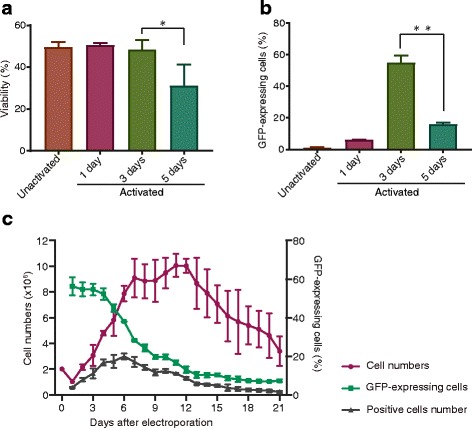
Fig. 1
Fig. 1
Activation and culturing time affect the efficiency of T cell electroporation. a, b Cell viability and percentage of positively transfected cells at 24 h after electroporation. c Change in the percentage of positively transfected cells (green line) and cell proliferation (red line) after electroporation. Positive cell number (gray line) = percentage of positive cells × viable cell number. Error bars in all figures represent standard deviation
Fig. 2
Fig. 2
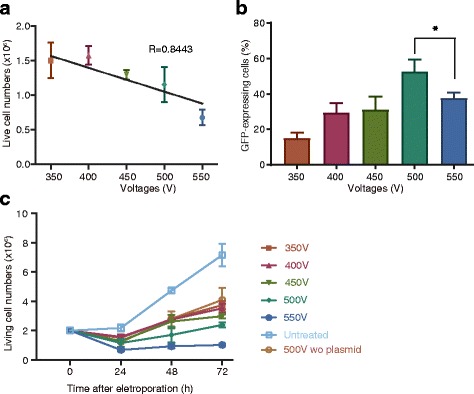
Strength of the externally applied electric field affects primary T cell transfection efficiency, viability, and growth. a Changes in viable cell number along with increasing voltage. b Transfection efficiency after applying different voltages at 24 h after electroporation. c Cell-growth alterations after electroporation
Fig. 3
Fig. 3
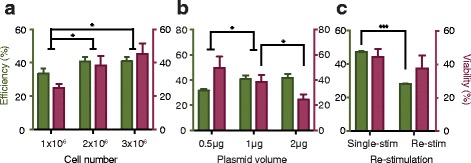
Key factors affecting electro-transfection efficiency. Green bars represent the percentage of positively transfected cells, and purple bars represent cell viability. a, b Effects of cell number and plasmid input on transfection results. c Electro-transfection of re-stimulated T cells. Re-stim, re-stimulated cells; single-stim, single-stimulated cells
Fig. 4
Fig. 4
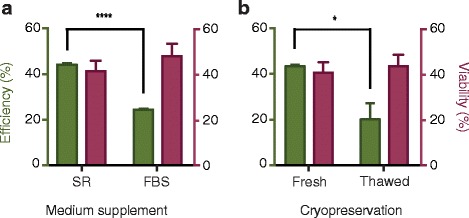
Influence of clinical factors, including serum and cryopreservation, on electroporation efficiency. a SR and FBS represent cells cultured with corresponding medium supplement. b Fresh and Thaw represent fresh or thawed cells
Fig. 5
Fig. 5
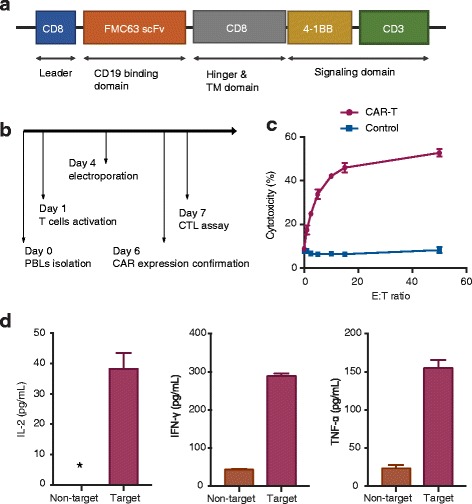
Optimized protocol for the generation of functional CAR-T cells within 1 week. a CAR molecular design. Leader, leader peptide; TM, transmembrane domain. b CAR-T cell production flowchart. c Cytotoxicity of CAR-T cells. E:T ratio represents the ratio of effector and target cells. The red line represents CAR-T cells, and the blue line represents control T cells. d Cytokine production of CAR-T cells. Non-target represents the group of wild-type K562 cells and CAR-T cells. Target represents the group of CD19-expressing K562 cells and CAR-T cells. *The IL-2 production of non-target cells groups was too low (< 3.9 pg/mL) to be calculated by a four-parameter logistic standard curve

References

    1. Fesnak AD, June CH, Levine BL. Engineered T cells: the promise and challenges of cancer immunotherapy. Nat Rev Cancer. 2016;16(9):566–581. doi: 10.1038/nrc.2016.97. - DOI - PMC - PubMed
    1. Levine BL. Performance-enhancing drugs: design and production of redirected chimeric antigen receptor (CAR) T cells. Cancer Gene Ther. 2015;22(2):79–84. doi: 10.1038/cgt.2015.5. - DOI - PubMed
    1. June CH, Levine BL. T cell engineering as therapy for cancer and HIV: our synthetic future. Philos Trans R Soc Lond B Biol Sci. 2015;370(1680):20140374. doi: 10.1098/rstb.2014.0374. - DOI - PMC - PubMed
    1. Gill S, June CH. Going viral: chimeric antigen receptor T-cell therapy for hematological malignancies. Immunol Rev. 2015;263(1):68–89. doi: 10.1111/imr.12243. - DOI - PubMed
    1. Ren J, Liu X, Fang C, Jiang S, June CH, Zhao Y. Multiplex genome editing to generate universal CAR T cells resistant to PD1 inhibition. Clin Cancer Res. 2017;23(9):2255–2266. doi: 10.1158/1078-0432.CCR-16-1300. - DOI - PMC - PubMed

Publication types