. 2018 Feb 13;115(7):1570-1575.
doi: 10.1073/pnas.1706977115. Epub 2018 Jan 29.

Disruption of the ciliary GTPase Arl13b suppresses Sonic hedgehog overactivation and inhibits medulloblastoma formation

Affiliations

Disruption of the ciliary GTPase Arl13b suppresses Sonic hedgehog overactivation and inhibits medulloblastoma formation

Sarah N Bay et al. Proc Natl Acad Sci U S A. .

Abstract

Medulloblastoma (MB) is the most common malignant pediatric brain tumor, and overactivation of the Sonic Hedgehog (Shh) signaling pathway, which requires the primary cilium, causes 30% of MBs. Current treatments have known negative side effects or resistance mechanisms, so new treatments are necessary. Shh signaling mutations, like those that remove Patched1 (Ptch1) or activate Smoothened (Smo), cause tumors dependent on the presence of cilia. Genetic ablation of cilia prevents these tumors by removing Gli activator, but cilia are a poor therapeutic target since they support many biological processes. A more appropriate strategy would be to identify a protein that functionally disentangles Gli activation and ciliogenesis. Our mechanistic understanding of the ciliary GTPase Arl13b predicts that it could be such a target. Arl13b mutants retain short cilia, and loss of Arl13b results in ligand-independent, constitutive, low-level pathway activation but prevents maximal signaling without disrupting Gli repressor. Here, we show that deletion of Arl13b reduced Shh signaling levels in the presence of oncogenic SmoA1, suggesting Arl13b acts downstream of known tumor resistance mechanisms. Knockdown of ARL13B in human MB cell lines and in primary mouse MB cell culture decreased proliferation. Importantly, loss of Arl13b in a Ptch1-deleted mouse model of MB inhibited tumor formation. Postnatal depletion of Arl13b does not lead to any overt phenotypes in the epidermis, liver, or cerebellum. Thus, our in vivo and in vitro studies demonstrate that disruption of Arl13b inhibits cilia-dependent oncogenic Shh overactivation.

Keywords: Arl13b; Shh signaling; cilia; medulloblastoma.


Conflict of interest statement

The authors declare no conflict of interest.

Figures
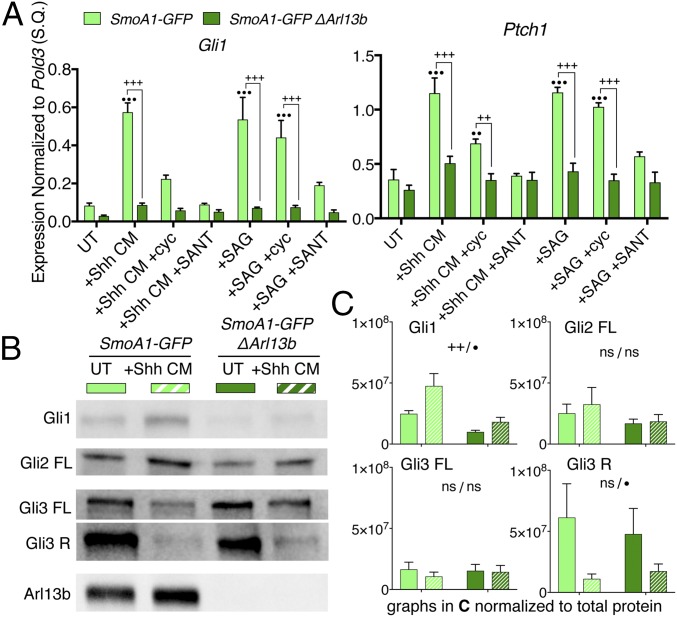
Fig. 1.
Fig. 1.
The loss of Arl13b reduces Shh pathway output in SmoA1-GFP MEFs. (A) qRT-PCR for Shh targets Gli1 and Ptch1 shows pathway activation is lowered when Arl13b is deleted in the presence of SmoA1. All data are mean ± SEM of three biological replicates; ++P < 0.005 and +++P < 0.0005 between genotypes within a given treatment; ••P < 0.005 and •••P < 0.0005 compared with untreated within a given genotype. (B) Western analysis of Gli processing in untreated and Shh-stimulated SmoA1-GFP MEFs with and without Arl13b. (C) Bar graphs show quantification of B. Data are mean ± SEM of at least three biological replicates; ++P < 0.005 represents genotype significance, P < 0.05 represents treatment significance; S.Q., starting quantity.
Fig. 2.
Fig. 2.
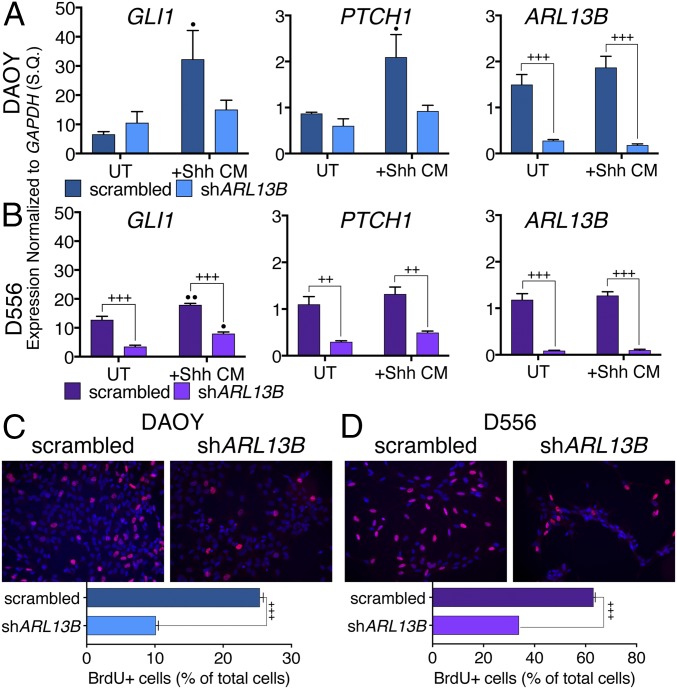
Knockdown of ARL13B reduces Shh signaling and proliferation in human MB cell lines. (A and B) qRT-PCR shows expression of SHH targets GLI1 and PTCH1 is reduced when ARL13B is knocked down in both DAOY and D556 cell lines. qRT-PCR for ARL13B demonstrates robustness of KD. All data are mean ± SEM of three biological replicates; ++P < 0.005 and +++P < 0.0005 between genotypes within a given treatment; P < 0.05 and ••P < 0.005 compared with untreated within a given genotype. (C and D) Knockdown of ARL13B reduces proliferation in DAOY and D556 human MB cell lines, shown by percentage of BrdU+ cells (red). Bar graphs show mean ± SEM of ≥2 biological replicates; +++P < 0.0001; Student’s t test; S.Q., starting quantity. (Magnification, 40×.)
Fig. 3.
Fig. 3.
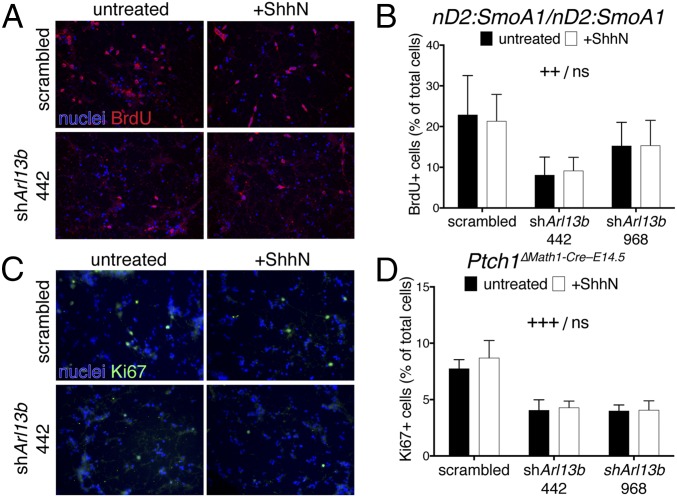
Knockdown of Arl13b in primary mouse MB cells reduces proliferation. (A) BrdU staining (red) in primary MB culture isolated from nD2::SmoA1/nD2::SmoA1 mice infected with scramble or shArl13b 442 and left untreated or treated with recombinant ShhN. (B) Bar graph shows quantification of experiments represented in A: BrdU-positive cells as a percentage of total cell number; data are mean ± SEM of three biological replicates. ++P < 0.01 significance due to genotype, no significance due to treatment. (C) Ki67 staining (green) in primary MB culture isolated from Ptch1Math1-Cre–E14.5 mice infected with scramble or shArl13b 442 and left untreated or treated with recombinant ShhN. (D) Bar graph shows quantification of experiments represented in C: Ki67-positive cells as a percentage of total cell number; data are mean ± SEM of three biological replicates. +++P < 0.001 significance due to genotype, no significance due to treatment. (Magnification, 40×.)
Fig. 4.
Fig. 4.
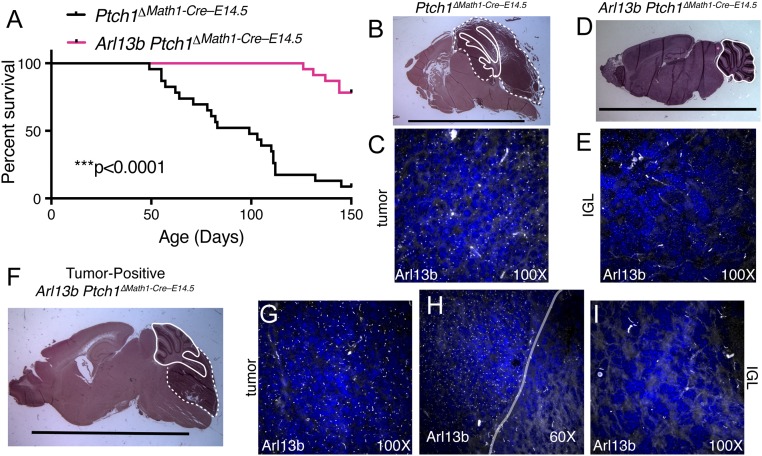
Deletion of Arl13b inhibits tumor formation in a mouse model of MB. Control: Ptch1Math1-Cre–E14.5 Experimental: Arl13b Ptch1Math1-Cre–E14.5. (A) Graph shows significant difference in survival curves between control and experimental mice. ***P < 0.0001; log-rank test. (B) H&E staining of a representative control brain with MB. (C) Image at 100× of tumor from B shows Arl13b-positive cilia in white. (D) H&E staining of a surviving experimental brain with no tumor. (E) Image at 100× of IGL from D shows few Arl13b-postive cilia in white. (F) H&E staining of a tumor-positive experimental brain shows normal cerebellar structure in addition to tumor. GI show the difference in Arl13b staining (white) between tumor tissue (G at 100×) and normal IGL (I at 100×). H shows the boundary between tumor and IGL at 60×. Solid line: identifiable cerebellar foliation; dotted line: tumor. (Scale bars, 1 cm.)
Fig. 5.
Fig. 5.
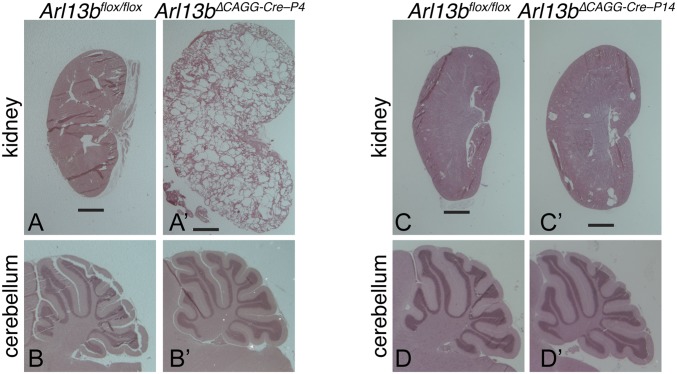
Early postnatal deletion of Arl13b causes cystic kidneys, whereas later postnatal deletion shows no global negative side effects. (A and A′) H&E staining of kidneys from p51 WT and Arl13bflox/flox; CAGG-CreER ΔP4 shows that early postnatal deletion of Arl13b results in severely cystic kidneys in adulthood. (B and B′) H&E staining of sagittal sections from p51 Arl13bflox/flox and Arl13bflox/flox; CAGG-CreER ΔP4 cerebella shows normal foliation in both. (C and C′) H&E staining of kidneys from p60 WT and Arl13bflox/flox; CAGG-CreER ΔP14 shows that later postnatal deletion of Arl13b at P14 results in grossly normal kidneys. (D and D′) H&E staining of sagittal sections from p60 Arl13bflox/flox and Arl13bflox/flox; CAGG-CreER ΔP14 cerebella shows normal foliation in both. (Scale bar, 1 mm.)

References

    1. Northcott PA, Korshunov A, Pfister SM, Taylor MD. The clinical implications of medulloblastoma subgroups. Nat Rev Neurol. 2012;8:340–351. - PubMed
    1. Louis DN, et al. The 2016 World Health Organization classification of tumors of the central nervous system: A summary. Acta Neuropathol. 2016;131:803–820. - PubMed
    1. Ruat M, Hoch L, Faure H, Rognan D. Targeting of smoothened for therapeutic gain. Trends Pharmacol Sci. 2014;35:237–246. - PubMed
    1. Huangfu D, et al. Hedgehog signalling in the mouse requires intraflagellar transport proteins. Nature. 2003;426:83–87. - PubMed
    1. Rohatgi R, Milenkovic L, Scott MP. Patched1 regulates hedgehog signaling at the primary cilium. Science. 2007;317:372–376. - PubMed

Publication types

MeSH terms