


An MCEM Framework for Drug Safety Signal Detection and Combination from Heterogeneous Real World Evidence
- PMID: 29379048
- PMCID: PMC5789130
- DOI: 10.1038/s41598-018-19979-7
An MCEM Framework for Drug Safety Signal Detection and Combination from Heterogeneous Real World Evidence
Abstract
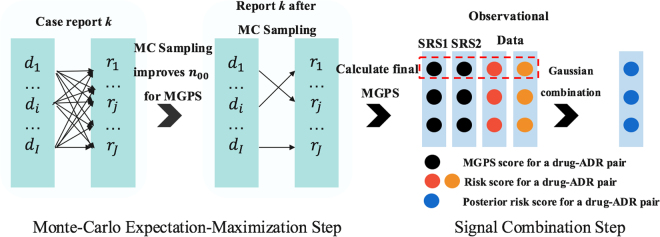
Delayed drug safety insights can impact patients, pharmaceutical companies, and the whole society. Post-market drug safety surveillance plays a critical role in providing drug safety insights, where real world evidence such as spontaneous reporting systems (SRS) and a series of disproportional analysis serve as a cornerstone of proactive and predictive drug safety surveillance. However, they still face several challenges including concomitant drugs confounders, rare adverse drug reaction (ADR) detection, data bias, and the under-reporting issue. In this paper, we are developing a new framework that detects improved drug safety signals from multiple data sources via Monte Carlo Expectation-Maximization (MCEM) and signal combination. In MCEM procedure, we propose a new sampling approach to generate more accurate SRS signals for each ADR through iteratively down-weighting their associations with irrelevant drugs in case reports. While in signal combination step, we adopt Bayesian hierarchical model and propose a new summary statistic such that SRS signals can be combined with signals derived from other observational health data allowing for related signals to borrow statistical support with adjustment of data reliability. They combined effectively alleviate the concomitant confounders, data bias, rare ADR and under-reporting issues. Experimental results demonstrated the effectiveness and usefulness of the proposed framework.
Conflict of interest statement
The authors declare that they have no competing interests.
Figures
References
-
- Giacomini, K., Krauss, R., Roden, D., Eichelbaum, M. & Hayden, M. When good drugs go bad. Nature. 446 (2007). - PubMed
-
- The importance of pharmacovigilance. http://apps.who.int/medicinedocs/en/d/Js4893e/ (2002).
-
- Clarke, A., Deeks, J. & Shakir, S. An assessment of the publicly disseminated evidence of safety used in decisions to withdraw medicinal products from the uk and us markets. Drug Safety. 29 (2006). - PubMed
Publication types
MeSH terms
LinkOut - more resources
Full Text Sources
Other Literature Sources
Medical
Research Materials
