. 2018 Jan 29;8(1):1759.
doi: 10.1038/s41598-018-19816-x.

Social rank-associated stress vulnerability predisposes individuals to cocaine attraction

Affiliations

Social rank-associated stress vulnerability predisposes individuals to cocaine attraction

Chen Yanovich et al. Sci Rep. .

Abstract

Studies of personality have suggested that dissimilarities in ability to cope with stressful situations results in differing tendency to develop addictive behaviors. The present study used selectively bred stress-resilient, socially-dominant (Dom) and stress-vulnerable, socially-submissive (Sub) mice to investigate the interaction between environmental stress and inbred predisposition to develop addictive behavior to cocaine. In a Conditioned Place Preference (CPP) paradigm using cocaine, Sub mice displayed an aversion to drug, whereas Dom mice displayed drug attraction. Following a 4-week regimen of Chronic Mild Stress (CMS), Sub mice in CPP displayed a marked increase (>400%) in cocaine attraction, whereas Dom mice did not differ in attraction from their non-stressed state. Examination of hippocampal gene expression revealed in Sub mice, exposure to external stimuli, stress or cocaine, increased CRH expression (>100%), which was evoked in Dom mice only by cocaine exposure. Further, stress-induced decreases in DRD1 (>60%) and DRD2 (>50%) expression in Sub mice differed markedly from a complete lack of change in Dom mice. From our findings, we propose that social stratification dictates vulnerability to stress-induced attraction that may lead to addiction via differential regulation of hippocampal response to dopaminergic input, which in turn may influence differing tendency to develop addictive behaviors.


Conflict of interest statement

The authors declare that they have no competing interests.

Figures
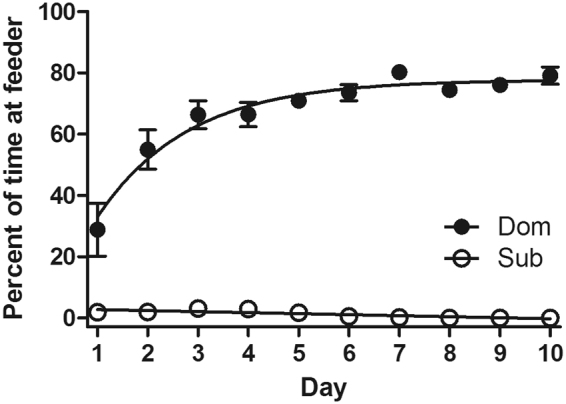
Figure 1
Figure 1
DSR results at generation 32 of Dom and Sub strains are stable and predictable. Data expressed as mean (±SEM) percent time spent at feeding well. Bonferroni means separation test indicated differences between mouse strains on all days (p < 0.001).
Figure 2
Figure 2
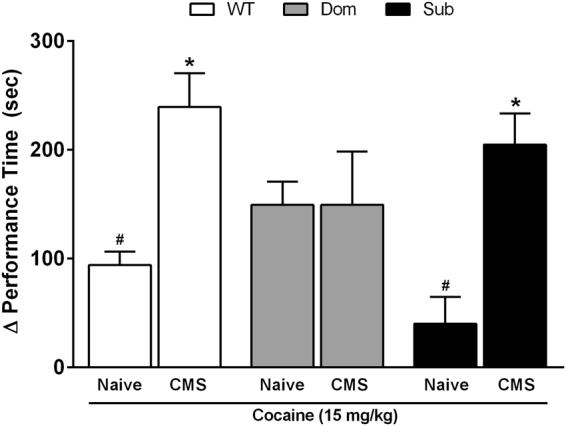
CPP performance time at day 6 in cocaine-treated mice (15 mg/kg): stress-naïve or 4-week CMS-exposed. Two-way ANOVA (F[1,35] = 21.70, p < 0.0001) with Bonferroni means separation tests: #strain differences among naïve treatments; *within stain differences between naïve and CMS treatments. Data are corrected to the difference (Δ performance time [s]) from day 0 drug-side baseline preference of individuals.
Figure 3
Figure 3
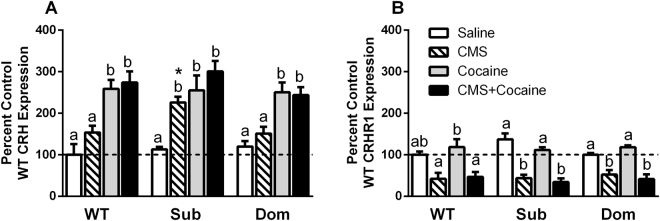
Effect of CMS and cocaine on Hippocampal CRH expression. Mice were exposed to CMS or no stress for 4 weeks, then treated with cocaine (15 mg/kg) or saline for 1 week in the CPP protocol. Letters above bars: one-way ANOVA with Bonferroni means separation test comparing treatments within mouse strain [abc] or treatments between strains [*]. (A) Corticotropin releasing hormone (CRH: WT: [F(3,16) = 13.34, p = 0.0001]; Sub: [F(3,16) = 11.83, p = 0.0002]; Dom: [F(3,16) = 12.63, p = 0.0002]; CMS: [F(2,12) = 7.219, p = 0.0087]). (B) CRH receptor 1 (CRHR1: WT: [F(3,16) = 7.596, p = 0.0022]; Sub: [F(3,16) = 26.11, p < 0.0001]; Dom: [F(3,16) = 19.39, p < 0.0001]).
Figure 4
Figure 4
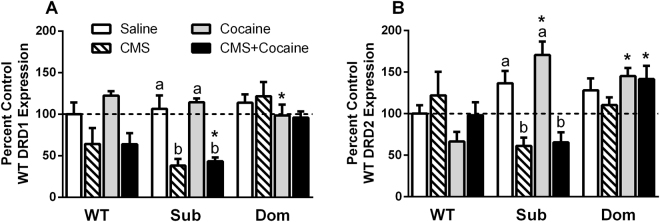
Effect of CMS and cocaine on locus coeruleus-hippocampal tract activity. Mice were exposed to CMS or no stress for 4 weeks, then treated with cocaine (15 mg/kg) or saline for 1 week in the CPP protocol. Letters above bars: one-way ANOVA with Bonferroni means separation test comparing: treatments within mouse strains [abc] or treatments across mouse strain [*]. (A) Dopamine receptor 1 (DRD1: WT: [F(3,16) = 4.303, p = 0.0209]; Sub: [F(3,16) = 17.43, p < 0.0001]; CMS: [F(2,12) = 7.49, p = 0.0077; CMS + Drug: [F(2,12) = 8.431, p = 0.0052]). (B) Dopamine receptor 2 (DRD2: Sub: [F(3,16) = 15.89, p < 0.0001]; Drug: [F(2,12) = 18.02, p = 0.0002; CMS + Drug: [F(2,12) = 6.695, p = 0.0111]).
Figure 5
Figure 5
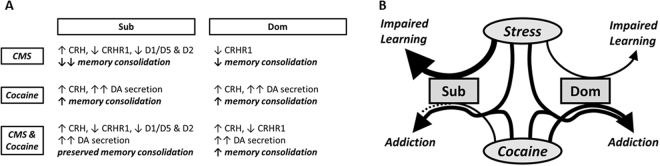
Theoretical model of neurological changes underlying differential behavioral response of Sub and Dom mouse strains. (A) Summary of observed and hypothesized hippocampal changes and their effects on learning. Arrows represent increase () or decrease (). Number of arrows relates to intensity of change. (B) Flow diagram of cognitive and addiction-like effects of CMS and cocaine treatments. Arrow size indicates relative intensity of response. Dotted line indicates weak effect.
Figure 6
Figure 6
Treatment flow diagram.

References

    1. Brady KT, McCauley JL, Back SE. Prescription Opioid Misuse, Abuse, and Treatment in the United States: An Update. The American journal of psychiatry. 2016;173:18–26. doi: 10.1176/appi.ajp.2015.15020262. - DOI - PMC - PubMed
    1. Kolodny A, et al. The prescription opioid and heroin crisis: a public health approach to an epidemic of addiction. Annual review of public health. 2015;36:559–574. doi: 10.1146/annurev-publhealth-031914-122957. - DOI - PubMed
    1. Russo SJ, Murrough JW, Han MH, Charney DS, Nestler EJ. Neurobiology of resilience. Nature neuroscience. 2012;15:1475–1484. doi: 10.1038/nn.3234. - DOI - PMC - PubMed
    1. Sinha R. Chronic stress, drug use, and vulnerability to addiction. Annals of the New York Academy of Sciences. 2008;1141:105–130. doi: 10.1196/annals.1441.030. - DOI - PMC - PubMed
    1. Koob GF, et al. Addiction as a stress surfeit disorder. Neuropharmacology. 2014;76(Pt B):370–382. doi: 10.1016/j.neuropharm.2013.05.024. - DOI - PMC - PubMed

Publication types