. 2018 Jan 29;8(1):1789.
doi: 10.1038/s41598-018-19957-z.

Rheumatoid arthritis patient antibodies highly recognize IL-2 in the immune response pathway involving IRF5 and EBV antigens

Affiliations

Rheumatoid arthritis patient antibodies highly recognize IL-2 in the immune response pathway involving IRF5 and EBV antigens

Marco Bo et al. Sci Rep. .

Abstract

Rheumatoid arthritis (RA) is a chronic autoimmune disease characterized by a progressive joint damage due to largely unknown environmental factors acting in concert with risk alleles conferring genetic susceptibility. A major role has been attributed to viral infections that include past contacts with Epstein-Barr virus (EBV) and, more recently, to non-protein coding sequences of human endogenous retrovirus K (HERV-K) integrated in the human genome. Molecular mimicry between viral and self proteins is supposed to cause the loss of immune tolerance in predisposed hosts. There are evidences that anti-IL-2 antibodies (Abs) are present in subjects affected by autoimmune diseases and may be responsible for alterations in regulatory T cell responses. In this study, we evaluated the levels of Abs against IL-2, viral epitopes and interferon regulatory factor 5 (IRF5) in 140 RA patients and 137 healthy controls (HCs). Ab reactivity reached the highest levels for IRF5, EBV and IL-2 (56%, 44% and 39%, respectively) in RA with significantly lower values among HCs (7-9%, p < 0.0001), which suggests a possible cross-reaction between IRF5/EBV homologous antigens and shifts in T cell balance disrupted by anti-IL-2 Abs.


Conflict of interest statement

The authors declare that they have no competing interests.

Figures
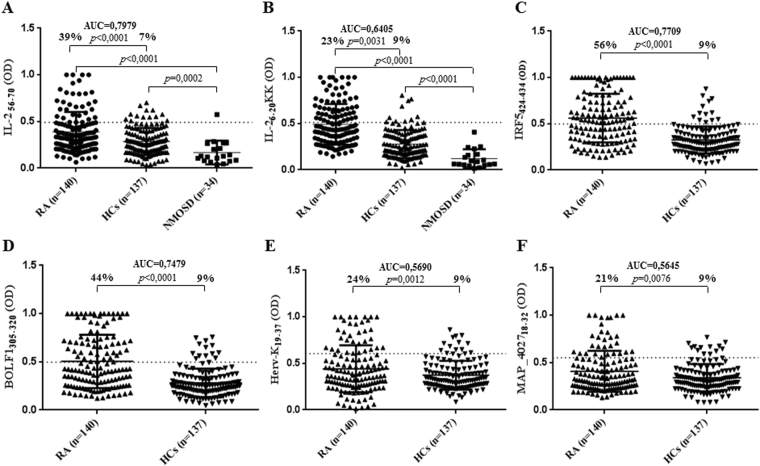
Figure 1
Figure 1
ELISA-based analysis of Abs reactivity against human, viral and MAP-derived peptides in RA, NMOSD and HCs. The sera were tested against plate-coated IL-26–20KK (B), IL-256–70 (A), IRF5424–434 (C), BOLF1305–320 (D), Herv-Kenv19–37 (E) and MAP_402718–32 (F) peptides. Bars represent the median ± interquartile range. Thresholds for Abs positivity are indicated by dashed lines. Percentages of Abs prevalence respective to each group, AUC and P-values are indicated above the distributions.
Figure 2
Figure 2
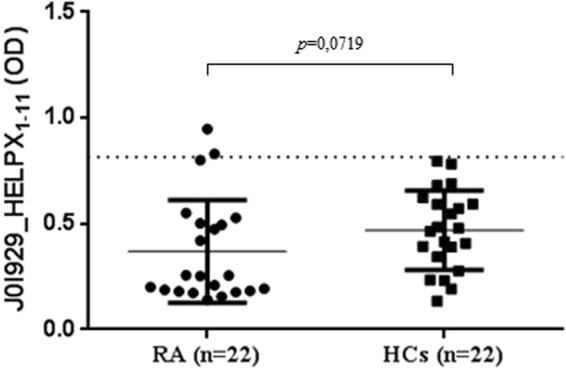
Abs reactivity against the antigenic peptide derived from H. pylori in RA patients and HCs. Bars represent mean value ± interquartile range, while dashed lines indicate the positivity threshold. Despite sequence homology to human ZnT8 protein fragment, no significant differences in Abs levels were detected.
Figure 3
Figure 3
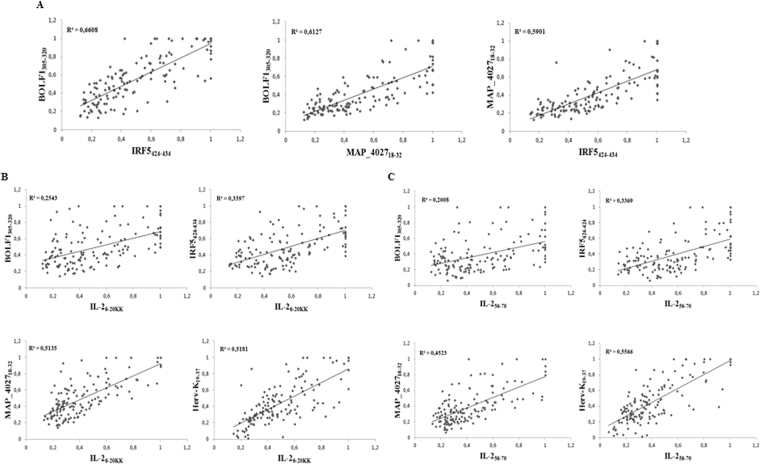
Scatter plots showing correlations between Abs titers in RA patients. Pairwise distributions are classified for homologous peptides (A), IL-26–20KK (B) and IL-256–70 (C). Each dot correspond to OD values obtained for a single patient.

References

    1. Firestein GS. Evolving concepts of rheumatoid arthritis. Nature. 2003;423:356–361. doi: 10.1038/nature01661. - DOI - PubMed
    1. McInnes IB, Schett G. The pathogenesis of rheumatoid arthritis. N Engl J Med. 2011;365:2205–2219. doi: 10.1056/NEJMra1004965. - DOI - PubMed
    1. Ollier W. Rheumatoid arthritis and Epstein-Barr virus: a case of living with the enemy? Ann Rheum Dis. 2000;59:497–499. doi: 10.1136/ard.59.7.497. - DOI - PMC - PubMed
    1. Hadinoto V, et al. The dynamics of EBV shedding implicate a central role for epithelial cells in amplifying viral output. PloS Pathog. 2009;5(7):e1000496. doi: 10.1371/journal.ppat.1000496. - DOI - PMC - PubMed
    1. Adtani P, Malathi N. Epstein-Barr virus and its association with rheumatoid arthritis and oral lichen planus. J Oral Maxillofac Pathol. 2015;19(3):282–5. doi: 10.4103/0973-029X.174643. - DOI - PMC - PubMed