


Case Reports
doi: 10.14309/crj.2018.3.
eCollection 2018.
Successful Treatment of Cannabinoid Hyperemesis Syndrome with Topical Capsaicin
Affiliations
- PMID: 29379817
- PMCID: PMC5758720
- DOI: 10.14309/crj.2018.3
Item in Clipboard
Case Reports
Successful Treatment of Cannabinoid Hyperemesis Syndrome with Topical Capsaicin
ACG Case Rep J.
.
Abstract
Cannabinoid hyperemesis syndrome (CHS) is a clinical entity in which marijuana users develop nausea, vomiting, and abdominal pain that improves with hot water bathing or cannabis cessation. Previous models suggest that CHS arises solely from the derangement of cannabinoid receptor type 1 signaling. However, involvement of transient receptor potential vanilloid subtype 1 (TRPV1) receptor, which is activated by marijuana, capsaicin, and heat, could fill gaps in existing models, including the enigmatic role of hot water bathing. We propose that chronic cannabis use decreases TRPV1 signaling and alters gastric motility, and we report the case of a CHS patient whose symptoms improved after topical capsaicin.
Figures
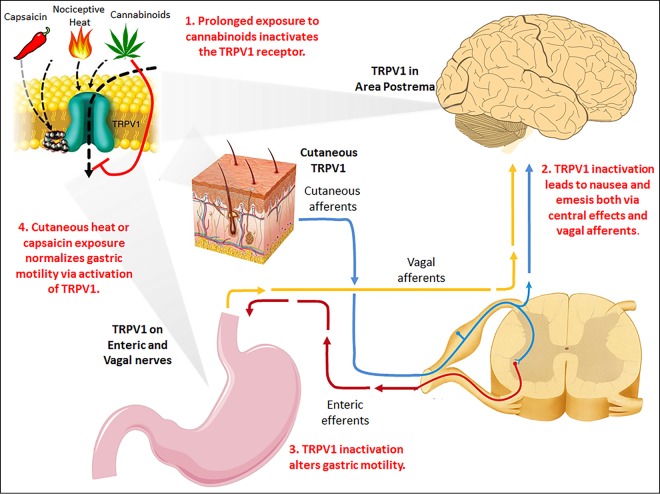
Proposed pathophysiology of cannabinoid hyperemesis syndrome. TRPV1 is expressed in area postrema of the medulla, along gastric enteric and vagal nerves, and on cutaneous receptors in the dermis and epidermis. Prolonged exposure to cannabinoids inactivates TRPV1, potentially resulting in central nausea, altered gastric motility, and abdominal pain. Exposure to nociceptive heat, such as with compulsive hot-water bathing, may transiently augment cutaneous TRPV1 firing and restore gastric motility, temporarily mitigating symptoms. Use of another TRPV1 agonist, capsaicin, may also provide relief. Cessation of marijuana use gradually leads to normalization of TRPV1 function and fully ameliorates symptoms.
References
-
- Wallace D, Martin AL, Park B. Cannabinoid hyperemesis: Marijuana puts patients in hot water. Australas Psychiatry. 2007;15(2):156–8. - PubMed
-
- Richards JR, Lapoint JM, Burillo-Putze G. Cannabinoid hyperemesis syndrome: potential mechanisms for the benefit of capsaicin and hot water hydrotherapy in treatment. Clin Toxicol (Phila). 2017;1:1–10. - PubMed
-
- Izzo AA, Sharkey KA. Cannabinoids and the gut: New developments and emerging concepts. Pharmacol Ther. 2010;126(1):21–38. - PubMed
Publication types
LinkOut - more resources
Full Text Sources
Other Literature Sources
Molecular Biology Databases
