


Identifying co-endemic areas for major filarial infections in sub-Saharan Africa: seeking synergies and preventing severe adverse events during mass drug administration campaigns
- PMID: 29382363
- PMCID: PMC5791223
- DOI: 10.1186/s13071-018-2655-5
Identifying co-endemic areas for major filarial infections in sub-Saharan Africa: seeking synergies and preventing severe adverse events during mass drug administration campaigns
Abstract
Background: Onchocerciasis and lymphatic filariasis (LF) are major filarial infections targeted for elimination in most endemic sub-Saharan Africa (SSA) countries by 2020/2025. The current control strategies are built upon community-directed mass administration of ivermectin (CDTI) for onchocerciasis, and ivermectin plus albendazole for LF, with evidence pointing towards the potential for novel drug regimens. When distributing microfilaricides however, considerable care is needed to minimise the risk of severe adverse events (SAEs) in areas that are co-endemic for onchocerciasis or LF and loiasis. This work aims to combine previously published predictive risk maps for onchocerciasis, LF and loiasis to (i) explore the scale of spatial heterogeneity in co-distributions, (ii) delineate target populations for different treatment strategies, and (iii) quantify populations at risk of SAEs across the continent.
Methods: Geographical co-endemicity of filarial infections prior to the implementation of large-scale mass treatment interventions was analysed by combining a contemporary LF endemicity map with predictive prevalence maps of onchocerciasis and loiasis. Potential treatment strategies were geographically delineated according to the level of co-endemicity and estimated transmission intensity.
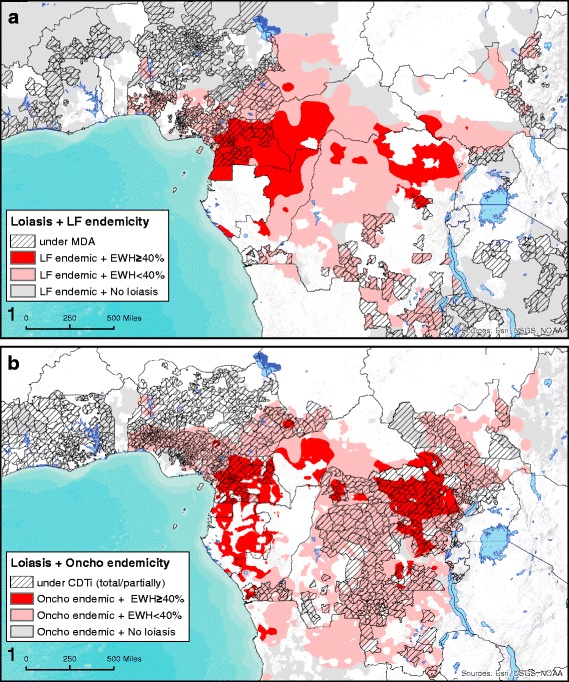
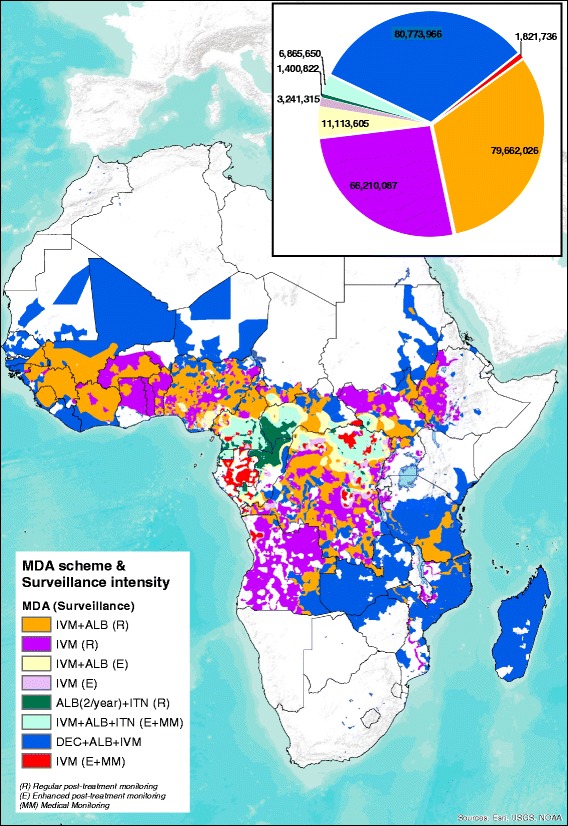
Results: In total, an estimated 251 million people live in areas of LF and/or onchocerciasis transmission in SSA, based on 2015 population estimates. Of these, 96 million live in areas co-endemic for both LF and onchocerciasis, providing opportunities for integrated control programmes, and 83 million live in LF-monoendemic areas potentially targetable for the novel ivermectin-diethylcarbamazine-albendazole (IDA) triple therapy. Only 4% of the at-risk population live in areas co-endemic with high loiasis transmission, representing up to 1.2 million individuals at high risk of experiencing SAEs if treated with ivermectin. In these areas, alternative treatment strategies should be explored, including biannual albendazole monotherapy for LF (1.4 million individuals) and 'test-and-treat' strategies (8.7 million individuals) for onchocerciasis.
Conclusions: These maps are intended to initiate discussion around the potential for tailored treatment strategies, and highlight populations at risk of SAEs. Further work is required to test and refine strategies in programmatic settings, providing the empirical evidence needed to guide efforts towards the 2020/2025 goals and beyond.
Keywords: Albendazole; DEC; Filariasis; GIS; Ivermectin; Loiasis; Lymphatic filariasis; Mapping; Onchocerciasis; Severe adverse events.
Conflict of interest statement
Ethics approval and consent to participate
Not applicable.
Consent for publication
Not applicable.
Competing interests
The authors declare that they have no competing interests.
Publisher’s Note
Springer Nature remains neutral with regard to jurisdictional claims in published maps and institutional affiliations.
Figures
References
-
- WHO . Accelerating work to overcome the global impact of neglected tropical diseases - a roadmap for implementation. Geneva: World Health Organization; 2012.
Publication types
MeSH terms
Substances
Grants and funding
LinkOut - more resources
Full Text Sources
Other Literature Sources
Research Materials
