. 2018 Apr;11(4):237-248.
doi: 10.1158/1940-6207.CAPR-17-0295. Epub 2018 Jan 30.

Genome-Wide Gene Expression Changes in the Normal-Appearing Airway during the Evolution of Smoking-Associated Lung Adenocarcinoma

Affiliations

Genome-Wide Gene Expression Changes in the Normal-Appearing Airway during the Evolution of Smoking-Associated Lung Adenocarcinoma

Jacob Kantrowitz et al. Cancer Prev Res (Phila). 2018 Apr.

Abstract

Smoking perpetuates in cytologically normal airways a molecular "field of injury" that is pertinent to lung cancer and early detection. The evolution of airway field changes prior to lung oncogenesis is poorly understood largely due to the long latency of lung cancer in smokers. Here, we studied airway expression changes prior to lung cancer onset in mice with knockout of the Gprc5a gene (Gprc5a-/-) and tobacco carcinogen (NNK) exposure and that develop the most common type of lung cancer, lung adenocarcinoma, within 6 months following exposure. Airway epithelial brushings were collected from Gprc5a-/- mice before exposure and at multiple times post-NNK until time of lung adenocarcinoma development and then analyzed by RNA sequencing. Temporal airway profiles were identified by linear models and analyzed by comparative genomics in normal airways of human smokers with and without lung cancer. We identified significantly altered profiles (n = 926) in the NNK-exposed mouse normal airways relative to baseline epithelia, a subset of which were concordantly modulated with smoking status in the human airway. Among airway profiles that were significantly modulated following NNK, we found that expression changes (n = 22) occurring as early as 2 months following exposure were significantly associated with lung cancer status when examined in airways of human smokers. Furthermore, a subset of a recently reported human bronchial gene classifier (Percepta; n = 56) was enriched in the temporal mouse airway profiles. We underscore evolutionarily conserved profiles in the normal-appearing airway that develop prior to lung oncogenesis and that comprise viable markers for early lung cancer detection in suspect smokers. Cancer Prev Res; 11(4); 237-48. ©2018 AACR.


Conflict of interest statement

Disclosure of Potential Conflicts of Interest

A.E. Spira has ownership interest (including patents) in and is a consultant/advisory board member for Veracyte Inc. No potential conflicts of interest were disclosed by the other authors.

Figures
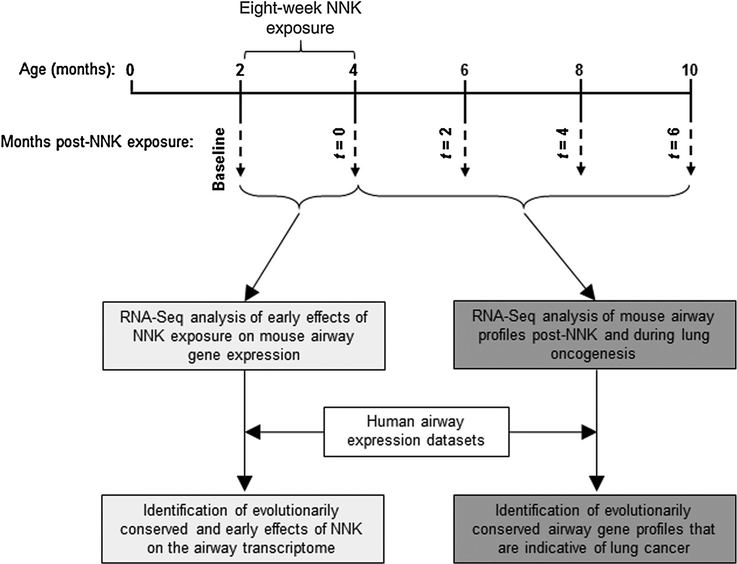
Figure 1.
Figure 1.
Identification of global gene expression changes in the normal-appearing airwayduring the development of lung adenocarcinoma. Study design depicting analysis of genome-wide changes in gene expression in the tobacco-carcinogen normal-appearing airway in vivo. Two-month-old Gprc5a−/− were treated intraperitoneally with 50 mg/kg bodyweight nicotine-specific NNK three times per week for 8 weeks. Upper airway epithelia were collected by brushings before NNK treatment (baseline) and at the indicated four time points after completion of NNK exposure as described in the Materials and Methods section. Total RNA was isolated and interrogated by RNA-Seq using the Ion Torrent Proton platform. Gene profiles were statistically analyzed to determine patterns that are impacted early on in the airway by NNK exposure (t = 0 vs. baseline) and those that temporally evolve for 6 months following completion of the treatment and during the development of lung adenocarcinoma. Using publicly available human airway expression datasets, cross-species comparative genomics analysis (see Materials and Methods and Supplementary Methods) was performed to identify genes from the mouse airway expression profiles that are evolutionarily conserved in airways of human suspect smokers, including patients with lung malignancy.
Figure 2.
Figure 2.
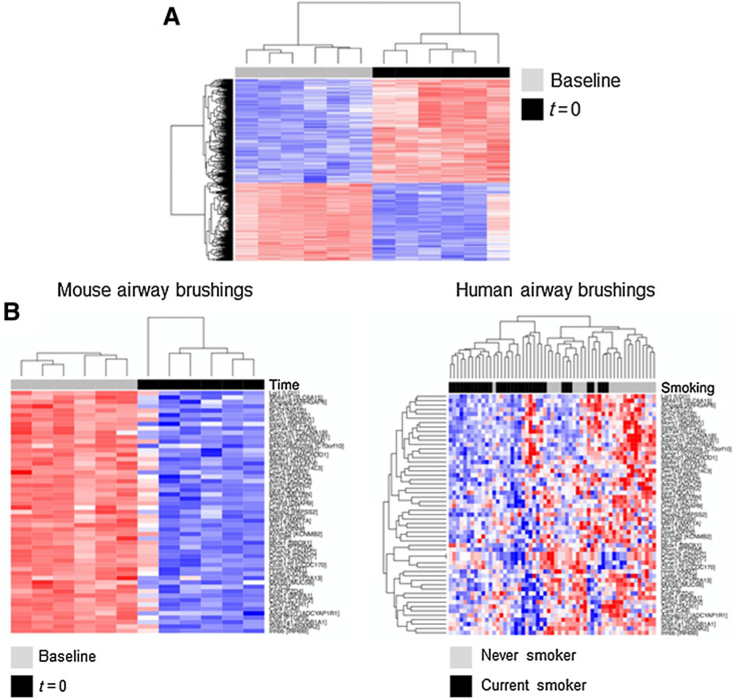
Evolutionary conserved effects of NNK tobacco carcinogen exposure on airway gene expression. A, Differentially expressed profiles (n = 926; 529 upregulated and 397 downregulated) between mouse airways at the time of completion of NNK exposure (t = 0) relative to baseline were identified using a linear model and a controlled FDR threshold of 0.1% (see Materials and Methods). B, Using orthologues from the identified genes, GSEA was performed to identify expression profiles that are concordantly (in same direction) enriched in airways of human cancer-free current smokers relative to nonsmokers. Statistically significant leading edge set of 54 downregulated orthologous genes was analyzed by semisupervised clustering in the mouse airway brushings (left). The same genes were assessed by unsupervised clustering in the human airway brushings (right). Columns represent samples and rows denote gene features; red and blue: higher and lower expression, respectively.
Figure 3.
Figure 3.
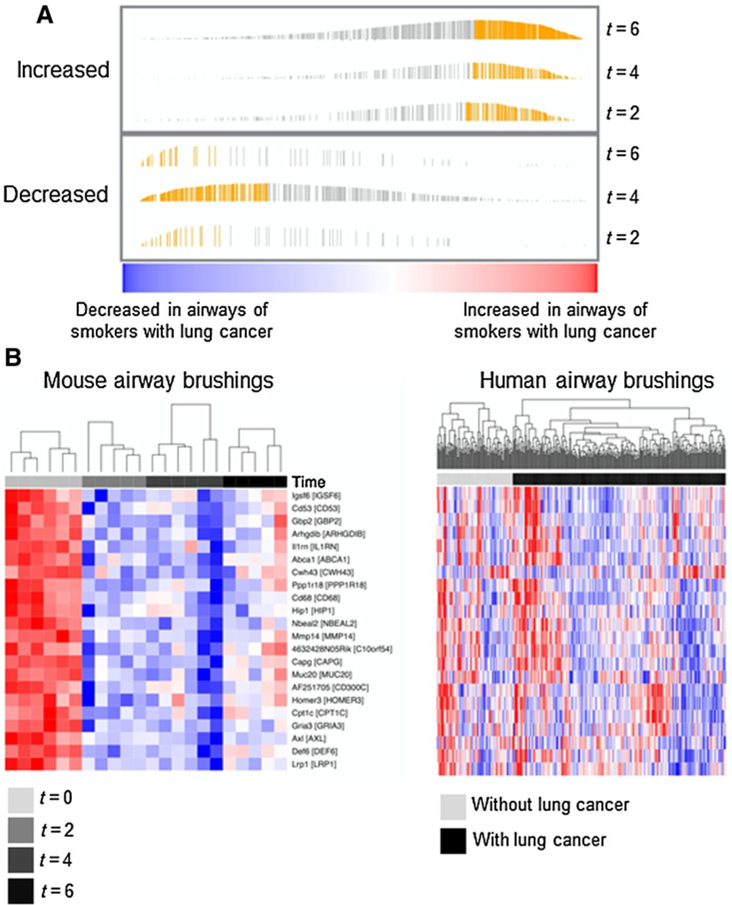
Temporal mapping of the molecular airway field of injury upon following tobacco carcinogen exposure and during in vivo development of lung adenocarcinoma. A, Murine genes changing in the normal-appearing airway at two (t = 2), four (t = 4), and six (t = 6) months following completion of NNK exposure and relative to the time at the end of the treatment (t = 0) were statistically identified as described in the Materials and Methods section and Supplementary Methods. The identified temporal mouse profiles were analyzed by comparative genomics and GSEA in the reported array dataset by Silvestri and colleagues (10), comprised of bronchial brushings from smokers with suspicion of lung malignancy (253 with and 90 without lung cancer). Enrichment plots generated by GSEA of ranked gene expression are depicted demonstrating enriched up-and down-regulated murine genes post NNK and at the indicated time points. Bar heights correspond to enrichment scores and yellow bars correspond to genes in the leading edge subset that were concordantly enriched in airways of human smokers with lung cancer relative to cancer-free smokers. B, Concordantly enriched genes that were differentially expressed at the earliest time point (t = 2) following NNK exposure were interrogated to derive a leading edge set consisting of 22 downregulated genes. The leading edge set was then analyzed by hierarchical semisupervised clustering in mouse (left) and human smoker (right) airway brushings. Columns, samples; rows, gene features (red, higher; blue, lower expression).
Figure 4.
Figure 4.
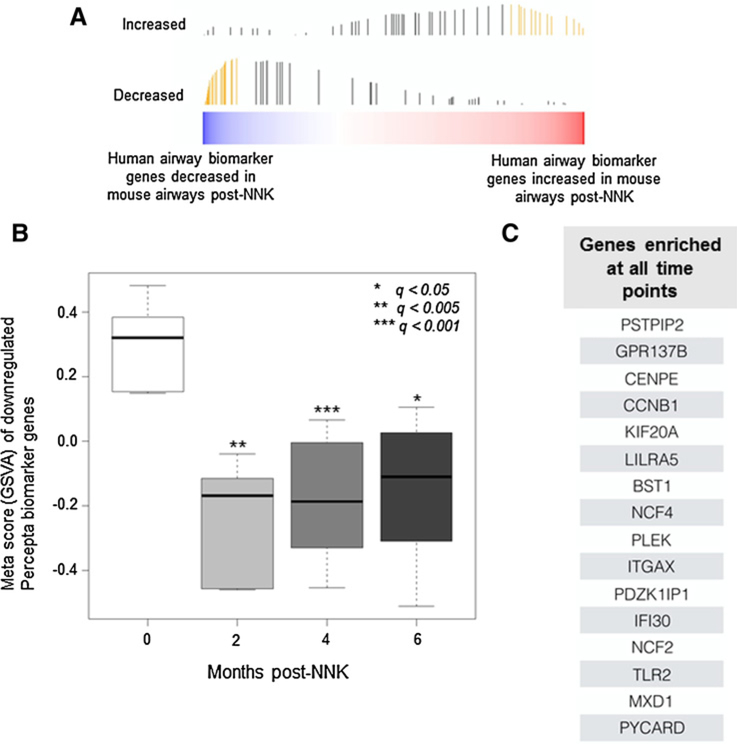
Human to mouse cross-species analysis of a human bronchial genomic classifier for lung cancer detection. A, A recently reported human bronchial 232-gene classifier (9) was analyzed by GSVA (see Supplementary Methods) in the identified mouse airway profiles that were found to be modulated in vivo following NNK exposure (bar heights correspond to running enrichment score calculated in GSVA and yellow bars correspond to the leading edge subset). B, Meta scores were plotted based on GSVA of a 56-gene leading edge set from the Percepta classifier that is downregulated in airways of human smokers with lung cancer relative to cancer-free smokers and concordantly decreased in the temporal mouse airway brushings. Meta scores were derived and plotted for conserved markers, which were concordantly downregulated at 2, 4, or 6 months after NNK treatment. Statistically significant differences among the different time points were based on a q-value cutoff (*, < 0.05; **, < 0.005; ***, < 0.001). C, GSEA (see Materials and Methods) of the 232-gene human classifier was performed to identify, from the human biomarker, a gene set that was concordantly enriched in the mouse airway samples across all time points.

References

    1. Herbst RS, Heymach JV, Lippman SM. Lung cancer. N Engl J Med 2008;359:1367–80. - PMC - PubMed
    1. Kadara H, Scheet P, Wistuba II, Spira AE. Early events in the molecular pathogenesis of lung cancer. Cancer Prev Res 2016;9:518–27. - PubMed
    1. Siegel RL, Miller KD, Jemal A. Cancer statistics, 2017. CA Cancer J Clin 2017;67:7–30. - PubMed
    1. National Lung Screening Trial Research Team, Aberle DR, Adams AM, Berg CD, Black WC, Clapp JD, et al. Reduced lung-cancer mortality with low-dose computed tomographic screening. N Engl J Med 2011;365:395–409. - PMC - PubMed
    1. Kadara H, Wistuba II. Field cancerization in non-small cell lung cancer: implications in disease pathogenesis. Proc Am Thorac Soc 2012;9:38–42. - PMC - PubMed

Publication types

MeSH terms