. 2018 Jan 30;9(1):428.
doi: 10.1038/s41467-017-02650-6.

Tbx5a lineage tracing shows cardiomyocyte plasticity during zebrafish heart regeneration

Affiliations

Tbx5a lineage tracing shows cardiomyocyte plasticity during zebrafish heart regeneration

Héctor Sánchez-Iranzo et al. Nat Commun. .

Abstract

During development, mesodermal progenitors from the first heart field (FHF) form a primitive cardiac tube, to which progenitors from the second heart field (SHF) are added. The contribution of FHF and SHF progenitors to the adult zebrafish heart has not been studied to date. Here we find, using genetic tbx5a lineage tracing tools, that the ventricular myocardium in the adult zebrafish is mainly derived from tbx5a+ cells, with a small contribution from tbx5a- SHF progenitors. Notably, ablation of ventricular tbx5a+-derived cardiomyocytes in the embryo is compensated by expansion of SHF-derived cells. In the adult, tbx5a expression is restricted to the trabeculae and excluded from the outer cortical layer. tbx5a-lineage tracing revealed that trabecular cardiomyocytes can switch their fate and differentiate into cortical myocardium during adult heart regeneration. We conclude that a high degree of cardiomyocyte cell fate plasticity contributes to efficient regeneration.


Conflict of interest statement

The authors declare no competing financial interests.

Figures
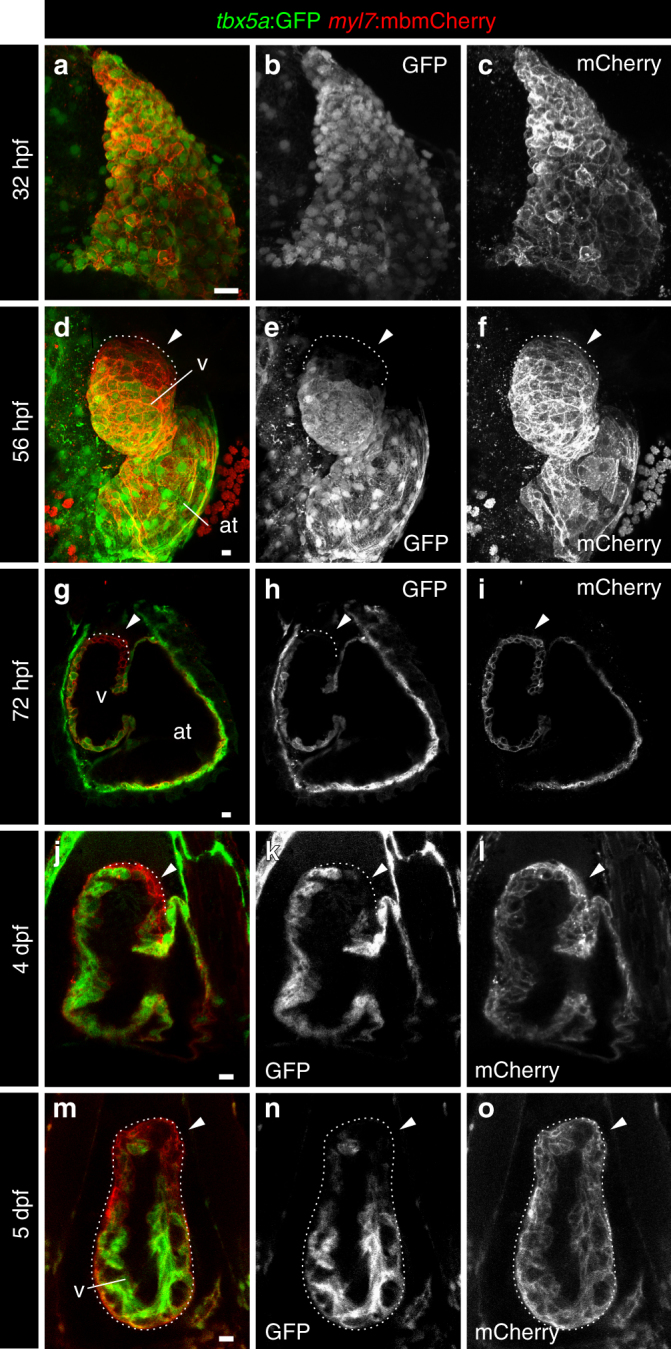
Fig. 1
Fig. 1
Expression profile of tbx5a-positive cardiomyocytes in embryonic zebrafish hearts. af Whole-mount immunofluorescence of tbx5a:GFP;myl7:mbmCherry double transgenic zebrafish hearts at 32 ac (n = 5/5) and 56 hours postfertilisation (hpf) df (n = 3/3). gl Confocal optical sections of tbx5a:GFP;myl7:mbmCherry hearts at 72 hpf gi (n = 5/5), 4 days postfertilisation (dpf) jl (n = 9/9), and 5 dpf (mo; n = 6/6). GFP (green) labels tbx5a+ cells and mCherry (red) marks cells expressing the pan-myocardial marker myosin light chain 7 (myl7). Shown are ventral views, cranial is to the top. At 32 hpf all cardiomyocytes are tbx5a:GFP+ but at 56, 72 hpf, 4, and 5 dpf tbx5a:GFP cardiomyocytes can be observed in the distal ventricle (arrowheads). The atrioventricular canal and large portions of the atrium are also GFP+. at, atrium; v, ventricle; Scale bars, 10 μm
Fig. 2
Fig. 2
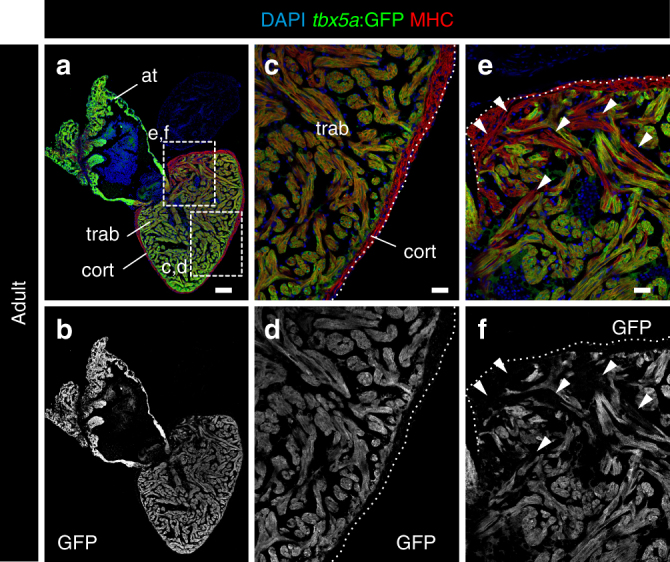
Expression profile of tbx5a-positive cardiomyocytes in adult zebrafish hearts. a, b Sagittal sections through tbx5a:GFP adult uninjured heart immunostained with GFP (green) and Myosin Heavy Chain (MHC; red). Nuclei are counterstained with DAPI (blue). ce Zoomed views of boxed area in a. b, d, f Single channels for GFP. The trabecular myocardium is tbx5a:GFP+, whereas the cortical layer is tbx5a:GFP. Note tbx5a:GFP cardiomyocytes (arrowheads) in the basal part of the ventricle close to the atrioventricular canal (n = 13/13). at, atrium; cort, cortical layer; trab, trabecular layer. Scale bars, a, b 100 μm and cf 25 μm
Fig. 3
Fig. 3
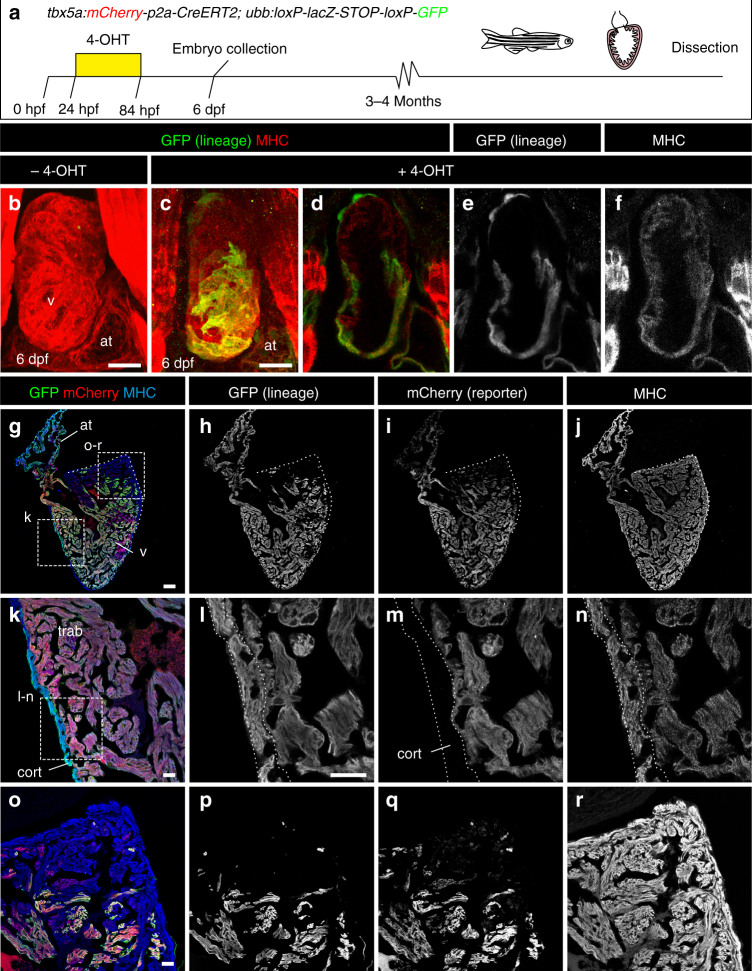
Fate mapping of tbx5a-derived cells during cardiac development. a tbx5a:mCherry-p2A-CreERT2;ubb:loxP-LacZ-STOP-loxP-GFP hearts fixed at different developmental stages. mCherry marks tbx5a-expressing cells; GFP marks tbx5a-derived cells. bf Whole-mount ventral view of hearts at 6 days postfertilisation (dpf) stained for GFP (green) and Myosin Heavy Chain (MHC, red). b In the absence of 4- Hydroxytamoxifen (4-OHT) administration, no GFP+ cells are visible (n = 5/5). cf 4-OHT was added from 24 to 84 hours postfertilisation (hpf). GFP expression is observed in the proximal part of the ventricle; n = 8/8. In some cases, GFP expression was also found in epicardial cells located in the distal part of the ventricle. gr Immunofluorescence staining of adult heart sections recombined as in c. Shown are merged and single channels for GFP (green), mCherry (red), and anti-MHC staining (blue); n = 5/5. at, atrium; cort, cortical layer; trab, trabecular layer; v, ventricle. Scale bars, g 100 μm and b, c, k, l, o 25 μm
Fig. 4
Fig. 4
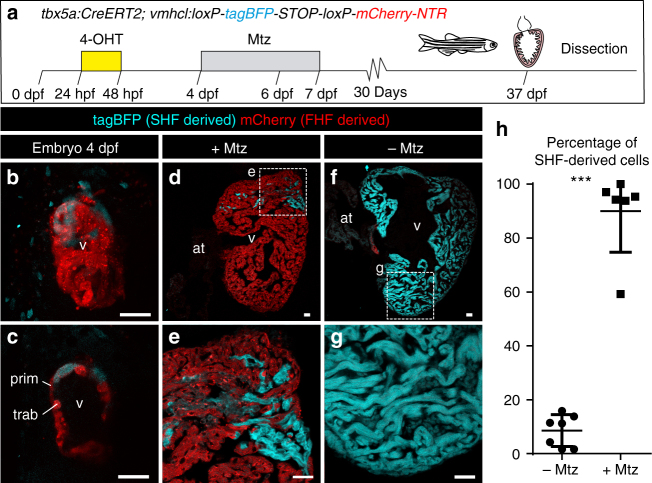
Genetic ablation of tbx5a-derived ventricular cardiomyocytes. a tbx5a+ ventricular cardiomyocytes were genetically ablated in tbx5a:CreERT2;vmhcl:loxP-tagBFP-loxP-mCherry-NTR double transgenic zebrafish. Recombination was induced by administration of 4-Hydroxytamoxifen (4-OHT). Cell ablation was induced by administration of Metronidazole (Mtz) from 4 to 7 days postfertilisation. b, c Ventral views of larval hearts at 4 dpf (maximal projection and optical section, respectively). Anterior is to the top. The proximal ventricle, including primordial layer and trabeculae, is completely mCherry+ and the distal ventricle is blue (tagBFP+); n = 7/7. d, e Sagittal section of the ventricle of an adult recombined heart. Most cells are mCherry+. Only the tbx5a region is tagBFP. n = 7/7. f, g, Sagittal section of a Mtz-treated fish. Most of the cardiomyocytes are tagBFP+; n = 6/6. h, Quantification of the percentage of myocardium that is tagBFP+ (SHF-derived), mean±SD; *** P < 0.0001 by two-tailed unpaired t-test. at, atrium; prim, primordial layer; SHF, second heart field; trab, trabeculae; v, ventricle. Scale bars, 25 μm
Fig. 5
Fig. 5
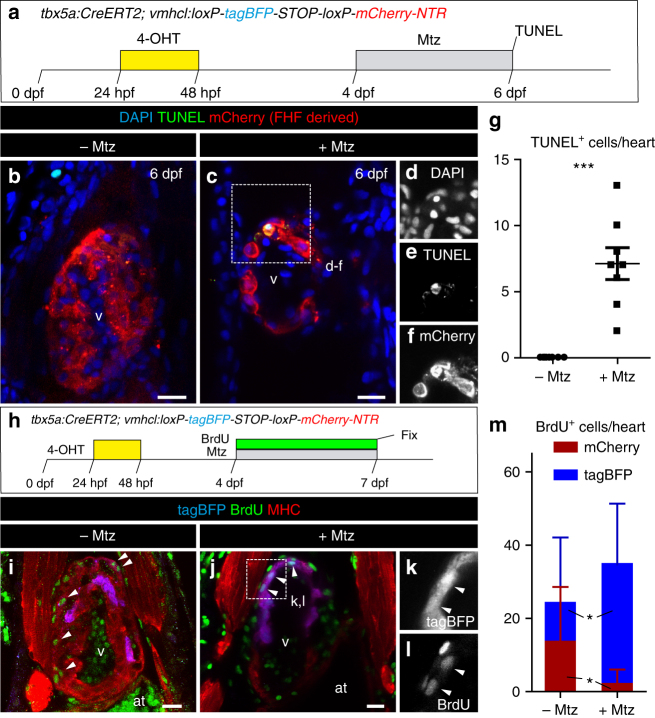
Apoptosis and cell proliferation upon genetic ablation of tbx5a-derived ventricular cardiomyocytes. a tbx5a+ ventricular cardiomyocytes were genetically ablated in tbx5a:CreERT2;vmhcl:loxP-tagBFP-loxP-mCherry-NTR double transgenic zebrafish. Recombination was induced by administration of 4-Hydroxytamoxifen (4-OHT). Cell ablation was induced by administration of Metronidazole (Mtz) from 4 to 7 days postfertilisation (dpf). b, c Optical sections of 6 dpf fish that had been treated with 4-OHT and Mtz as indicated in a (b) or only with 4-OHT c immunostained for mCherry (red) and terminal deoxynucleotidyl transferase (TdT)-mediated dUTP nick end labeling (TUNEL) (green). Note that some rounded mCherry+ cells are TUNEL+. df Single channels of selected area in c. g Quantification of the number of TUNEL+ trabecular and cortical mCherry+ cardiomyocytes per heart from animals of the +Mtz (n = 8) and –Mtz (n = 8) group, mean ± SD; ***P = 0.0004 by Mann–Whitney non-parametric t-test. h Schematic representation of the 5-Bromo-2´-deoxyuridine (BrdU) treatment to assess proliferation. i, j Fish were treated with 4-OHT and BrdU i or with 4-OHT, Mtz, and BrdU j. k, l Single channels of the boxed area in j. m Quantification of BrdU+/mCherry+ and BrdU+/tagBFP+ cells per heart. Shown are means ± SD (n = 8 for − Mtz hearts and n = 11 for + Mtz hearts, from two separate independent experiments) *P = 0.0240 for tagBFP+ cells and P = 0.0371 for mCherry+ cells by two-tailed t-test. at, atrium; hpf, hours postfertilization; v, ventricle. Scale bars, 25 μm
Fig. 6
Fig. 6
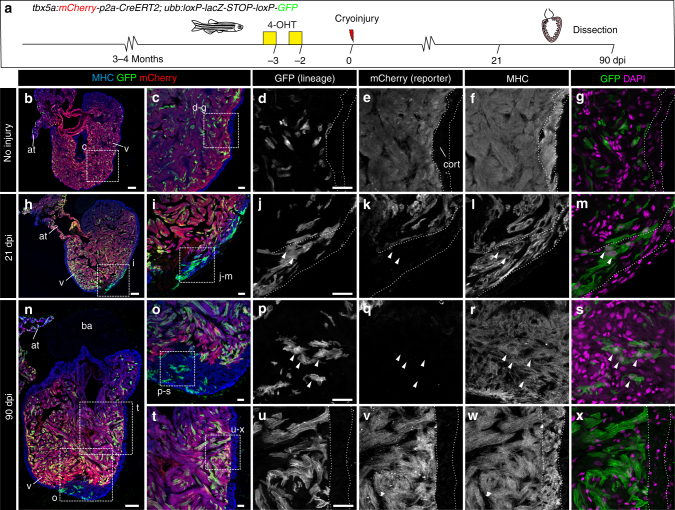
Contribution of tbx5a-derived cells during regeneration of the adult zebrafish heart. a tbx5a:Cherry-p2A-CreERT2 was crossed into ubb:loxP-lacZ-STOP-loxP-GFP. 4-Hydroxytamoxifen (4-OHT) was added 2 and 3 days before cryoinjury, to induce recombination of loxP sites. Hearts were fixed at 21 and 90 days postinjury (dpi) and sectioned for immunofluorescent detection of GFP+ tbx5a-derived cells and mCherry+ tbx5a-expressing cells. Nuclei were counterstained with DAPI. b In the uninjured heart (n = 7/7), mCherry expression was homogeneous in the trabecular myocardium and absent in the cortical layer. GFP+ cells were found in the trabecular layer. c Zoomed view of boxed area in b. df Single channels of boxed area shown in c. g GFP and DAPI channels only. h, n Section of hearts at 21 dpi h and 90 dpi n. Upon cryoinjury to the ventricular apex, tbx5a-derived cardiomyocytes were present also in the cortical layer, particularly at the site of injury (hm, n = 6/7; os, n = 5/6; tx, n = 6/6), whereas tbx5a+ cardiomyocytes in general were restricted to the trabecular myocardium (n = 5/6) tx. Nuclear counterstaining revealed GFP+ cell bodies in the cortical layer (arrowheads). at, atrium; cort, cortical layer; ba, bulbus arteriosus; v, ventricle. Scale bars, b, h,n 100 µm and c, d, i, j, o, p, t, u 25 μm
Fig. 7
Fig. 7
tbx5a+ and tbx5a cardiomyocytes from adult ventricles exhibit distinct expression profiles. a, b GFP+/nuc-dsRed+ and GFP/nuc-dsRed+ cardiomyocytes were  fluorescence-activated cell (FAC) sorted from adult tbx5a:GFP;myl7:nuc-dsRed ventricles (n = 5 pooled heart per replicate; four replicates in total). c Volcano plot representing RNA-seq results comparing both populations. Black, false discovery rate (FDR) > 0.05, log fold change (LFC) < 1; orange, FDR > 0.05, LFC > 1; red, FDR < 0.05, LFC < 1; green, FDR < 0.05, LFC > 1. d Heatmap of genes differentially expressed in tbx5a+ and tbx5a cardiomyocytes from adult hearts. Dark blue, higher expression; light blue, lower expression. cm, cardiomyocytes
Fig. 8
Fig. 8
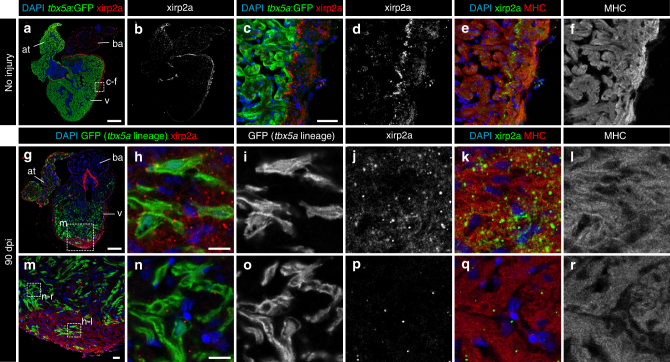
Trabecular tbx5a-derived cardiomyocytes within the cortical myocardium express the cortical marker Xirp2a. Immunofluorescence with anti-Xirp2a and GFP and anti-Myosin Heavy Chain (MHC) on ventricle sections. af Uninjured adult tbx5a:GFP ventricle. Xirp2a expression was observed in the cortical layer but not in the trabecular layer showing a complementary pattern with tbx5a:GFP as predicted by the RNA-Seq (n = 3/3). gr Double transgenic tbx5a:mCherry-p2a-CreERT2;ubb:loxP-lacZ-loxP-GFP were treated with 4-Hydroxytamoxifen (4-OHT) from 84 to 72 and 60 to 48 hours before cryoinjury. Hearts were fixed at 90 days postinjury (dpi). GFP+ cells marking the tbx5a lineage within the cortical layer were positive for Xirp2a, whereas GFP+ cells within the trabecular layer did not express this marker (n = 6/6). at, atrium; ba, bulbus arteriosus; v, ventricle. Scale bars, a, g 100 µm, c, m 25 μm, and h, n 10 µm
Fig. 9
Fig. 9
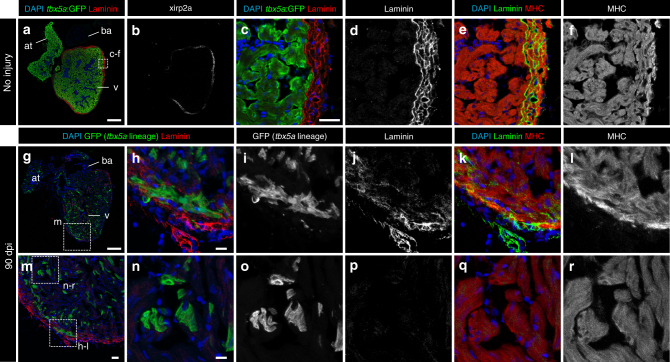
Trabecular tbx5a-derived cardiomyocytes within the cortical myocardium are surrounded by Laminin. Immunofluorescence with anti-Laminin, anti-GFP, and anti-Myosin Heavy Chain (MHC) on ventricle sections. af Uninjured adult tbx5a:GFP ventricle. Laminin expression was observed in the cortical layer but not in the trabecular layer showing a complementary pattern with tbx5a:GFP (n = 3/3). gr Double transgenic tbx5a:mCherry-p2a-CreERT2;ubb:loxP-lacZ-loxP-GFP adult fish were treated with 4-Hydroxytamoxifen (4-OHT) from 84 to 72 and 60 to 48 hours before cryoinjury. Hearts were fixed at 90 days postinjury (dpi). GFP+ cells marking the tbx5a lineage within the cortical layer were surrounded by Laminin staining (n = 6/6). at, atrium; ba, bulbus arteriosus; v, ventricle. Scale bars, a, g 100 µm, c, m 25 μm, and h, n 10 µm
Fig. 10
Fig. 10
Summary of the contribution of tbx5a-positive and -negative myocardium during heart development and regeneration. a Identification of tbx5a-expressing and tbx5a-derived cells in the zebrafish heart. Red, tbx5a+ cells; green, tbx5a-derived cells not expressing tbx5a; yellow, tbx5a-expressing cells derived from embryonic tbx5a+ cells. b Replacement of the embryonic first heart field  myocardium with second heart field  progenitors. Blue, ventricular cardiomyocytes; red, tbx5a-derived ventricular cardiomyocytes; dotted red, ablated tbx5a-derived ventricular cardiomyocytes. c Contribution of tbx5a-derived cells during heart regeneration in the zebrafish. Red, tbx5a+ cells; green, tbx5a-derived cells not expressing tbx5a; yellow, tbx5a-expressing cells derived from trabecular adult tbx5a+ cells. 4-OHT, 4-Hydroxytamoxifen; at, atrium; Mtz, Metronidazole; v,ventricle

References

    1. Kikuchi K, et al. Primary contribution to zebrafish heart regeneration by gata4(+) cardiomyocytes. Nature. 2010;464:601–605. doi: 10.1038/nature08804. - DOI - PMC - PubMed
    1. Jopling C, et al. Zebrafish heart regeneration occurs by cardiomyocyte dedifferentiation and proliferation. Nature. 2010;464:606–609. doi: 10.1038/nature08899. - DOI - PMC - PubMed
    1. Gonzalez-Rosa JM, Burns CE, Burns CG. Zebrafish heart regeneration: 15 years of discoveries. Regeneration (Oxf.) 2017;4:105–123. doi: 10.1002/reg2.83. - DOI - PMC - PubMed
    1. Liu J, et al. A dual role for ErbB2 signaling in cardiac trabeculation. Development. 2010;137:3867–3875. doi: 10.1242/dev.053736. - DOI - PMC - PubMed
    1. Gupta V, Poss KD. Clonally dominant cardiomyocytes direct heart morphogenesis. Nature. 2012;484:479–484. doi: 10.1038/nature11045. - DOI - PMC - PubMed

Publication types

MeSH terms