. 2018 Jan 30;9(1):442.
doi: 10.1038/s41467-018-02825-9.

The genetic prehistory of the Baltic Sea region

Affiliations

The genetic prehistory of the Baltic Sea region

Alissa Mittnik et al. Nat Commun. .

Erratum in

  • Author Correction: The genetic prehistory of the Baltic Sea region.
    Mittnik A, Wang CC, Pfrengle S, Daubaras M, Zariņa G, Hallgren F, Allmäe R, Khartanovich V, Moiseyev V, Tõrv M, Furtwängler A, Valtueña AA, Feldman M, Economou C, Oinonen M, Vasks A, Balanovska E, Reich D, Jankauskas R, Haak W, Schiffels S, Krause J. Mittnik A, et al. Nat Commun. 2018 Apr 11;9(1):1494. doi: 10.1038/s41467-018-03872-y. Nat Commun. 2018. PMID: 29643405 Free PMC article.

Abstract

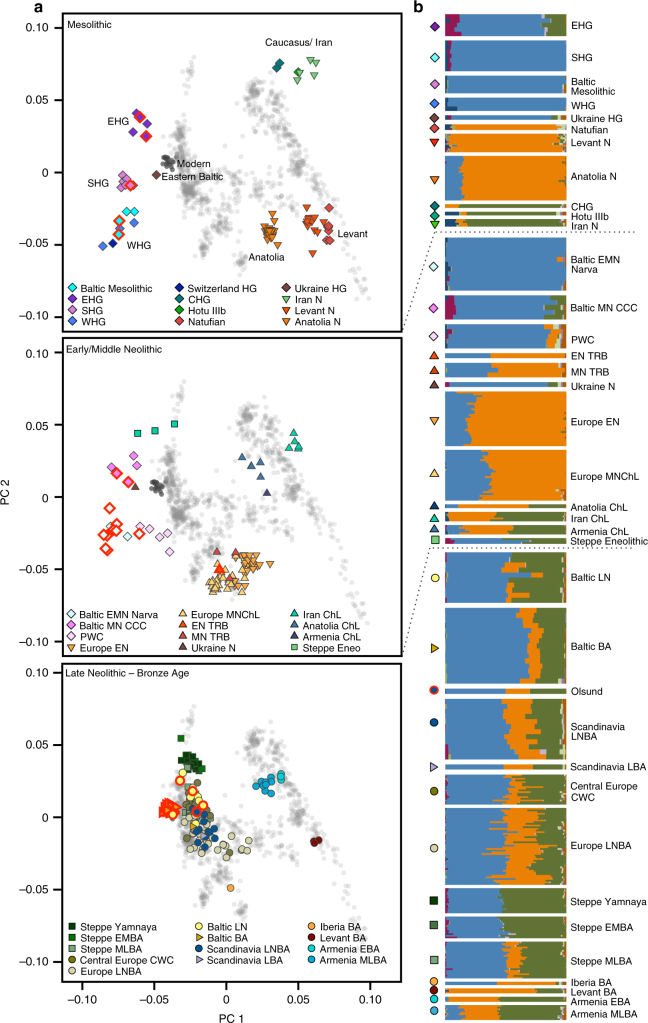
While the series of events that shaped the transition between foraging societies and food producers are well described for Central and Southern Europe, genetic evidence from Northern Europe surrounding the Baltic Sea is still sparse. Here, we report genome-wide DNA data from 38 ancient North Europeans ranging from ~9500 to 2200 years before present. Our analysis provides genetic evidence that hunter-gatherers settled Scandinavia via two routes. We reveal that the first Scandinavian farmers derive their ancestry from Anatolia 1000 years earlier than previously demonstrated. The range of Mesolithic Western hunter-gatherers extended to the east of the Baltic Sea, where these populations persisted without gene-flow from Central European farmers during the Early and Middle Neolithic. The arrival of steppe pastoralists in the Late Neolithic introduced a major shift in economy and mediated the spread of a new ancestry associated with the Corded Ware Complex in Northern Europe.


Conflict of interest statement

The authors declare no competing financial interests.

Figures
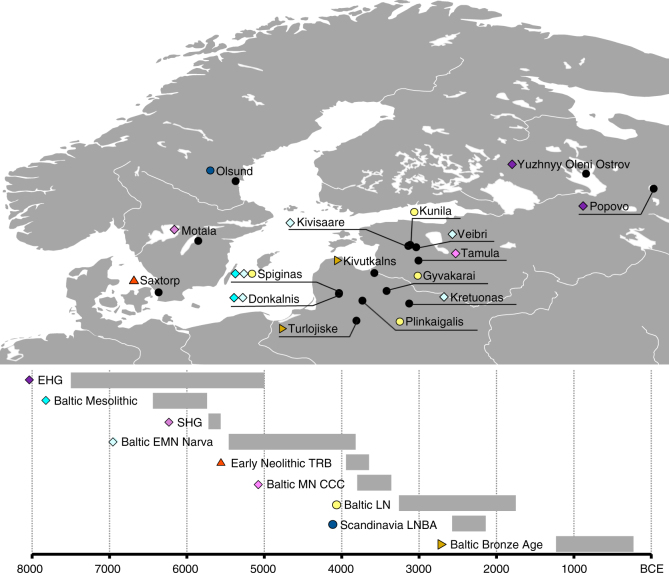
Fig. 1
Fig. 1
Sampling locations and dating of 38 ancient Northern European samples introduced in this study. Chronology based on calibrated radiocarbon dates or relative dating, see Supplementary Note 2. Map generated with QGIS 2.18.2 (http://www.qgis.org/) using the Natural Earth data set (http://www.naturalearthdata.com) for the basemap
Fig. 2
Fig. 2
PCA and ADMIXTURE analysis reflecting three time periods in Northern European prehistory. a Principal components analysis of 1012 present-day West Eurasians (grey points, modern Baltic populations in dark grey) with 294 projected published ancient and 38 ancient North European samples introduced in this study (marked with a red outline). Population labels of modern West Eurasians are given in Supplementary Fig. 7 and a zoomed-in version of the European Late Neolithic and Bronze Age samples is provided in Supplementary Fig. 8. b Ancestral components in ancient individuals estimated by ADMIXTURE (k = 11)
Fig. 3
Fig. 3
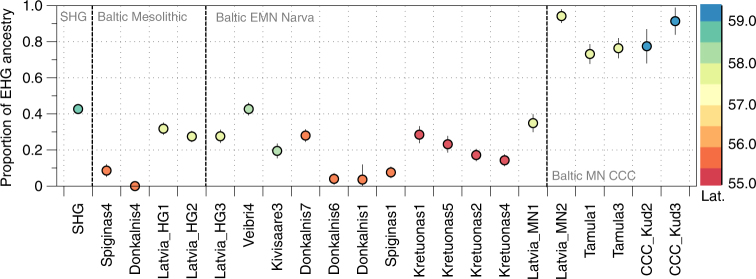
EHG ancestry in SHG and Eastern Baltic hunter-gatherers. Ancestry proportions were estimated with qpAdm, and standard errors are shown as vertical lines. Colours indicate latitude of the site at which the individuals were excavated

References

    1. Lazaridis I, et al. Ancient human genomes suggest three ancestral populations for present-day Europeans. Nature. 2014;513:409–413. doi: 10.1038/nature13673. - DOI - PMC - PubMed
    1. Haak W, et al. Massive migration from the steppe was a source for Indo-European languages in Europe. Nature. 2015;522:207–211. doi: 10.1038/nature14317. - DOI - PMC - PubMed
    1. Allentoft ME, et al. Population genomics of Bronze Age Eurasia. Nature. 2015;522:167–172. doi: 10.1038/nature14507. - DOI - PubMed
    1. Mathieson I, et al. Genome-wide patterns of selection in 230 ancient Eurasians. Nature. 2015;528:499–503. doi: 10.1038/nature16152. - DOI - PMC - PubMed
    1. Fu Q, et al. The genetic history of Ice Age Europe. Nature. 2016;534:200–205. doi: 10.1038/nature17993. - DOI - PMC - PubMed

Publication types

LinkOut - more resources