Review
. 2018 Jan 9:11:1756283X17745776.
doi: 10.1177/1756283X17745776. eCollection 2018.

Vonoprazan fumarate, a novel potassium-competitive acid blocker, in the management of gastroesophageal reflux disease: safety and clinical evidence to date

Affiliations
Review

Vonoprazan fumarate, a novel potassium-competitive acid blocker, in the management of gastroesophageal reflux disease: safety and clinical evidence to date

Kentaro Sugano. Therap Adv Gastroenterol. .

Abstract

Potassium-competitive acid blocker (P-CAB) is a class of drug that competitively blocks the potassium-binding site of H+, K+-adenosine triphosphate (ATP)ase. Although the history of this class of drugs started over 30 years ago, clinical use of two P-CABs, revaprazan and vonoprazan, were only recently approved in Korea and Japan, respectively. Among them, vonoprazan has several advantages over conventional proton-pump inhibitors (PPIs), including rapid onset of action, long duration of acid suppression, fewer interindividual variations in terms of acid suppression, and minimum dietary influence on its action. These advantages of vonoprazan have been proved in clinical trials conducted for license approvals for several acid-related diseases. In this review article, current evidence of vonoprazan in the management of gastroesophageal reflux disease (GERD) will be summarized. Since the clinical trial data, as well as postmarketed clinical data, have consistently demonstrated superiority of vonoprazan over conventional PPIs in terms of achieving healing of mucosal breaks and maintaining the healing, it may provide an excellent, if not complete, option for fulfilling some of the unmet needs for current GERD therapy. The safety problem of vonoprazan is also discussed, as more pronounced hypergastrinemia inevitably ensues with its use.

Keywords: gastroesophageal reflux disease; potassium-competitive acid blocker; proton pump inhibitor; safety; vonoprazan.


Conflict of interest statement

Conflict of interest statement: KS has received lecture fees from Takeda Pharma Inc., EA Pharma and Astra Zeneca.

Figures
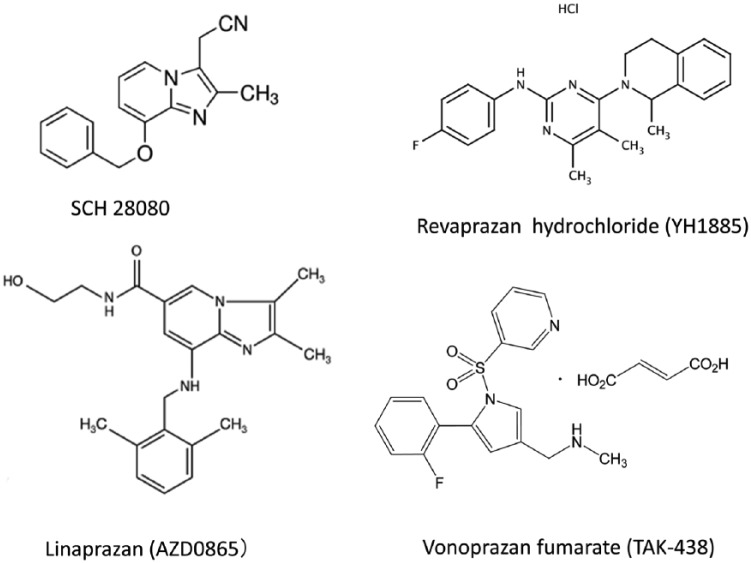
Figure 1.
Figure 1.
Chemical structure of potassium-competitive acid blockers. Currently, only two P-CABs, revaprazan and vonoprazan, are marketed. P-CAB, potassium-competitive acid blocker.
Figure 2.
Figure 2.
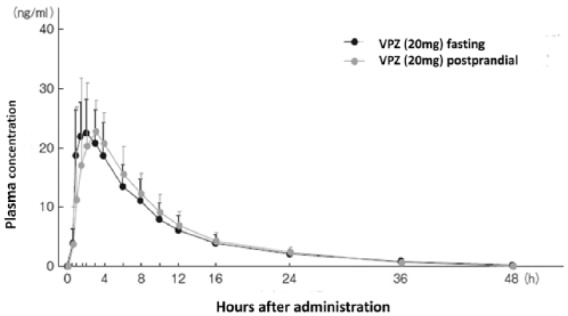
Plasma concentration of vonoprazan after a single oral dose of 20 mg. Pharmacokinetics after an oral dose of 20 mg vonoprazan given either before or after breakfast were similar. Elimination half-life (t1/2) of vonoprazan was also similar irrespective of the timing of prescription. The t1/2 was about 7.7 h in this experiment, which is much longer than conventional proton-pump inhibitors (see Table 2). This data was adopted from Pharmaceuticals and Medical Devices Agency of Japan.
Figure 3.
Figure 3.
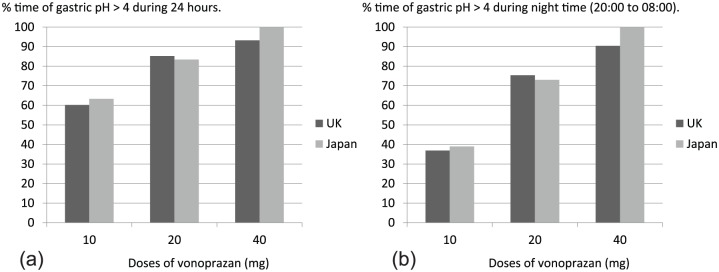
Response for pH > 4 holding time with various doses of vonoprazan. Vonoprazan dose dependently prolonged 24 h pH > 4 holding time in healthy young male volunteers. The proportion of time (%) of gastric pH > 4 in 24 h (a) and night time (20:00 to 08:00) (b) after a single morning dose for 7 days was depicted using data from Jenkins and colleagues. As noted, differences between volunteers from the UK and Japan were small in both profiles. Notably, a single morning dose of vonoprazan effectively increased night time pH > 4 holding time, if the higher dose was used.
Figure 4.
Figure 4.
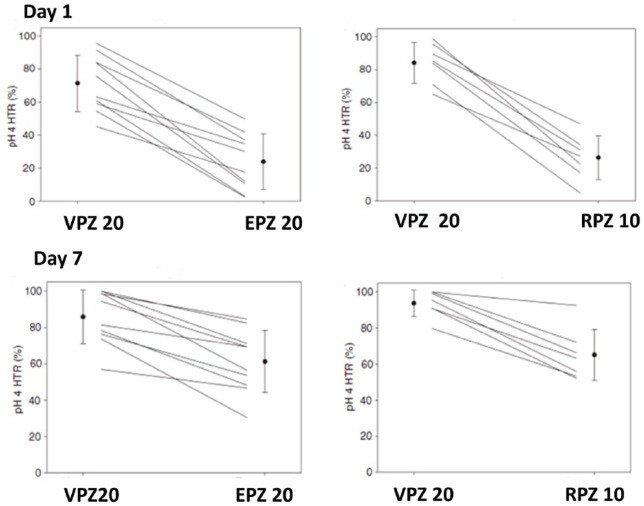
pH > 4 holding time on the 1st and 7th day. 24 h pH > 4 holding time of vonoprazan was compared with proton-pump inhibitors (esomeprazole and rabeprazole). VPZ at the dose of 20 mg showed rapid (from the 1st day) and more potent gastric acid suppression throughout the 7 days than 20 mg of esomeprazole or 10 mg of rabeprazole. In the study comparing VPZ 20 mg with EPZ 20 mg, % of pH > 4 holding time on the 1st and 7th day was 71.4 ± 17.0 and 85.8 ± 14.7% for VPZ, 23.9 ± 16.9 and 61.2 ± 17.1% for EPZ, respectively. In the study comparing VPZ 20 mg with RPZ 10 mg, % of pH > 4 holding time on the 1st and 7th day was 84.2 ± 12.4 and 93.8 ± 7.3% for VPZ, 26.3 ± 13.4 and 65.1 ± 14.2% for RPZ, respectively. Data are from Sakurai and colleagues. VPZ, vonoprazan; EPZ, esomeprazole; RPZ, rabeprazole; HTR, holding time rate.
Figure 5.
Figure 5.
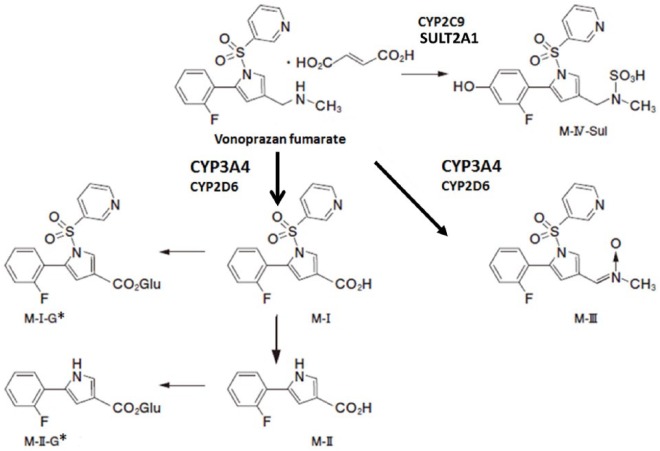
Metabolic disposition pathways of vonoprazan. The major route of metabolic disposition of vonoprazan was reported via CYP3A4, which converts vonoprazan to compounds M-I and M-III (thick arrows). Although CYP2D6, CYP2C9 and CYP2C19, and sulfotransferase2A1 (SULT2A1) also participate in metabolic disposition, their roles are relatively minor. M-I-G* and M-II-G* were inferred glucuronic-acid-conjugated (G) products from M-I, and M-II, respectively. Data are taken from the Pharmaceuticals and Medical Devices Agency of Japan with some modifications.
Figure 6.
Figure 6.
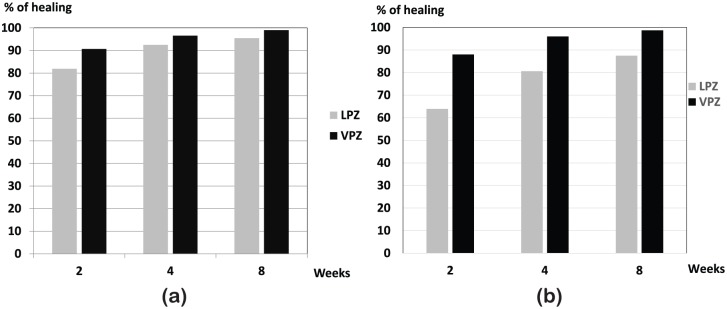
Efficacy of vonoprazan 20 mg for healing erosive esophagitis. Overall healing rate in patients with esophagitis of vonoprazan 20 mg once daily was compared with that of lansoprazole 30 mg once daily. Noninferiority of vonoprazan against lansoprazole was verified (a) in patients with severe grade of esophagitis (grade C/D of the Los Angeles classification), vonoprazan achieved significantly faster and higher healing (b) depicts healing rate of LA-grade C/D. LPZ, lansoprazole; VPZ, vonoprazan.

References

    1. El-Serag HB, Sweet S, Winchester CC, et al. Update on the epidemiology of gastro-oesophageal reflux disease: a systematic review. Gut 2014; 63: 871–880. - PMC - PubMed
    1. Fock KM, Talley N, Goh KL, et al. Asia-Pacific consensus on the management of gastro-oesophageal reflux disease: an update focusing on refractory reflux disease and Barrett’s oesophagitis. Gut 2016; 65: 1402–1415. - PubMed
    1. Kinoshita Y, Adachi K, Hongo M, et al. Systematic review of the epidemiology of gastroesophageal reflux disease in Japan. J Gastroenterol 2011; 46: 1092–1103. - PubMed
    1. Richter JE, Kahrilas PJ, Johanson J, et al. Efficacy and safety of esomeprazole compared with omeprazole in GERD patients with erosive esophagitis: a randomized controlled trial. Am J Gastroenterol 2001; 96: 656–665. - PubMed
    1. Sifrim D, Zerbib F. Diagnosis and management of patients with reflux symptoms refractory to proton pump inhibitors. Gut 2012; 61: 1340–1354. - PubMed