


Effects of Toremifene, a Selective Estrogen Receptor Modulator, on Spontaneous and Stimulated GH Secretion, IGF-I, and IGF-Binding Proteins in Healthy Elderly Subjects
- PMID: 29383334
- PMCID: PMC5789038
- DOI: 10.1210/js.2017-00457
Effects of Toremifene, a Selective Estrogen Receptor Modulator, on Spontaneous and Stimulated GH Secretion, IGF-I, and IGF-Binding Proteins in Healthy Elderly Subjects
Abstract
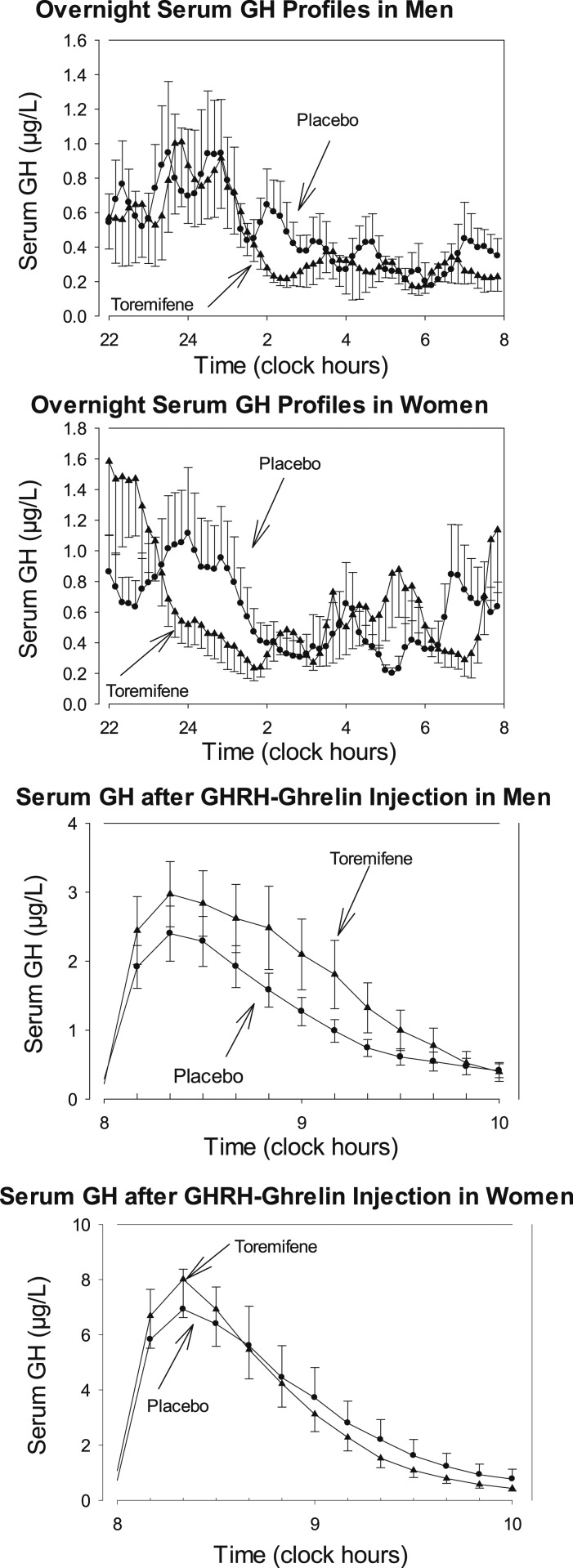
Context: Estrogens amplify spontaneous and stimulated growth hormone (GH) secretion, whereas they diminish GH-dependent insulin-like growth factor (IGF)-I in a dose-dependent manner. Selective estrogen receptor modulators (SERMs), including tamoxifen and toremifene, are widely adjunctively used in breast and prostate cancer. Although some endocrine effects of tamoxifen are known, few data are available for toremifene.
Objective: To explore sex-dependent effects of toremifene on spontaneous 10-hour overnight GH secretion, followed by GH-releasing hormone-ghrelin stimulation. Additionally, effects on IGF-I, its binding proteins, and sex hormone-binding globulin (SHBG) were quantified.
Participants and design: Twenty men and 20 women, within an allowable age range of 50 to 80 years, volunteered for this double-blind, placebo-controlled prospective crossover study. Ten-minute blood sampling was done for 10 hours overnight and then for 2 hours after combined GH-releasing hormone-ghrelin injection.
Main outcome measures: Pulsatile GH and stimulated GH secretion, and fasting levels of IGF-I, IGF-binding protein (IGFBP)1, IGFBP3, and SHBG.
Results: Toremifene did not enhance pulsatile or stimulated GH secretion, but decreased IGF-I by 20% in men and women. IGFBP3 was unchanged, whereas while IGFBP1 and SHBG increased in both sexes to a similar extent.
Conclusions: The expected rise in spontaneous and stimulated GH secretion under the diminished negative feedback restraint of powered IGF-I favors a central inhibitory antiestrogenic effect of toremifene. Estrogenic effects of toremifene on the liver were present, as evidenced by increased IGFBP1 and SHBG levels. Men and women responded to this SERM comparably.
Keywords: SERM; breast cancer; elderly; growth hormone; men; toremifene.
Figures

References
-
- Giustina A, Veldhuis JD. Pathophysiology of the neuroregulation of growth hormone secretion in experimental animals and the human. Endocr Rev. 1998;19(6):717–797. - PubMed
-
- Bray MJ, Vick TM, Shah N, Anderson SM, Rice LW, Iranmanesh A, Evans WS, Veldhuis JD. Short-term estradiol replacement in postmenopausal women selectively mutes somatostatin’s dose-dependent inhibition of fasting growth hormone secretion. J Clin Endocrinol Metab. 2001;86(7):3143–3149. - PubMed
-
- Anderson SM, Shah N, Evans WS, Patrie JT, Bowers CY, Veldhuis JD. Short-term estradiol supplementation augments growth hormone (GH) secretory responsiveness to dose-varying GH-releasing peptide infusions in healthy postmenopausal women. J Clin Endocrinol Metab. 2001;86(2):551–560. - PubMed
-
- Veldhuis JD, Anderson SM, Patrie JT, Bowers CY. Estradiol supplementation in postmenopausal women doubles rebound-like release of growth hormone (GH) triggered by sequential infusion and withdrawal of somatostatin: evidence that estrogen facilitates endogenous GH-releasing hormone drive. J Clin Endocrinol Metab. 2004;89(1):121–127. - PubMed
-
- Gentili A, Mulligan T, Godschalk M, Clore J, Patrie J, Iranmanesh A, Veldhuis JD. Unequal impact of short-term testosterone repletion on the somatotropic axis of young and older men. J Clin Endocrinol Metab. 2002;87(2):825–834. - PubMed
Grants and funding
LinkOut - more resources
Full Text Sources
Other Literature Sources
Miscellaneous