


Improving Rates of Outpatient Influenza Vaccination Through EHR Portal Messages and Interactive Automated Calls: A Randomized Controlled Trial
- PMID: 29383550
- PMCID: PMC5910339
- DOI: 10.1007/s11606-017-4266-9
Improving Rates of Outpatient Influenza Vaccination Through EHR Portal Messages and Interactive Automated Calls: A Randomized Controlled Trial
Abstract
Background: Patient reminders for influenza vaccination, delivered via electronic health record (EHR) patient portal messages and interactive voice response (IVR) calls, offer an innovative approach to improving patient care.
Objective: To test the effectiveness of portal and IVR outreach in improving rates of influenza vaccination.
Design: Randomized controlled trial of EHR portal messages and IVR calls promoting influenza vaccination.
Participants: Adults with no documented influenza vaccination 2 months after the start of influenza season (2014-2015).
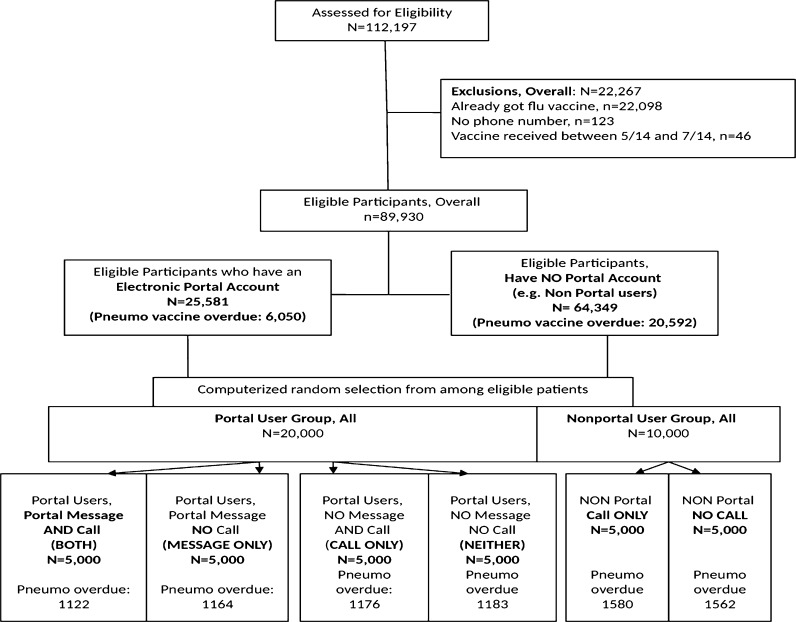
Intervention: Using a factorial design, we assigned 20,000 patients who were active portal users to one of four study arms: (a) receipt of a portal message promoting influenza vaccines, (b) receipt of IVR call with similar content, (c) both a and b, or (d) neither (usual care). We randomized 10,000 non-portal users to receipt of IVR call or usual care. In all intervention arms, information on pneumococcal vaccination was included if the targeted patient was overdue for pneumococcal vaccine.
Main measures: EHR-documented influenza vaccination during the 2014-2015 influenza season, measured April 2015.
Key results: Among portal users, 14.0% (702) of those receiving both portal messages and calls, 13.4% (669) of message recipients, 12.8% (642) of call recipients, and 11.6% (582) of those with usual care received vaccines. On multivariable analysis of portal users, those receiving portal messages alone (OR 1.20, 95% CI 1.06-1.35) or IVR calls alone (OR 1.15 95% CI 1.02-1.30) were more likely than usual care recipients to be vaccinated. Those receiving both messages and calls were also more likely than the usual care group to be vaccinated (ad hoc analysis, using a Bonferroni correction: OR 1.29, 97.5% CI 1.13, 1.48). Among non-portal users, 8.5% of call recipients and 8.6% of usual care recipients received influenza vaccines (p = NS). Pneumococcal vaccination rates showed no significant improvement.
Conclusions: Our outreach achieved a small but significant improvement in influenza vaccination rates. Registration: ClinicalTrials.gov Identifier NCT02266277 ( https://clinicaltrials.gov/ct2/show/NCT02266277 ).
Keywords: electronic health records; influenza vaccination; patient care.
Conflict of interest statement
The authors declare that they do not have a conflict of interest.
Figures
Comment in
-
Capsule Commentary on Cutrona et al., Improving Rates of Outpatient Influenza Vaccination Through EHR Portal Messages and Interactive Automated Calls: a Randomized Controlled Trial.J Gen Intern Med. 2018 May;33(5):745. doi: 10.1007/s11606-018-4384-z. J Gen Intern Med. 2018. PMID: 29532295 Free PMC article. No abstract available.
References
-
- NIH Fact Sheets - Influenza. In: Diseases NIH-NIAID, editor. Research Portfolio Online Reporting Tools (RePORT)2011. Accessed on Jan 9, 2018 at https://report.nih.gov/NIHfactsheets/ViewFactSheet.aspx?csid=133.
-
- National Center for Health Statistics (US. "Health, United States, 2015: with special feature on racial and ethnic health disparities." (2016 May). Report No.: 2016-1232. - PubMed
-
- Kochanek KD, Murphy SL, Xu J. Deaths: Final Data for 2011. National vital statistics reports : from the Centers for Disease Control and Prevention, National Center for Health Statistics, National Vital Statistics System. 2015;63(3):1–120. - PubMed
-
- Kochanek KD, Xu J, Murphy SL, Minino AM, Kung HC. Deaths: final data for 2009. National vital statistics reports : from the Centers for Disease Control and Prevention, National Center for Health Statistics, National Vital Statistics System. 2011;60(3):1–116. - PubMed
Publication types
MeSH terms
Substances
Associated data
LinkOut - more resources
Full Text Sources
Other Literature Sources
Medical
Miscellaneous
