


Applying GRADE-CERQual to qualitative evidence synthesis findings-paper 5: how to assess adequacy of data
- PMID: 29384077
- PMCID: PMC5791045
- DOI: 10.1186/s13012-017-0692-7
Applying GRADE-CERQual to qualitative evidence synthesis findings-paper 5: how to assess adequacy of data
Abstract
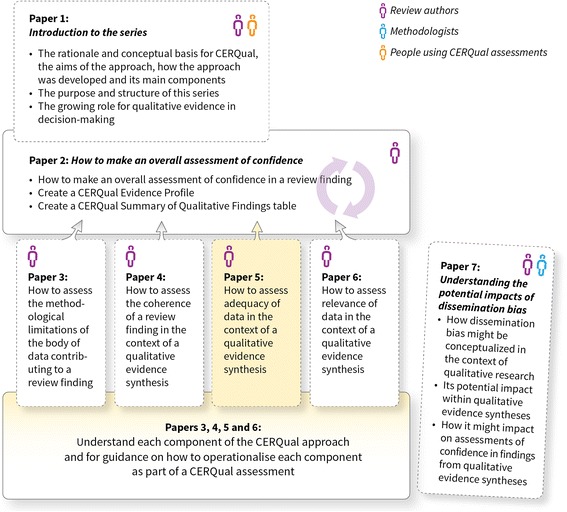
Background: The GRADE-CERQual (Confidence in Evidence from Reviews of Qualitative research) approach has been developed by the GRADE (Grading of Recommendations Assessment, Development and Evaluation) working group. The approach has been developed to support the use of findings from qualitative evidence syntheses in decision-making, including guideline development and policy formulation. CERQual includes four components for assessing how much confidence to place in findings from reviews of qualitative research (also referred to as qualitative evidence syntheses): (1) methodological limitations; (2) coherence; (3) adequacy of data; and (4) relevance. This paper is part of a series providing guidance on how to apply CERQual and focuses on CERQual's adequacy of data component.
Methods: We developed the adequacy of data component by searching the literature for definitions, gathering feedback from relevant research communities and developing consensus through project group meetings. We tested the CERQual adequacy of data component within several qualitative evidence syntheses before agreeing on the current definition and principles for application.
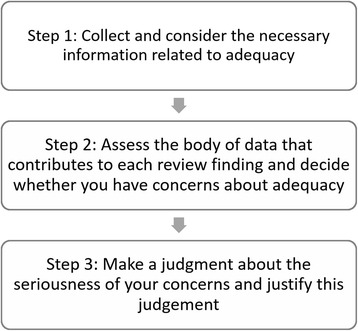
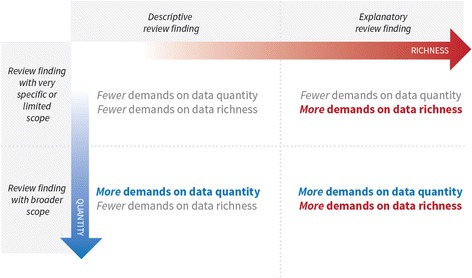
Results: When applying CERQual, we define adequacy of data as an overall determination of the degree of richness and the quantity of data supporting a review finding. In this paper, we describe the adequacy component and its rationale and offer guidance on how to assess data adequacy in the context of a review finding as part of the CERQual approach. This guidance outlines the information required to assess data adequacy, the steps that need to be taken to assess data adequacy, and examples of adequacy assessments.
Conclusions: This paper provides guidance for review authors and others on undertaking an assessment of adequacy in the context of the CERQual approach. We approach assessments of data adequacy in terms of the richness and quantity of the data supporting each review finding, but do not offer fixed rules regarding what constitutes sufficiently rich data or an adequate quantity of data. Instead, we recommend that this assessment is made in relation to the nature of the finding. We expect the CERQual approach, and its individual components, to develop further as our experiences with the practical implementation of the approach increase.
Keywords: Confidence; Data adequacy; Evidence-based practice; GRADE; Guidance; Methodology; Qualitative evidence synthesis; Qualitative research; Research design; Systematic review methodology.
Conflict of interest statement
Ethics approval and consent to participate
Not applicable. This study did not undertake any formal data collection involving humans or animals.
Consent for publication
Not applicable.
Competing interests
The authors declare that they have no competing interests.
Publisher’s Note
Springer Nature remains neutral with regard to jurisdictional claims in published maps and institutional affiliations.
Figures
References
-
- Lewin S, Glenton C, Munthe-Kaas H, Carlsen B, Colvin CJ, Gulmezoglu M, Noyes J, Booth A, Garside R, Rashidian A. Using qualitative evidence in decision making for health and social interventions: an approach to assess confidence in findings from qualitative evidence syntheses (GRADE-CERQual) PLoS Med. 2015;12(10):e1001895. doi: 10.1371/journal.pmed.1001895. - DOI - PMC - PubMed
-
- Munthe-Kaas HM, Bohren M, Carlsen B, Glenton C, Lewin S, Colvin CJ, Tuncalp Ö, Noyes J, Booth A, Garside R, et al. Applying GRADE-CERQual to qualitative evidence synthesis findings—paper 3: how to assess methodological limitations. Implement Sci. 2018;13(Suppl 1): 10.1186/s13012-017-0690-9. - PMC - PubMed
-
- Noyes J, Booth A, Lewin S, Carlsen B, Glenton C, Munthe-Kaas HM, Colvin CJ, Garside R, Bohren M, Rashidian A, et al. Applying GRADE-CERQual to qualitative evidence synthesis findings—paper 6: how to assess relevance of the data. Implement Sci. 2018;13(Suppl 1): 10.1186/s13012-017-0693-6. - PMC - PubMed
Publication types
MeSH terms
Grants and funding
LinkOut - more resources
Full Text Sources
Other Literature Sources
