Review
. 2018 Apr 13;4(4):467-477.
doi: 10.1021/acsinfecdis.7b00244. Epub 2018 Feb 9.

Genetically Validated Drug Targets in Leishmania: Current Knowledge and Future Prospects

Affiliations
Review

Genetically Validated Drug Targets in Leishmania: Current Knowledge and Future Prospects

Nathaniel G Jones et al. ACS Infect Dis. .

Abstract

There has been a very limited number of high-throughput screening campaigns carried out with Leishmania drug targets. In part, this is due to the small number of suitable target genes that have been shown by genetic or chemical methods to be essential for the parasite. In this perspective, we discuss the state of genetic target validation in the field of Leishmania research and review the 200 Leishmania genes and 36 Trypanosoma cruzi genes for which gene deletion attempts have been made since the first published case in 1990. We define a quality score for the different genetic deletion techniques that can be used to identify potential drug targets. We also discuss how the advances in genome-scale gene disruption techniques have been used to assist target-based and phenotypic-based drug development in other parasitic protozoa and why Leishmania has lacked a similar approach so far. The prospects for this scale of work are considered in the context of the application of CRISPR/Cas9 gene editing as a useful tool in Leishmania.

Keywords: CRISPR/Cas9; Leishmania; Trypanosoma cruzi; drug discovery; gene knockouts; null; pathogen; target validation.


Conflict of interest statement

The authors declare no competing financial interest.

Figures
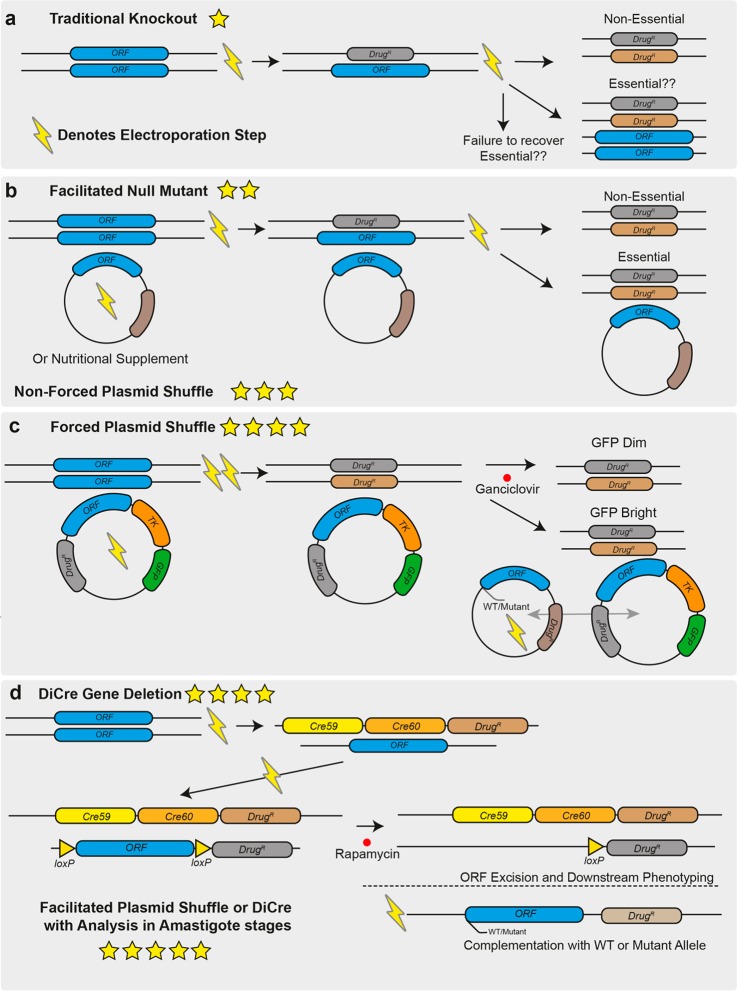
Figure 1
Figure 1
Overview of techniques that can be used for genetic target validation in Leishmania. (a) Gene deletion by homologous replacement. Drug resistance markers are targeted to the gene of interest by long homology flanks (0.5–1 kb) in sequential transfections by electroporation. This process can now be facilitated using CRISPR/Cas9 and short homology flanked cassettes in a single transfection. Deletions targeting essential genes will result in cell death and failure to isolate null mutants or in ploidy changes that allow the cell to retain alleles of the wild-type locus as well as drug resistance markers. (b) Facilitated null mutant with unforced plasmid shuffle. An episome expressing the gene of interest is first transfected into the cell line or a nutritional supplement is provided, allowing it to survive the subsequent deletion of the chromosomal alleles of the gene of interest. The drug selection pressure for the episome can be removed and retention of the plasmid can be determined if the gene is not essential; then it will be possible to isolate parasites that lack the episome. (c) Forced plasmid shuffle. As in B, an episome expressing the gene of interest is transfected into the parasite to allow the deletion of the chromosomal alleles of the target gene. The episome also encodes a negative-selectable marker, herpes simplex virus thymidine kinase. Selection with ganciclovir favors the survival of parasites that lack the episome, so if a gene is nonessential, the episome will rapidly be lost from the population but will be retained for an essential gene despite the associated costs. The addition of a second episome containing mutant versions of the gene of interest allows for exploration of the roles of specific domains and residues in the encoded protein for correct gene function by assessing which plasmid of the two is preferentially retained. (d) DiCre inducible gene deletion. One allele of the target gene is replaced by a drug-selectable cassette containing a “floxed” allele, and in a second transfection stage, the remaining allele is replaced by a second drug resistance marker. The addition of rapamycin induces DiCre dimerization and excision of the floxed allele, and the phenotypes that emerge in the induced null mutants can then be analyzed. As in C, complementation allows for the assessment of null mutant specificity and functional assessment of defined domains or residues in the protein. In all panels, the number of stars indicate the quality of the genetic evidence for gene essentiality, with one star being the weakest and five stars being the strongest.
Figure 2
Figure 2
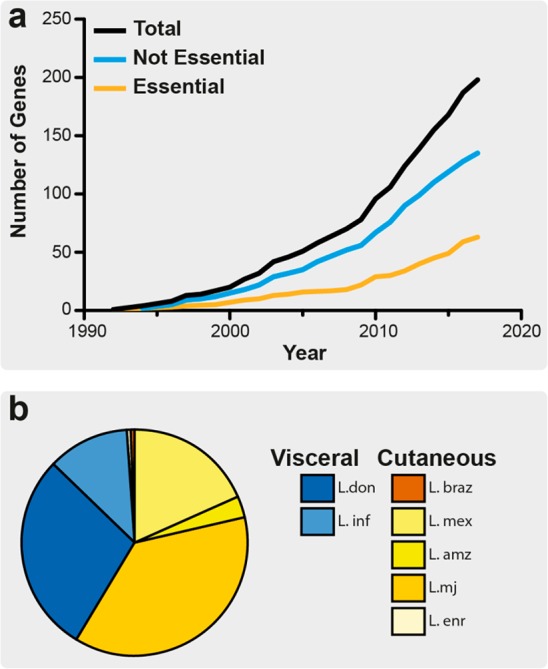
Overview of the number of Leishmania genes with published attempts at the creation of a null mutant. (a) Line graph depicting the cumulative number of genes for which attempts have been made to generate null mutants, for human infective Leishmania species. Only the first attempt at a gene deletion for each individual gene was recorded. Data from this study were ordered by year, and cumulative values of publications per year were derived, where the total number of attempted gene deletions is shown as well as the number of essential genes identified. (b) Pie chart showing the proportion of unique gene deletion attempts by species of Leishmania. Cutaneous species are shaded in yellows, and visceral species, in blues.
Figure 3
Figure 3
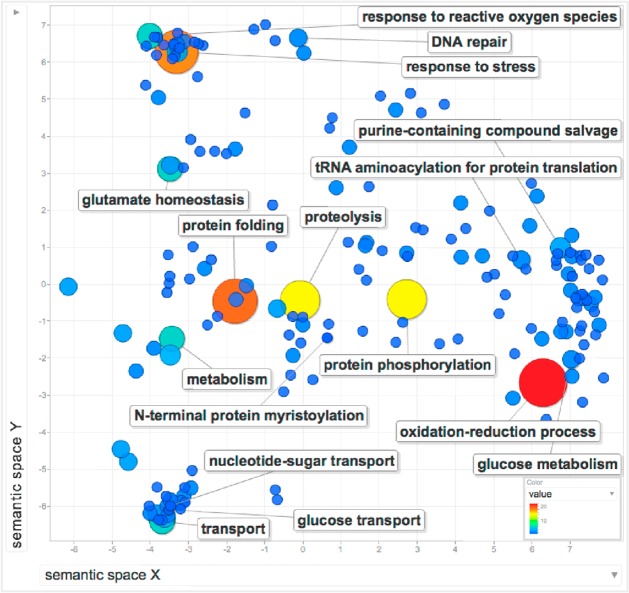
REVIGO analysis of GO terms associated with targeted Leishmania genes. L. major orthologues for all gene IDs in Table S1 were used to recover the associated GO terms for biological processes. The number of occurrences of each GO term was used to weight a REVIGO analysis, depicted as larger circles and hotter colors. The more frequently occurring biological processes are annotated in the figure, as are key (but less frequent) GO terms such as N-terminal protein myristoylation.
Figure 4
Figure 4
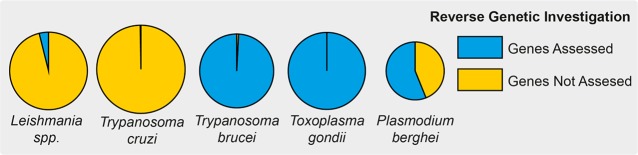
Number of reverse genetic manipulations of Leishmania in comparison to other model parasitic protozoans. (A) Comparison of reverse genetic screening in Leishmania spp. (Table S1), Trypanosoma cruzi (Table S2), Trypanosoma brucei,Toxoplasma gondii, and Plasmodium berghei. Pie chart segments depict the proportion of genes in each organism that have been targeted using reverse genetics, with the overall area of the pie depicting the relative sizes of the genomes.

References

    1. Alvar J.; Vélez I. D.; Bern C.; Herrero M.; Desjeux P.; Cano J.; Jannin J.; Boer den. M. (2012) Leishmaniasis worldwide and global estimates of its incidence. PLoS One 7 (5), e35671. 10.1371/journal.pone.0035671. - DOI - PMC - PubMed
    1. DNDi . https://www.dndi.org/diseases-projects/leishmaniasis/, accessed November 02, 2017.
    1. WHO . http://www.who.int/leishmaniasis/en/, accessed November 02, 2017.
    1. Mandell M. A.; Beverley S. M. (2017) Continual renewal and replication of persistent Leishmania major parasites in concomitantly immune hosts. Proc. Natl. Acad. Sci. U. S. A. 114 (5), E801–E810. 10.1073/pnas.1619265114. - DOI - PMC - PubMed
    1. Field M. C.; Horn D.; Fairlamb A. H.; Ferguson M. A. J.; Gray D. W.; Read K. D.; De Rycker M.; Torrie L. S.; Wyatt P. G.; Wyllie S.; et al. (2017) Anti-trypanosomatid drug discovery: an ongoing challenge and a continuing need. Nat. Rev. Microbiol. 15 (4), 217–231. 10.1038/nrmicro.2016.193. - DOI - PMC - PubMed

Publication types

MeSH terms

LinkOut - more resources