


Quaternary prevention: reviewing the concept
- PMID: 29384397
- PMCID: PMC5795741
- DOI: 10.1080/13814788.2017.1422177
Quaternary prevention: reviewing the concept
Abstract
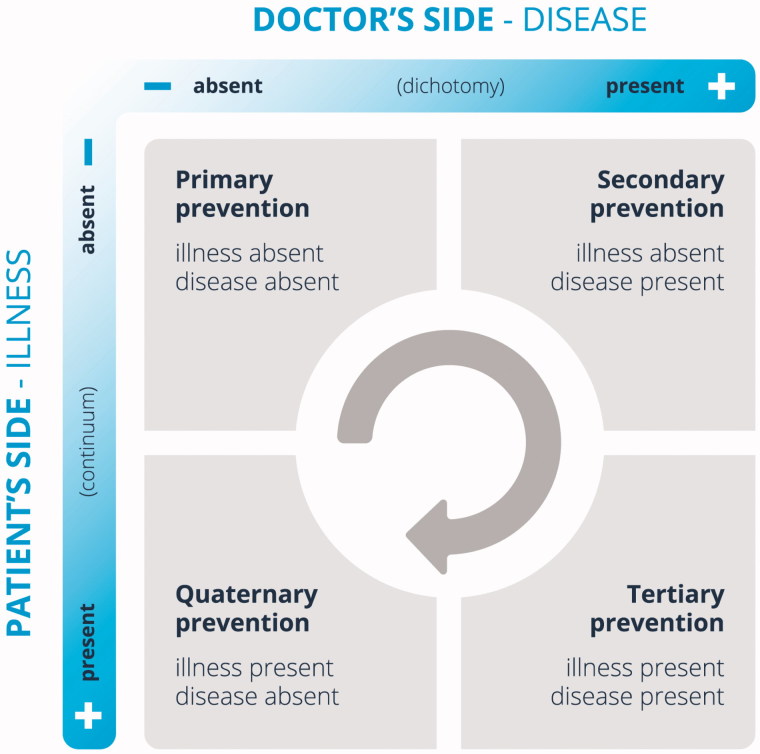
Background: According to the Wonca International Dictionary for General/Family Practice Quaternary Prevention is defined as: 'Action taken to identify patient at risk of overmedicalization, to protect him from new medical invasion, and to suggest to him interventions, which are ethically acceptable.' The concept of quaternary prevention was initially proposed by Marc Jamoulle and the targets were mainly patients with illness but without a disease.
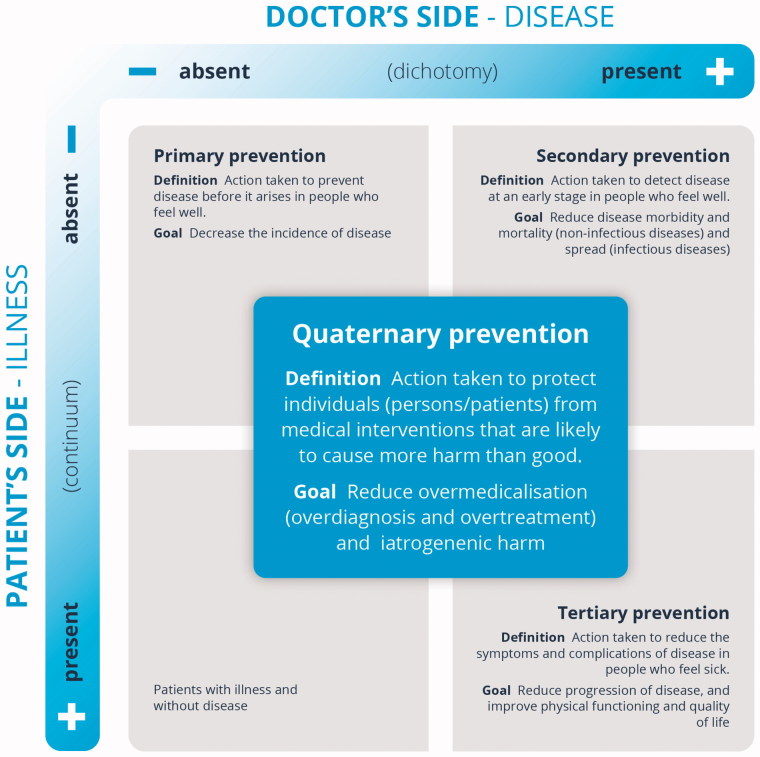
Objectives: The purpose of this opinion article is to open the debate around a new possible definition and a new conceptual model of quaternary prevention based on the belief that quaternary prevention should be present in physicians' minds for every intervention they suggest to a patient.
Discussion: The debate around quaternary prevention is vital in the context of contemporary medicine and has expanded worldwide. The human being may suffer harm from medical interventions from conception, during their childhood, during their entire healthy lifetime as well as during a self-limited disease, a chronic disease, or a terminal disease. The current definition of quaternary prevention has limitations because it excludes patients and medical interventions where a quaternary prevention perspective would be needed and useful to protect patients from harm. In this context, a new definition and conceptual model of quaternary prevention is proposed.
Conclusion: In this new proposal, quaternary prevention is defined as an 'action taken to protect individuals (persons/patients) from medical interventions that are likely to cause more harm than good.'
Keywords: Prevention; health ethics; overdiagnosis; patient involvement (empowerment; quaternary prevention; self-management).
Conflict of interest statement
The authors report no conflicts of interest. The authors alone are responsible for the content and writing of the paper.
Figures
References
-
- Clark D, MacMahon B.. Preventive medicine. Boston (MA): Little, Brown & Co; 1967.
-
- Nightengale E, Cureton M, Kalmar V.. Perspectives on health promotion and disease prevention in the United States. Washington (DC): Institute of Medicine, National Academy of Sciences; 1978.
-
- Bentzen N. Wonca dictionary of general/family practice. Copenhagen: Manedsskrift for Praktisk Laegergerning; 2003.
-
- Krouss M, Croft L, Morgan DJ.. Physician understanding and ability to communicate harms and benefits of common medical treatments. JAMA Intern Med. 2016;176:1565–1567. - PubMed
MeSH terms
LinkOut - more resources
Full Text Sources
Other Literature Sources
Medical
