


Postoperative outcomes of breast reconstruction after mastectomy: A retrospective study
- PMID: 29384865
- PMCID: PMC5805437
- DOI: 10.1097/MD.0000000000009766
Postoperative outcomes of breast reconstruction after mastectomy: A retrospective study
Abstract
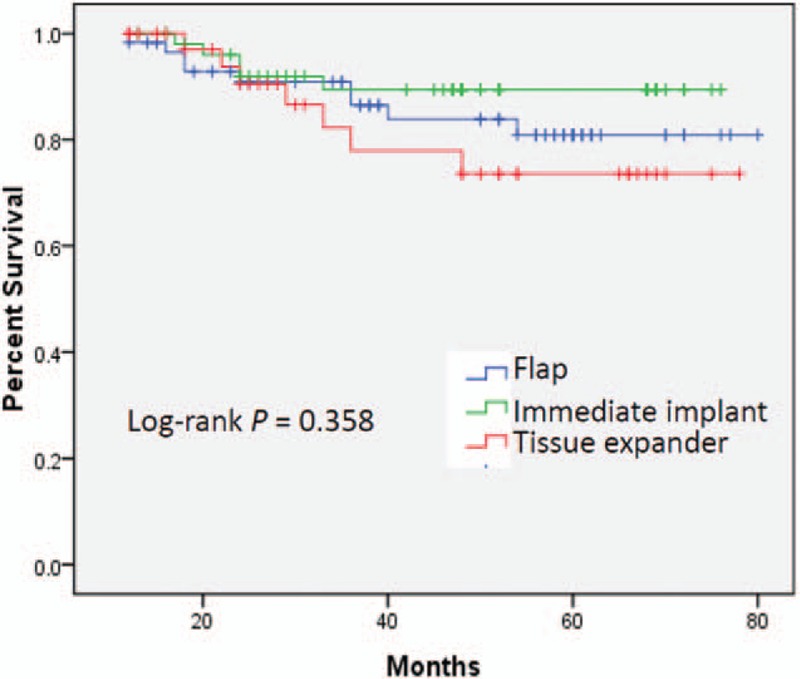
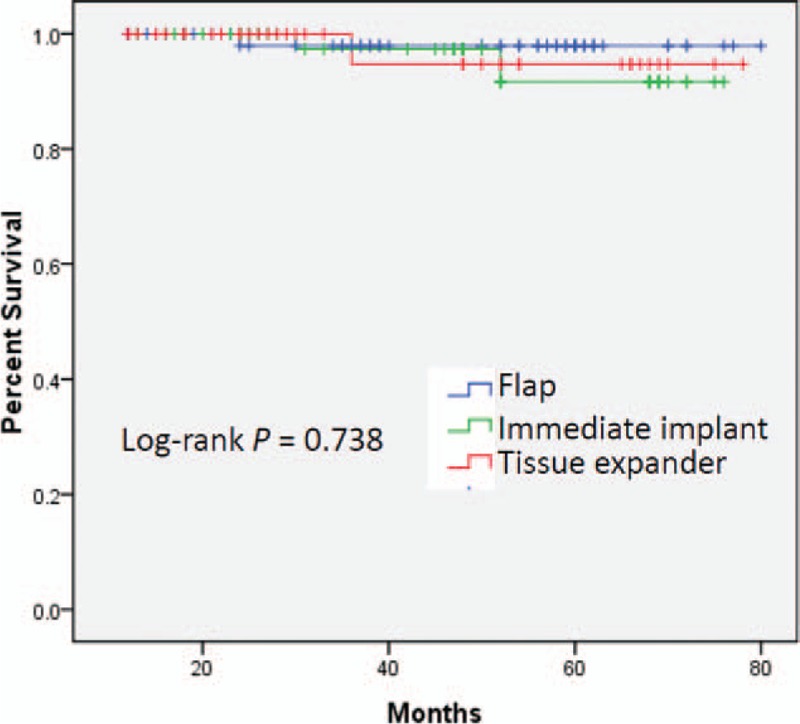
Breast reconstruction after mastectomy plays an active role in improving the quality-of-life (QoL) and alleviating the psychological trauma of breast cancer patients, and has become an indispensable part of the comprehensive treatment in breast cancer. However, compared with mastectomy alone, breast reconstruction also increase operative complications. The surgical, oncological outcomes, and cosmetic effect of breast reconstruction remains to be evaluated. Data for patients with breast cancer who underwent breast reconstruction after mastectomy from February 2009 to November 2015 in our hospital were retrospectively analyzed, with a median follow-up time of 44 months. The operating time, blood loss, drainage fluid, postoperative complications, postoperative cosmesis, oncological outcomes, and QoL were evaluated and compared between different reconstruction types. A total of 151 women were included. The flap-based group had higher complication rates of marginal necrosis of incision, while the incidence of capsular contracture was higher in immediate implant group. There was no difference in blood loss, drainage fluid, and other postoperative complications. Several independent factors were associated with increased postoperative complications included diabetic, obese, and reconstruction with flap. There was no significant difference in the disease-free survival rate and overall survival rate between different surgical groups. In terms of cosmetic effect, patients in the tissue expander group were more likely to get a satisfactory postoperative breast appearance. QoL outcomes shown that the tissue expander group has better body image and sexual enjoyment, while there was no significant difference for other QoL domains. In conclusion, different methods of breast reconstruction are safe and feasible for patients with breast cancer, tissue expander implantation following delayed implant breast reconstruction is a more effective treatment on cosmetic and QoL outcomes.
Conflict of interest statement
The authors report no conflicts of interest.
Figures
References
-
- Xing L, He Q, Wang YY, et al. Advances in the surgical treatment of breast cancer. Chin Clin Oncol 2016;5:34. - PubMed
-
- Yueh JH, Slavin SA, Adesiyun T, et al. Patient satisfaction in postmastectomy breast reconstruction: a comparative evaluation of DIEP, TRAM, latissimus flap, and implant techniques. Plast Reconstr Surg 2010;125:1585–95. - PubMed
-
- Noone RB. Thirty-five years of breast reconstruction: eleven lessons to share. Plast Reconstr Surg 2009;124:1820–7. - PubMed
-
- Heneghan HM, Prichard RS, Lyons R, et al. Quality of life after immediate breast reconstruction and skin-sparing mastectomy—a comparison with patients undergoing breast conserving surgery. Eur J Surg Oncol 2011;37:937–43. - PubMed
-
- Robertson S, Wengstrom Y, Eriksen C, et al. Breast surgeons performing immediate breast reconstruction with implants—assessment of resource-use and patient-reported outcome measures. Breast 2012;21:590–6. - PubMed
Publication types
MeSH terms
LinkOut - more resources
Full Text Sources
Other Literature Sources
Medical
