


Analysis of anesthesia-controlled operating room time after propofol-based total intravenous anesthesia compared with desflurane anesthesia in functional endoscopic sinus surgery
- PMID: 29384881
- PMCID: PMC5805453
- DOI: 10.1097/MD.0000000000009805
Analysis of anesthesia-controlled operating room time after propofol-based total intravenous anesthesia compared with desflurane anesthesia in functional endoscopic sinus surgery
Abstract
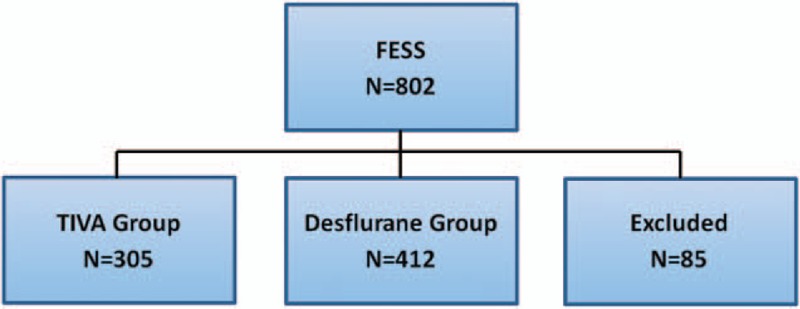
Anesthesia technique may contribute to the improvement of operation room (OR) efficiency by reducing anesthesia-controlled time. We compared the difference between propofol-based total intravenous anesthesia (TIVA) and desflurane anesthesia (DES) for functional endoscopic sinus surgery (FESS) undergoing general anesthesiaWe performed a retrospective study using data collected in our hospital to compare the anesthesia-controlled time of FESS using either TIVA via target-controlled infusion with propofol/fentanyl or DES/fentanyl-based anesthesia between January 2010 and December 2011. The various time intervals (surgical time, anesthesia time, extubation time, total OR stay time, post anesthesia care unit [PACU] stay time) and the percentage of prolonged extubation were compared between the 2 anesthetic techniques.We included data from 717 patients, with 305 patients receiving TIVA and 412 patients receiving DES. An emergence time >15 minutes is defined as prolonged extubation. The extubation time was faster (8.8 [3.5] vs. 9.6 [4.0] minutes; P = .03), and the percentage of prolonged extubation was lower (7.5% vs. 13.6%, risk difference 6.1%, P < .001) in the TIVA group than in the DES group. However, there was no significant difference between ACT, total OR stay time, and PACU stay time.In our hospital, propofol-based TIVA by target-controlled infusion provide faster emergence and lower chance of prolonged extubation compared with DES anesthesia in FESS. However, the reduction in extubation time may not improve OR efficiency.
Conflict of interest statement
The authors report no conflicts of interest.
References
-
- Junger A, Klasen J, Hartmann B, et al. Shorter discharge time after regional or intravenous anaesthesia in combination with laryngeal mask airway compared with balanced anaesthesia with endotracheal intubation. Eur J Anaesthesiol 2002;19:119–24. - PubMed
-
- Apfelbaum JL, Grasela TH, Hug CC, Jr, et al. The initial clinical experience of 1819 physicians in maintaining anesthesia with propofol: characteristics associated with prolonged time to awakening. Anesth Analg 1993;77:S10–1. - PubMed
-
- Dexter F, Bayman EO, Epstein RH. Statistical modeling of average and variability of time to extubation for meta-analysis comparing desflurane to sevoflurane. Anesth Analg 2010;110:570–80. - PubMed
-
- Wachtel RE, Dexter F, Epstein RH, et al. Meta-analysis of desflurane and propofol average times and variability in times to extubation and following commands. Can J Anaesth 2011;58:714–24. - PubMed
Publication types
MeSH terms
Substances
LinkOut - more resources
Full Text Sources
Other Literature Sources
Medical
