


Prostate cancer treated with reduced-volume intensity-modulated radiation therapy: Report on the 5-year outcome of a prospective series
- PMID: 29384928
- PMCID: PMC6392517
- DOI: 10.1097/MD.0000000000009450
Prostate cancer treated with reduced-volume intensity-modulated radiation therapy: Report on the 5-year outcome of a prospective series
Abstract
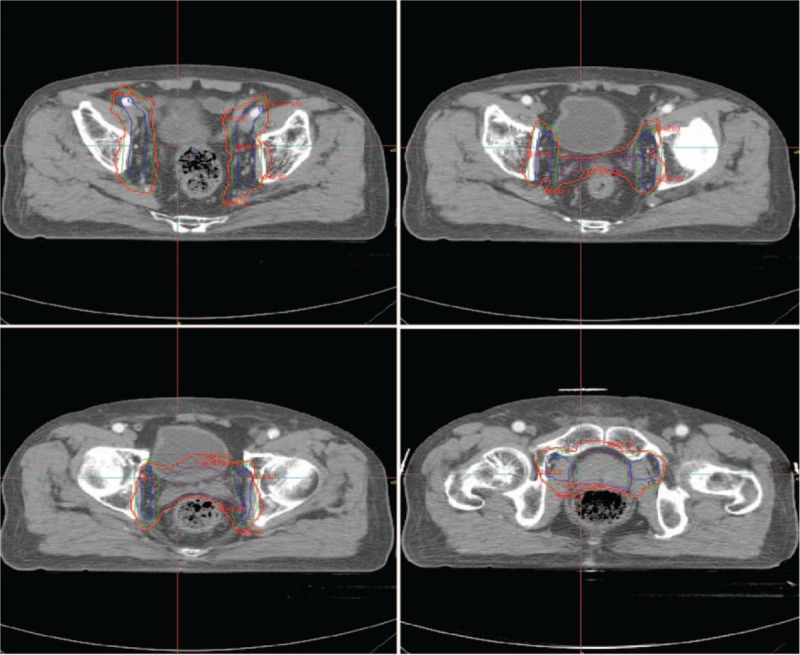
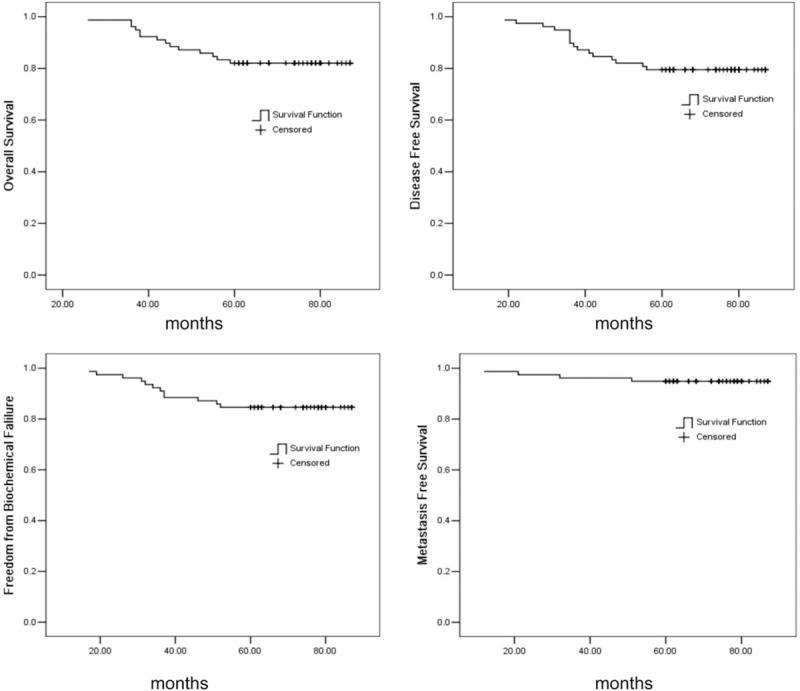
How to define a clinical target volume (CTV) as small as possible for prostate cancer to reduce the dose received by normal organs is an interesting study. We conduct a research to analyze the clinical efficacy of intensity modulated radiotherapy (IMRT) using reduced CTV in the treatment of prostate cancer. From January 2006 to June 2010, 78 patients with prostate cancer were treated with IMRT according to this institutional protocol. Of them, 18 had stage II tumors, 39 had stage III tumors, and 21 had stage IVa tumors. Clinical outcomes included overall survival, biochemical recurrence, recurrence-free survival, and acute and chronic injuries caused by radiotherapy. Risk factors were evaluated using the Cox regression model. As of December 31, 2014, all patients completed radiotherapy as planned. Myelosuppression was mostly grade 1, acute urinary injury was mostly grades 1 and 2, and intestinal injury was mostly grade 1. The 5-year follow-up rate was 91.0%. The overall, progression-free, biochemical recurrence-free, and distant metastasis-free survival rates were 82.1%, 79.4%, 84.6%, and 94.9%, respectively. Tumor volumes defined by small target volumes and Radiation Therapy Oncology Group were 274.21 ± 92.64 and 600.68 ± 113.72, respectively, representing a significant difference (P < .05). Age, prostate-specific antigen level, eastern cooperative oncology Group score, Gleason score, and volume of CTV were independent risk factors for mortality and disease progression. Our findings indicated that IMRT with reduced CTV have less acute and chronic injuries caused by radiation, particularly grade 3 or higher urinary and intestinal injuries, while ensuring survival benefits and protecting the hematopoietic function.
Copyright © 2017 The Authors. Published by Wolters Kluwer Health, Inc. All rights reserved.
Conflict of interest statement
The authors report no conflicts of interest.
Figures
References
-
- Siegel RL, Miller KD, Jemal A. Cancer statistics, 2017. CA Cancer J Clin 2017;67:7–30. - PubMed
-
- American Cancer Society. Cancer Facts & Figures 2011. Atlanta, GA: American Cancer Society; 2011.
-
- Johansson E, Steineck G, Holmberg L, et al. Long-term quality-of-life outcomes after radical prostatectomy or watchful waiting: the Scandinavian prostate cancer group-4 randomised trial. Lancet Oncol 2011;12:891–9. - PubMed
-
- Luo HC, Cheng HH, Lin GS, et al. Intensity-modulated radiotherapy combined with endocrine therapy for intermediate and advanced prostate cancer: long-term outcome of Chinese patients. Asia Pac J Cancer Prev 2013;14:4711–5. - PubMed
-
- Luo HC, Cheng LP, Cheng HH, et al. Long-term quality of life outcomes in patients with locally advanced prostate cancer after intensity-modulated radiotherapy combined with androgen deprivation. Med Oncol 2014;31:991–7. - PubMed
MeSH terms
LinkOut - more resources
Full Text Sources
Other Literature Sources
Medical
Research Materials
