


The Association between Iron and Vitamin D Status in Female Elite Athletes
- PMID: 29385099
- PMCID: PMC5852743
- DOI: 10.3390/nu10020167
The Association between Iron and Vitamin D Status in Female Elite Athletes
Abstract
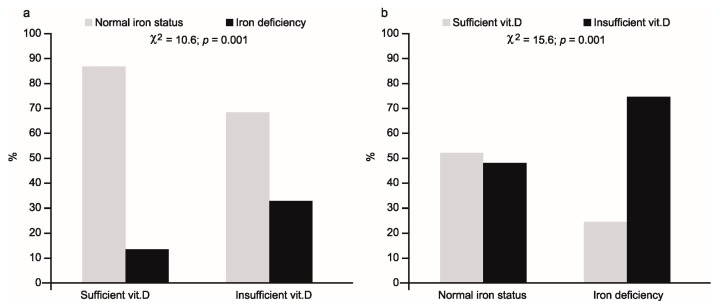
Vitamin D may influence iron metabolism and erythropoiesis, whereas iron is essential for vitamin D synthesis. We examined whether vitamin D deficiencies (VDD) are associated with reduced iron status and whether progressive iron deficiency (ID) is accompanied by inferior vitamin D status. The study included 219 healthy female (14-34 years old) athletes. VDD was defined as a 25(OH)D concentration < 75 nmol/L. ID was classified based on ferritin, soluble transferrin receptor (sTfR), total iron binding capacity (TIBC) and blood morphology indices. The percentage of ID subjects was higher (32%) in the VDD group than in the 25(OH)D sufficient group (11%) (χ² = 10.6; p = 0.001). The percentage of VDD subjects was higher (75%) in the ID than in the normal iron status group (48%) (χ² = 15.6; p = 0.001). The odds ratios (ORs) for VDD increased from 1.75 (95% CI 1.02-2.99; p = 0.040) to 4.6 (95% CI 1.81-11.65; p = 0.001) with progressing iron deficiency. ID was dependent on VDD in both VDD groups (25(OH)D < 75 and < 50 nmol/L). The ID group had a lower 25(OH)D concentration (p = 0.000). The VDD group had lower ferritin (p = 0.043) and iron (p = 0.004) concentrations and higher values of TIBC (p = 0.016) and sTfR (p = 0.001). The current results confirm the association between vitamin D and iron status in female athletes, although it is difficult to assess exactly which of these nutrients exerts a stronger influence over the other.
Keywords: 25(OH)D; athletes; healthy female; iron status; mutual relationships; vitamin D status.
Conflict of interest statement
The authors have no conflicts of interest on this manuscript.
Figures
References
-
- De Benoist B., McLean E., Egli I., Cogswell M., editors. Worldwide Prevalence of Anemia 1993–2005. World Health Organization; Geneva, Switzerland: 2008. pp. 1–40. Global Database Anemia 2008.
-
- Pludowski P., Holick M.F., Pilz S., Wagner C.L., Hollis B.W., Grant W.B., Shoenfeld Y., Lerchbaum E., Llewellyn D.J., Kienreich K., et al. Vitamin D effects on musculoskeletal health, immunity, autoimmunity, cardiovascular disease, cancer, fertility, pregnancy, dementia and mortality—A review of recent evidence. Autoimmun. Rev. 2013;12:976–989. doi: 10.1016/j.autrev.2013.02.004. - DOI - PubMed
MeSH terms
Substances
LinkOut - more resources
Full Text Sources
Other Literature Sources
Medical
