


Immunological non-response and low hemoglobin levels are predictors of incident tuberculosis among HIV-infected individuals on Truvada-based therapy in Botswana
- PMID: 29385208
- PMCID: PMC5792012
- DOI: 10.1371/journal.pone.0192030
Immunological non-response and low hemoglobin levels are predictors of incident tuberculosis among HIV-infected individuals on Truvada-based therapy in Botswana
Erratum in
-
Correction: Immunological non-response and low hemoglobin levels are predictors of incident tuberculosis among HIV-infected individuals on Truvada-based therapy in Botswana.PLoS One. 2018 Jun 1;13(6):e0198711. doi: 10.1371/journal.pone.0198711. eCollection 2018. PLoS One. 2018. PMID: 29856867 Free PMC article.
Abstract
Background: There is a high burden of tuberculosis (TB) in HIV antiretroviral programmes in Africa. However, few studies have looked at predictors of incident TB while on Truvada-based combination antiretroviral therapy (cART) regimens.
Methods: We estimated TB incidence among individuals enrolled into an observational cohort evaluating the efficacy and tolerability of Truvada-based cART in Gaborone, Botswana between 2008 and 2011. We used Cox proportional hazards regressions to determine predictors of incident TB.
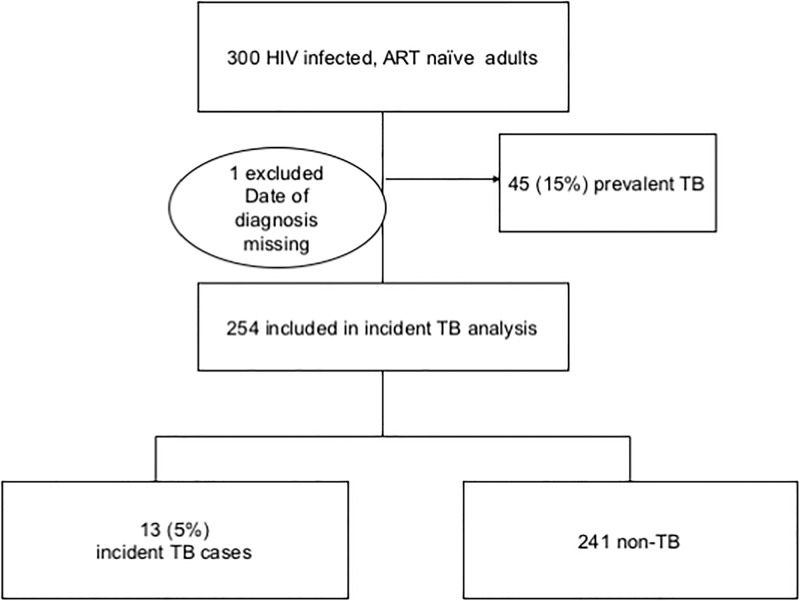
Results: Of 300 participants enrolled, 45 (15%) had a diagnosis of TB at baseline. During 428 person-years (py) of follow-up, the incidence rate of TB was 3.04/100py (95% CI, 1.69-5.06), with 60% of the cases occurring within 3 months of ART initiation. Incident cases had low baseline CD4+ T cell counts (153cells/mm3 [Q1, Q3: 82, 242]; p = 0.69) and hemoglobin levels (9.2g/dl [Q1, Q3: 8.5,10.1]; p<0.01). In univariate analysis, low BMI (HR = 0.73; 95% CI 0.58-0.91; p = 0.01) and hemoglobin levels <8 g/dl (HR = 10.84; 95%CI: 2.99-40.06; p<0.01) were risk factors for TB. Time to incident TB diagnosis was significantly reduced in patients with poor immunological recovery (p = 0.04). There was no association between baseline viral load and risk of TB (HR = 1.75; 95%CI: 0.70-4.37).
Conclusion: Low hemoglobin levels prior to initiation of ART are significant predictors of incident tuberculosis. Therefore, there is potential utility of iron biomarkers to identify patients at risk of TB prior to initiation on ART. Furthermore, additional strategies are required for patients with poor immunological recovery to reduce excess risk of TB while on ART.
Conflict of interest statement
Figures

References
-
- http://www.who.int/tb/publications/global_report/en/. Global TB report2015 Accessed [27 October 2016].
-
- Lawn SD, Wood R. Tuberculosis control in South Africa—will HAART help? South African medical journal = Suid-Afrikaanse tydskrif vir geneeskunde. 2006;96(6):502–4. Epub 2006/07/15. . - PubMed
-
- Stephen D. Lawn LM, Linda-Gail Bekker, Robin Wood. Burden of tuberculosis in an antiretroviral treatment programme in sub-Saharan Africa: impact on treatment outcomes and implications for tuberculosis control. AIDS. 2006;20:1605–12. doi: 10.1097/01.aids.0000238406.93249.cd - DOI - PubMed
-
- Abdool Karim SS, Naidoo K, Grobler A, Padayatchi N, Baxter C, Gray AL, et al. Timing of Initiation of Antiretroviral Drugs during Tuberculosis Therapy. The New England journal of medicine. 2010;362:697–706. doi: 10.1056/NEJMoa0905848 - DOI - PMC - PubMed
Publication types
MeSH terms
Substances
Grants and funding
LinkOut - more resources
Full Text Sources
Other Literature Sources
Medical
Research Materials
