


Evaluation of Optimized Tube-Gel Methods of Sample Preparation for Large-Scale Plant Proteomics
- PMID: 29385730
- PMCID: PMC5874765
- DOI: 10.3390/proteomes6010006
Evaluation of Optimized Tube-Gel Methods of Sample Preparation for Large-Scale Plant Proteomics
Abstract
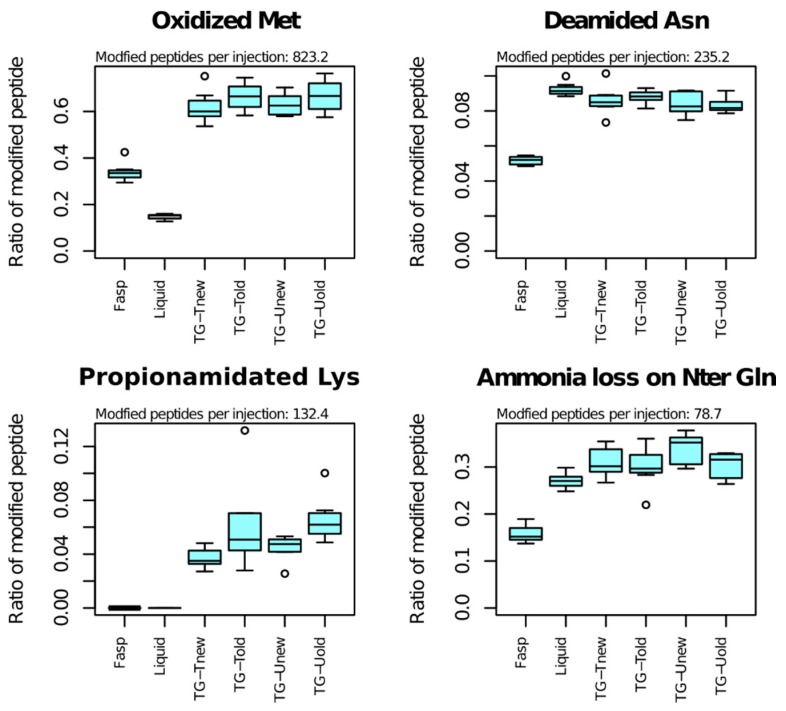
The so-called tube-gel method is a sample preparation protocol allowing for management of SDS for protein solubilization through in-gel protein trapping. Because of its simplicity, we assumed that once miniaturized, this method could become a standard for large scale experiments. We evaluated the performances of two variants of the miniaturized version of the tube-gel method based on different solubilization buffers (Tris-SDS or urea-SDS). To this end, we compared them to two other digestion methods: (i) liquid digestion after protein solubilization in the absence of SDS (liquid method) and (ii) filter-aided sample preparation (FASP). As large-scale experiments may require long term gel storage, we also examined to which extent gel aging affected the results of the proteomics analysis. We showed that both tube-gel and FASP methods extracted membrane proteins better than the liquid method, while the latter allowed the identification and quantification of a greater number of proteins. All methods were equivalent regarding quantitative stability. However, important differences were observed regarding post-translational modifications. In particular, methionine oxidation was higher with the tube-gel method than with the other methods. Based on these results, and considering time, simplicity, and cost aspects, we conclude that the miniaturized tube-gel method is suitable for sample preparation in the context of large-scale experiments.
Keywords: FASP; plant proteomics; protein digestion; protein extraction; shotgun proteomics; tube-gel.
Conflict of interest statement
The authors declare no conflict of interest.
Figures

References
-
- Bertrand E.M., Allen A.E., Dupont C.L., Norden-Krichmar T.M., Bai J., Valas R.E., Saito M.A. Influence of cobalamin scarcity on diatom molecular physiology and identification of a cobalamin acquisition protein. Proc. Natl. Acad. Sci. USA. 2012;109:E1762–E1771. doi: 10.1073/pnas.1201731109. - DOI - PMC - PubMed
-
- Lee Y.C., Srajer Gajdosik M., Josic D., Clifton J.G., Logothetis C., Yu-Lee L.Y., Gallick G.E., Maity S.N., Lin S.H. Secretome analysis of an osteogenic prostate tumor identifies complex signaling networks mediating cross-talk of cancer and stromal cells within the tumor microenvironment. Mol. Cell. Proteom. 2015;14:471–483. doi: 10.1074/mcp.M114.039909. - DOI - PMC - PubMed
LinkOut - more resources
Full Text Sources
Other Literature Sources
