. 2018 Apr;12(4):1084-1093.
doi: 10.1038/s41396-017-0025-5. Epub 2018 Jan 31.

The consequences of niche and physiological differentiation of archaeal and bacterial ammonia oxidisers for nitrous oxide emissions

Affiliations

The consequences of niche and physiological differentiation of archaeal and bacterial ammonia oxidisers for nitrous oxide emissions

Linda Hink et al. ISME J. 2018 Apr.

Abstract

High and low rates of ammonium supply are believed to favour ammonia-oxidising bacteria (AOB) and archaea (AOA), respectively. Although their contrasting affinities for ammonium are suggested to account for these differences, the influence of ammonia concentration on AOA and AOB has not been tested under environmental conditions. In addition, while both AOB and AOA contribute to nitrous oxide (N2O) emissions from soil, N2O yields (N2O-N produced per NO2--N generated from ammonia oxidation) of AOA are lower, suggesting lower emissions when AOA dominate ammonia oxidation. This study tested the hypothesis that ammonium supplied continuously at low rates is preferentially oxidised by AOA, with lower N2O yield than expected for AOB-dominated processes. Soil microcosms were supplied with water, urea or a slow release, urea-based fertiliser and 1-octyne (inhibiting only AOB) was applied to distinguish AOA and AOB activity and associated N2O production. Low ammonium supply, from mineralisation of organic matter, or of the fertiliser, led to growth, ammonia oxidation and N2O production by AOA only, with low N2O yield. High ammonium supply, from free urea within the fertiliser or after urea addition, led to growth of both groups, but AOB-dominated ammonia oxidation was associated with twofold greater N2O yield than that dominated by AOA. This study therefore demonstrates growth of both AOA and AOB at high ammonium concentration, confirms AOA dominance during low ammonium supply and suggests that slow release or organic fertilisers potentially mitigate N2O emissions through differences in niche specialisation and N2O production mechanisms in AOA and AOB.


Conflict of interest statement

The authors declare that they have no conflict of interest.

Figures
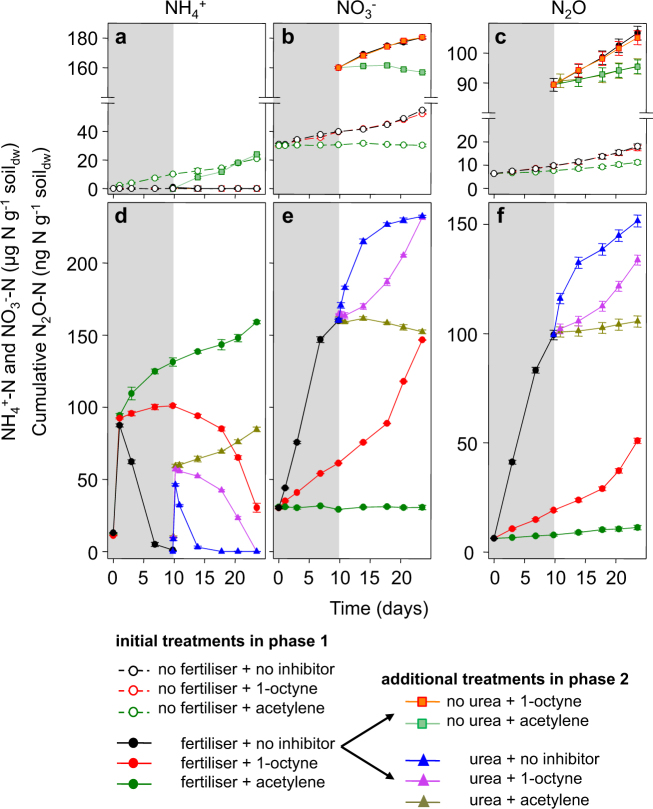
Fig. 1
Fig. 1. Changes in NH4+, NO3 and N2O during incubation of soil microcosms for 24 days.
Microcosms were incubated after amendment with a slow-release, urea-based fertiliser that contained 15% free urea, or with water only (no fertiliser), in combination with 1-octyne, acetylene or no inhibitor. ac present data in which NH4+ was supplied at a low continuous rate, through slow mineralisation of native organic nitrogen (phases 1 and 2) or of polymethylene urea (phase 2). df present data in which NH4+ was supplied at a single high concentration, through rapid mineralisation of free urea within the slow-release fertiliser (phase 1) or through addition of urea (phase 2). Phase 1 (days 0–10) is indicated by a grey background and phase 2 (days 10–24) by a white background. Inhibitor treatments were applied to fertiliser-amended microcosms by additional amendment with urea or water. NH4+ and NO3 concentrations were determined in destructively sampled microcosms and cumulative N2O production was determined following repeated sampling of headspace gas. Data represent mean values and standard errors of three replicate microcosms
Fig. 2
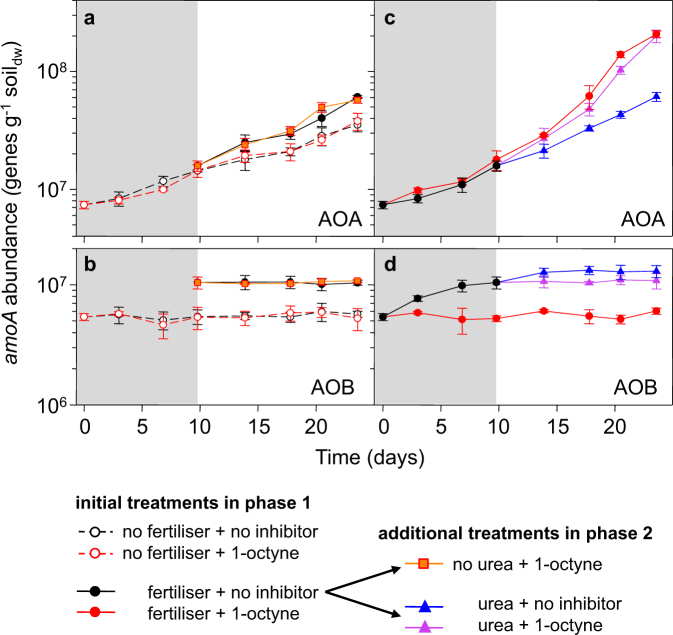
Fig. 2. Changes in abundance of archaeal and bacterial amoA genes during incubation of soil microcosms for 24 days.
Quantification was performed on extracted DNA from destructively sampled soil microcosms that were amended with fertiliser or water only (no fertiliser) in combination with 1-octyne or no inhibitor. a, b present data in which NH4+ was supplied at a low continuous rate, through slow mineralisation of native organic nitrogen (phases 1 and 2) or of polymethylene urea (phase 2). c, d present data in which NH4+ was supplied at a single high concentration, through rapid mineralisation of free urea within the slow-release fertiliser (phase 1) or through addition of urea (phase 2). Representation of phases 1 and 2 and treatments are as described in the legend for Fig. 1. Mean concentrations and standard errors of triplicate microcosms are plotted. Differences in temporal changes were assessed by comparing confidence intervals of regression analysis (see Figs. S2 and S3)
Fig. 3
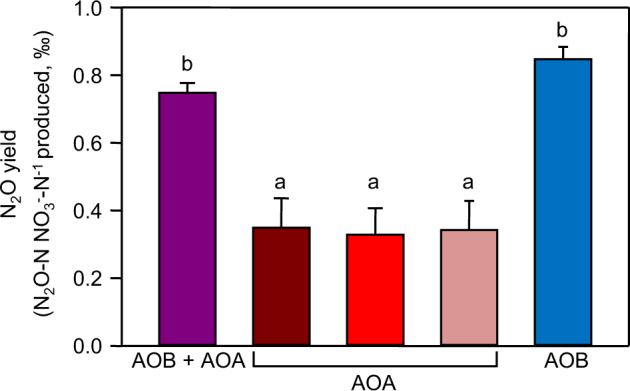
Fig. 3. The yield of N2O associated with ammonia oxidation by AOA and AOB.
N2O yield associated with activity of both AOA and AOB at high NH4+ concentration in fertilised microcosms during phase 1 (purple bar); AOA only oxidising NH3 derived from mineralisation of native organic nitrogen (dark red bar), from mineralisation of native organic nitrogen and from slowly released urea during phase 2 (medium red bar) or from mineralisation of free fertiliser-urea with inhibition of AOB by 1-octyne during phases 1 and 2 (light red bar); AOB only, calculated based on the known yield of AOA and both AOA and AOB, in addition to the observation that under conditions where both were contributing to NH3 oxidation, ~80% was performed by AOB (blue bar). Mean yields and standard errors are plotted. Significant differences are indicated by different lower case letters

References

    1. Stocker TF, Qin D, Plattner GK, Tignor M, Allen SK, Boschung J, et al. IPCC 2013: climate change 2013: the physical science basis. Contribution of working group I to the fifth assessment report of the intergovernmental panel on climate change. Cambridge and New York: Cambridge University Press; 2013.
    1. Ravishankara AR, Daniel JS, Portmann RW. Nitrous oxide (N2O): the dominant ozone-depleting substance emitted in the 21st century. Science. 2009;326:123–125. doi: 10.1126/science.1176985. - DOI - PubMed
    1. Tilman D, Fargione J, Wolff B, D’Antonio C, Dobson A, Howarth R, et al. Forecasting agriculturally driven global environmental change. Science. 2001;292:281–284. doi: 10.1126/science.1057544. - DOI - PubMed
    1. Glass ADM. Nitrogen use efficiency of crop plants: physiological constraints upon nitrogen absorption. Crit Rev Plant Sci. 2003;22:453–470. doi: 10.1080/07352680390243512. - DOI
    1. Zumft WG. Cell biology and molecular basis of denitrification. Microbiol Mol Biol R. 1997;61:533–616. - PMC - PubMed

Publication types