Comparative evaluation of three different rotary instrumentation systems for removal of gutta-percha from root canal during endodontic retreatment: An in vitro study
- PMID: 29386777
- PMCID: PMC5767824
- DOI: 10.4103/JCD.JCD_132_17
Comparative evaluation of three different rotary instrumentation systems for removal of gutta-percha from root canal during endodontic retreatment: An in vitro study
Abstract
Context: Endodontic retreatment is performed in teeth with endodontic failures. The main goal of retreatment is cleaning and shaping of the root canal with removal of old root filling material. Hand instruments and rotary instruments are mainly used for removing this filling material.
Aim of study: To compare the relative efficacy of three rotary instrumentation systems for removal of gutta-percha from root canal during endodontic retreatment.
Objective of study: To find out which NiTi system is more efficacious in retreatment and to check out the efficacy of retreatment with and without use of solvent.
Materials and methods: Sixty freshly extracted, single-rooted human mandibular premolars were instrumented with K-files, and each root canal was filled with gutta-percha and AH Plus (Dentsply Detrey, Konstanz, Germany) sealer using lateral compaction. Specimens were then divided into three experimental groups with twenty specimens each. Groups were then subdivided into ten specimens each. Groups were then retreated either with or without solvent. The removal of gutta-percha was performed using ProTaper retreatment files, Mtwo retreatment files, and R-Endo files after 2 weeks. The amount of root canal filling material remnant in the coronal, middle, and apical thirds was measured using stereomicroscope and computer image analysis program.
Statistical analysis used: Data were evaluated statistically using analysis of variance.
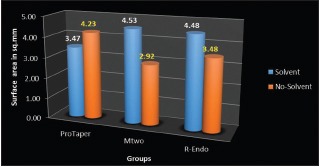
Results: ProTaper group was found to have less remnant filling material as compared to the other groups in coronal and middle thirds, but a significant difference was observed between ProTaper and Mtwo and Mtwo and R-Endo in the nonsolvent groups (P < 0.05). Mtwo group demonstrated less amount of remaining filling material in the nonsolvent group.
Conclusions: Both nickel-titanium systems and ProTaper and Mtwo retreatment file systems, were found to be effective in the removal of root canal filling material. However, complete removal of gutta-percha from root canals did not occur with any of the experimental groups.
Keywords: Endodontic retreatment; gutta-percha; obturation; rotary instrumentation.
Conflict of interest statement
There are no conflicts of interest.
Figures



References
-
- Torabinejad M. Principles and Practice of Endodontics. 3rd ed. Philadelphia, PA: Saunders; 2002. Orthograde retreatment.
-
- Stabholz A, Friedman S. Endodontic retreatment – Case selection and technique. Part 2: Treatment planning for retreatment. J Endod. 1988;14:607–14. - PubMed
-
- Schirrmeister JF, Wrbas KT, Meyer KM, Altenburger MJ, Hellwig E. Efficacy of different rotary instruments for gutta-percha removal in root canal retreatment. J Endod. 2006;32:469–72. - PubMed
-
- Betti LV, Bramante CM. Quantec SC rotary instruments versus hand files for gutta-percha removal in root canal retreatment. Int Endod J. 2001;34:514–9. - PubMed
LinkOut - more resources
Full Text Sources
Other Literature Sources
Research Materials