


Management of primary Sjögren's syndrome: recent developments and new classification criteria
- PMID: 29387177
- PMCID: PMC5784475
- DOI: 10.1177/1759720X17746319
Management of primary Sjögren's syndrome: recent developments and new classification criteria
Abstract
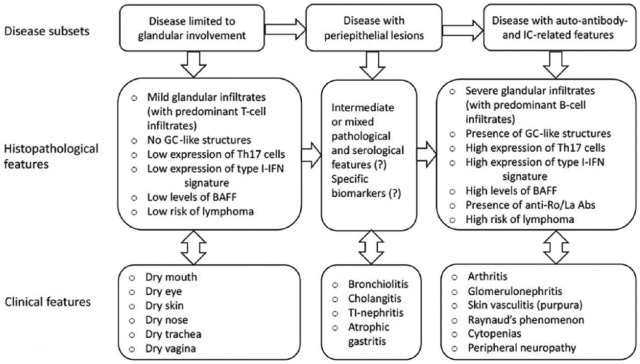
For many years primary Sjögren's syndrome (pSS) has been considered an orphan disease, since no specific therapies were recognized as being capable of contrasting the development and progression of this disorder. The treatment of oral and ocular features, as well as of the systemic organ involvement, has been entrusted to the joint management of different subspecialty physicians, like ophthalmologists, otolaryngologists, dentists and rheumatologists. These latter subspecialty doctors are usually more involved in the treatment of systemic extraglandular involvement and, to do it, they have long been using the conventional therapies borrowed by the treatment schedules adopted in other systemic autoimmune diseases. The increasing knowledge of the biological pathways that are operative in patients with pSS, and the parallel development of molecular biology technology, have allowed the production and availability of a number of biological agents able to positively act on different disease mechanisms, and thus are candidates for testing in therapeutic trials. Meanwhile, the scientific community has made a great effort to develop new accurate and validated classification criteria and outcome measures to be applied in the selection of patients to be included and monitored in therapeutic studies. Some of the new-generation biotechnological agents have been tested in a number of open-label and randomized controlled trials that have produced in many cases inconclusive or contradictory results. Behind the differences in trial protocols, adopted outcome measures and predefined endpoints, reasons for such unsatisfactory results can be found in the large heterogeneity of clinical subtypes in the examined cohorts. The future challenge for a substantial advancement in the therapeutic approach to pSS could be to identify the pathologic mechanisms, outcome tools and biomarkers that characterize the different subsets of the disease in order to test carefully selected target therapies with the highest probability of success in each different clinical phenotype.
Keywords: Sjögren’s syndrome; biological therapies; classification criteria; clinical subsetting; outcome measures; pathogenetic mechanisms.
Conflict of interest statement
Conflict of interest statement: The authors declare that there is no conflict of interest.
Figures
References
-
- Goules AV, Tzioufas AG. Primary Sjögren’s syndrome: clinical phenotypes, outcome and the development of biomarkers. Autoimmun Rev 2016; 15: 695–703. - PubMed
-
- Karageorgas T, Fragioudakis S, Nezos A, et al. Fatigue in primary Sjögren’s syndrome: clinical, laboratory, psychometric, and biologic associations. Arthritis Care Res 2016; 68: 123–131. - PubMed
Publication types
LinkOut - more resources
Full Text Sources
Other Literature Sources
