


Yoga for the Management of Cancer Treatment-Related Toxicities
- PMID: 29388071
- PMCID: PMC5901971
- DOI: 10.1007/s11912-018-0657-2
Yoga for the Management of Cancer Treatment-Related Toxicities
Abstract
Purpose of review: To (1) explain what yoga is, (2) summarize published literature on the efficacy of yoga for managing cancer treatment-related toxicities, (3) provide clinical recommendations on the use of yoga for oncology professionals, and (4) suggest promising areas for future research.
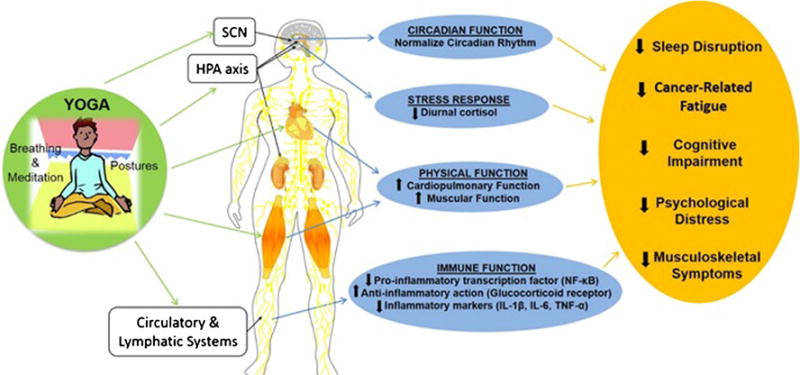
Recent findings: Based on a total of 24 phase II and one phase III clinical trials, low-intensity forms of yoga, specifically gentle hatha and restorative, are feasible, safe, and effective for treating sleep disruption, cancer-related fatigue, cognitive impairment, psychosocial distress, and musculoskeletal symptoms in cancer patients receiving chemotherapy and radiation and cancer survivors. Clinicians should consider prescribing yoga for their patients suffering with these toxicities by referring them to qualified yoga professionals. More definitive phase III clinical trials are needed to confirm these findings and to investigate other types, doses, and delivery modes of yoga for treating cancer-related toxicities in patients and survivors.
Keywords: Cancer-related fatigue; Cognitive impairment; Musculoskeletal symptoms; Psychological distress; Sleep disorder; Yoga.
Conflict of interest statement
Luke J. Peppone declares that he has no conflict of interest.
Michelle C. Janelsins declares that she has no conflict of interest.
Supriya G. Mohile has served as a consultant for Seattle Genetics.
Charles Kamen declares that he has no conflict of interest.
Ian R. Kleckner is supported by a grant from the National Cancer Institute.
Chunkit Fung declares that he has no conflict of interest.
Matthew Asare declares that he has no conflict of interest.
Calvin L. Cole declares that he has no conflict of interest.
Eva Culakova declares that she has no conflict of interest.
Karen M. Mustian declares that she has no conflict of interest.
Figures
References
-
- Howlader NNA, Krapcho M, Miller D, Bishop K, Kosary CL, Yu M, Ruhl J, Tatalovich Z, Mariotto A, Lewis DR, Chen HS, Feuer EJ, Cronin KA, editors. SEER Cancer Statistics Review, 1975-2014. National Cancer Institute; Bethesda, MD: https://seer.cancer.gov/csr/1975_2014/, based on November 2016 SEER data submission, posted to the SEER web site, April 2017.
-
- Miller KD, Siegel RL, Lin CC, Mariotto AB, Kramer JL, Rowland JH, et al. Cancer treatment and survivorship statistics, 2016. CA Cancer J Clin. 2016;66(4):271–89. https://doi.org/10.3322/caac.21349. - DOI - PubMed
-
- Minton O, Stone P. How common is fatigue in disease-free breast cancer survivors? A systematic review of the literature. Breast Cancer Res Treat. 2008;112(1):5–13. https://doi.org/10.1007/s10549-007-9831-1. - DOI - PubMed
-
- Prue G, Rankin J, Allen J, Gracey J, Cramp F. Cancer-related fatigue: a critical appraisal. Eur J Cancer. 2006;42(7):846–63. https://doi.org/10.1016/j.ejca.2005.11.026. - DOI - PubMed
Publication types
MeSH terms
Grants and funding
LinkOut - more resources
Full Text Sources
Other Literature Sources
Research Materials
