Review
. 2018 Feb/Mar;80(2):126-140.
doi: 10.1097/PSY.0000000000000544.

Psychological Stress and Mitochondria: A Conceptual Framework

Affiliations
Review

Psychological Stress and Mitochondria: A Conceptual Framework

Martin Picard et al. Psychosom Med. 2018 Feb/Mar.

Abstract

Background: The integration of biological, psychological, and social factors in medicine has benefited from increasingly precise stress response biomarkers. Mitochondria, a subcellular organelle with its own genome, produce the energy required for life and generate signals that enable stress adaptation. An emerging concept proposes that mitochondria sense, integrate, and transduce psychosocial and behavioral factors into cellular and molecular modifications. Mitochondrial signaling might in turn contribute to the biological embedding of psychological states.

Methods: A narrative literature review was conducted to evaluate evidence supporting this model implicating mitochondria in the stress response, and its implementation in behavioral and psychosomatic medicine.

Results: Chronically, psychological stress induces metabolic and neuroendocrine mediators that cause structural and functional recalibrations of mitochondria, which constitutes mitochondrial allostatic load. Clinically, primary mitochondrial defects affect the brain, the endocrine system, and the immune systems that play a role in psychosomatic processes, suggesting a shared underlying mechanistic basis. Mitochondrial function and dysfunction also contribute to systemic physiological regulation through the release of mitokines and other metabolites. At the cellular level, mitochondrial signaling influences gene expression and epigenetic modifications, and modulates the rate of cellular aging.

Conclusions: This evidence suggests that mitochondrial allostatic load represents a potential subcellular mechanism for transducing psychosocial experiences and the resulting emotional responses-both adverse and positive-into clinically meaningful biological and physiological changes. The associated article in this issue of Psychosomatic Medicine presents a systematic review of the effects of psychological stress on mitochondria. Integrating mitochondria into biobehavioral and psychosomatic research opens new possibilities to investigate how psychosocial factors influence human health and well-being across the life-span.


Conflict of interest statement

The authors have no conflict of interest to report.

Figures
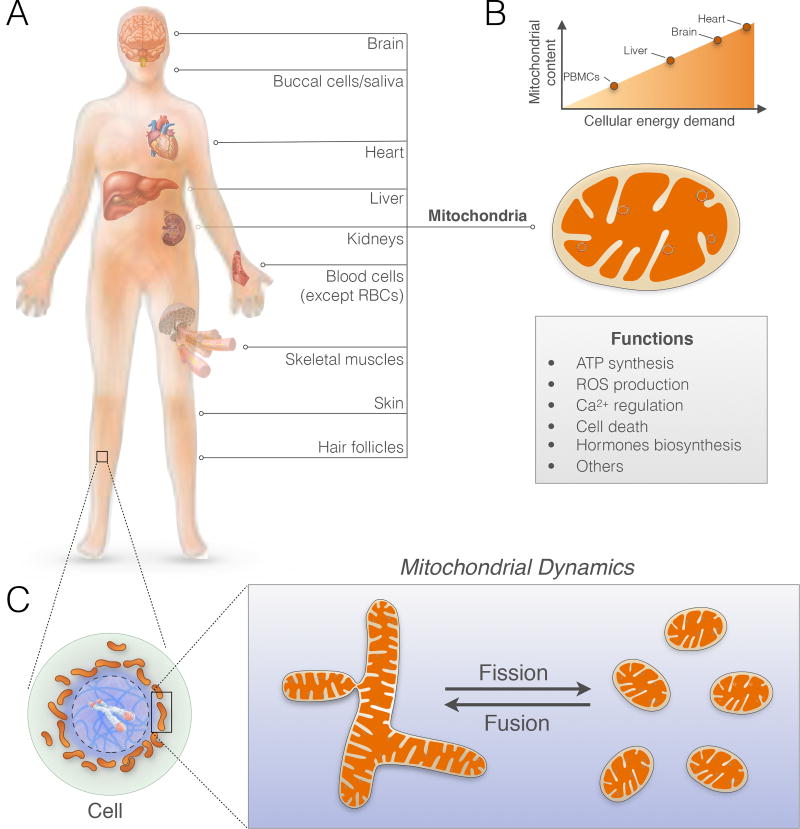
Figure 1
Figure 1. Mitochondrial content and function in humans
(A) Hundreds of mitochondria are present within various cells and organs across the body. (B) Mitochondrial content varies according to energy demand in different organs, where they perform multiple functions ranging from energy transformation, signaling, and hormone biosynthesis. (C) General schematic of a cell, its cytoplasm (green), nucleus (blue), and mitochondria (brown). Mitochondria are dynamic and undergo changes in shape through fusion and fission within minutes in response to external biochemical and energetic signals.
Figure 2
Figure 2
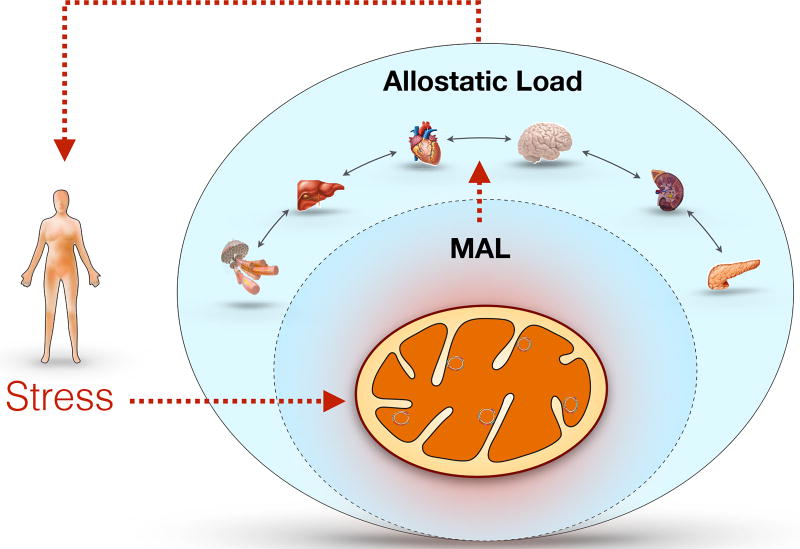
Model of mitochondrial allostatic load (MAL) as a source of systemic allostatic load. Mitochondrial allostasis is the active process of responding to challenges including the demand for ATP and other biomolecules to maintain cell function and survival, as well as providing signaling molecules (e.g., limited amount of ROS). MAL is defined as the dysregulation mitochondrial functions resulting from the structural and functional changes that mitochondria undergo in response to stressors. Challenges that overwhelm the capacity to respond and produce an imbalance contribute, over time, to impaired cell function, senescence, and even cell death. Clinical cases of inherited mitochondrial disorders demonstrate the direct influence of mitochondrial dysfunction on multiple organ systems. Because mitochondria are intrinsic partners and participants in systemic allostasis, MAL is a nested construct that contributes to systemic allostatic load and overload.
Figure 3
Figure 3. Mitochondrial stress transduction
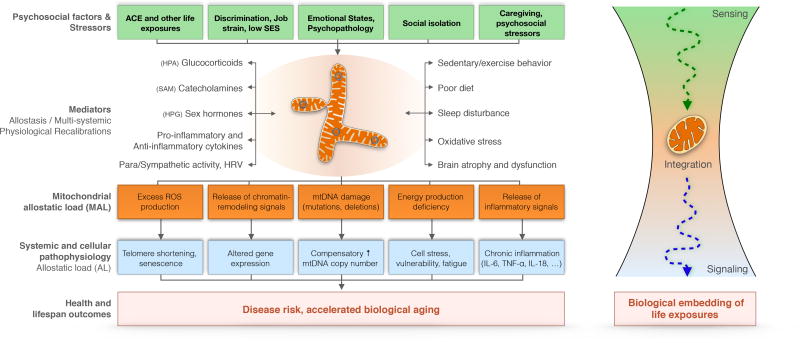
(Left) Conceptual model of mitochondrial stress pathophysiology outlining the effects of psychosocial factors on health and disease risk via mitochondria. Mitochondria interact bi-directionally with stress mediators of allostasis, contributing to physiological stress responses and multi-systemic recalibrations. Chronic activation of these systems leads to mitochondrial allostatic load (MAL), which is transduced through molecular signals into systemic pathophysiology, allostatic load (AL), and molecular changes within cells. Relationships between psychosocial factors (green boxes) and pathophysiological measures (blue boxes) can be modeled statistically as a direct effect with mitochondria as mediator/moderator. (Right) Schematic representation of mitochondrial sensing, integration, and signaling of life exposures, including psychosocial stressors and emotional (negative and positive) states. Three main testable corollary hypotheses arise from this model: 1) Exposure to psychosocial factors and stressors induce MAL; 2) MAL and primary mitochondrial defects cause systemic dysregulation and adverse health outcomes; 3) The end effect and biological embedding of the same exposure will differ based on the mitochondrial health of the system/individual. Bi-directional relationships exist between some biobehavioral and psychosocial factors, but are not depicted here for parsimony.
Figure 4
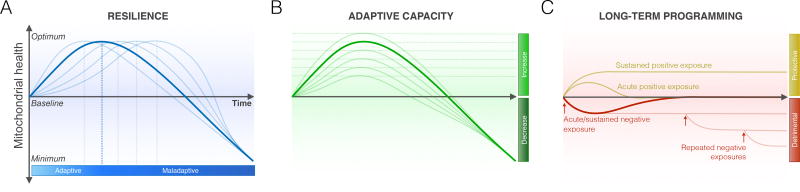
Figure 4. Possible inverted U-shaped mitochondrial responses to chronic stress
(A) Bi-phasic mitochondrial stress responses as a form of mitohormesis (186), as induced by glucocorticoids (e.g., (14)). The transition from adaptive to maladaptive is marked by the inversion of the curve at the top. Each line depicts a cellular or physiological system with a different degree of resilience, as indicated by the duration for which it can sustain an adaptive response to the stressor before undergoing a decline in mitochondrial health below baseline. (B) The adaptive capacity of mitochondria can vary, as indicated by the degree to which they can generate an adaptive increase in function during stress, depicted hereby the height of curves. (C) Certain stressors, particularly during sensitive developmental windows, can also have long-term programming effects that establish lasting set points (detrimental or protective) for mitochondrial health. For example, anti-retroviral pharmacotherapy for HIV-AIDS may lead to the permanent accumulation of mtDNA defects that undermine respiratory chain function and decrease baseline function (187). Subsequent exposures (arrows) may have additive effects and further decrease function (below baseline), as a form of detrimental embedding. On the other hand, positive behavioral exposures such as exercise training can increase basal mitochondrial function (above baseline), as a form or protective embedding.

References

    1. Engel GL. The need for a new medical model: a challenge for biomedicine. Science. 1977;196:129–36. - PubMed
    1. Kiecolt-Glaser JK, McGuire L, Robles TF, Glaser R. Psychoneuroimmunology and psychosomatic medicine: back to the future. Psychosom Med. 2002;64:15–28. - PubMed
    1. McEwen BS, Stellar E. Stress and the individual. Mechanisms leading to disease. Arch Intern Med. 1993;153:2093–101. - PubMed
    1. Introductory Statement. Psychosom Med. 1939;1:3–5.
    1. Picard M. Pathways to aging: the mitochondrion at the intersection of biological and psychosocial sciences. J Aging Res. 2011;2011:814096. - PMC - PubMed

Publication types