Psychological Stress and Mitochondria: A Systematic Review
- PMID: 29389736
- PMCID: PMC5901654
- DOI: 10.1097/PSY.0000000000000545
Psychological Stress and Mitochondria: A Systematic Review
Abstract
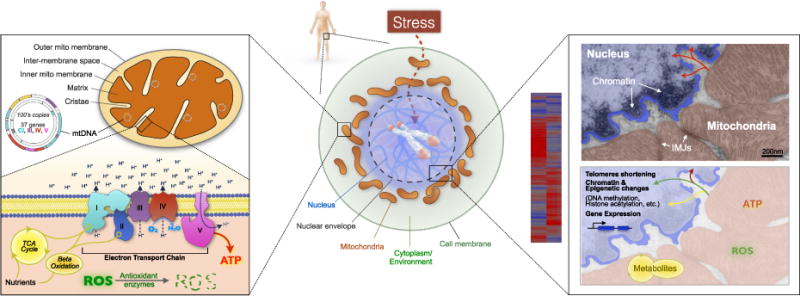
Objective: Mitochondria are multifunctional life-sustaining organelles that represent a potential intersection point between psychosocial experiences and biological stress responses. This article provides a systematic review of the effects of psychological stress on mitochondrial structure and function.
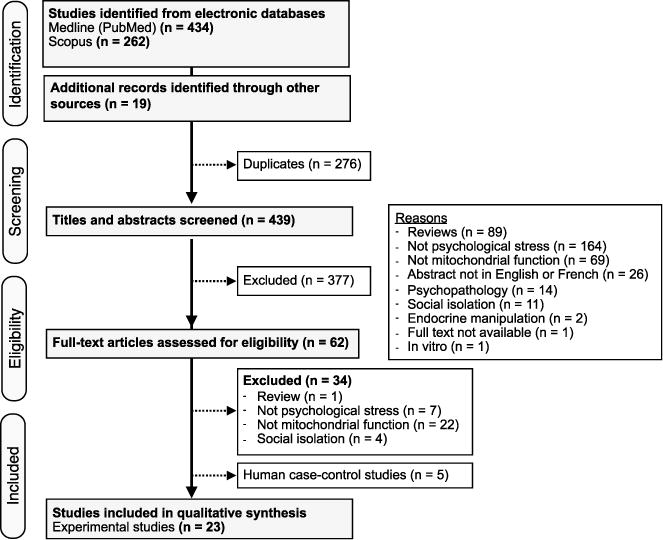
Methods: A systematic review of the literature investigating the effects of psychological stress on mitochondrial function was conducted. The review focused on experimentally controlled studies allowing us to draw causal inference about the effect of induced psychological stress on mitochondria.
Results: A total of 23 studies met the inclusion criteria. All studies involved male laboratory animals, and most demonstrated that acute and chronic stressors influenced specific facets of mitochondrial function, particularly within the brain. Nineteen studies showed significant adverse effects of psychological stress on mitochondria and four found increases in function or size after stress. In humans, only six observational studies were available, none with experimental designs, and most only measured biological markers that do not directly reflect mitochondrial function, such as mitochondrial DNA copy number.
Conclusons: Overall, evidence supports the notion that acute and chronic stressors influence various aspects of mitochondrial biology, and that chronic stress exposure can lead to molecular and functional recalibrations among mitochondria. Limitations of current animal and human studies are discussed. Maladaptive mitochondrial changes that characterize this subcellular state of stress are termed mitochondrial allostatic load. Prospective studies with sensitive measures of specific mitochondrial outcomes will be needed to establish the link between psychosocial stressors, emotional states, the resulting neuroendocrine and immune processes, and mitochondrial energetics relevant to mind-body research in humans.
Conflict of interest statement
The authors have no conflict of interest to report.
Figures
References
-
- Morava E, Kozicz T. Mitochondria and the economy of stress (mal)adaptation. Neurosci Biobehav Rev. 2013;37:668–80. - PubMed
-
- Manoli I, Alesci S, Blackman MR, Su YA, Rennert OM, Chrousos GP. Mitochondria as key components of the stress response. Trends Endocrinol Metab. 2007;18:190–8. - PubMed
-
- Picard M, Juster RP, McEwen BS. Mitochondrial allostatic load puts the ‘gluc’ back in glucocorticoids. Nat Rev Endocrinol. 2014;10:303–10. - PubMed
-
- Gorman GS, Chinnery PF, DiMauro S, Hirano M, Koga Y, McFarland R, Suomalainen A, Thorburn DR, Zeviani M, Turnbull DM. Mitochondrial diseases. Nat Rev Dis Primers. 2016;2:16080. - PubMed
Publication types
MeSH terms
Grants and funding
LinkOut - more resources
Full Text Sources
Other Literature Sources
Medical
Miscellaneous