


Antimicrobial susceptibility pattern, and associated factors of Salmonella and Shigella infections among under five children in Arba Minch, South Ethiopia
- PMID: 29391040
- PMCID: PMC5793425
- DOI: 10.1186/s12941-018-0253-1
Antimicrobial susceptibility pattern, and associated factors of Salmonella and Shigella infections among under five children in Arba Minch, South Ethiopia
Abstract
Background: Diarrheal diseases continue to be the major cause of morbidity and mortality among children under 5 years. Salmonella and Shigella specious are the major enteric pathogen causing diarrhea among children worldwide. Examination of stool sample is the most sensitive method to diagnose diarrheal disease in children. This study aimed to determining the prevalence, antimicrobial susceptibility pattern and associated factor of Salmonella and Shigella infection among under five children.
Methods: A cross sectional study was conducted on under 5 years children attending Arba Minch town. Pre-tested and structured questionnaire was used for collecting data about socio-demographic characteristics and associated factors. Stool sample was used to isolate and identified the pathogen. Antimicrobial susceptibility test was performed for isolated Salmonella and Shigella specious. A logistic regression analysis was used to see the association between different variables and outcome variable. Odds ratio with 95% CI was computed to determine the presence and strength of the association.
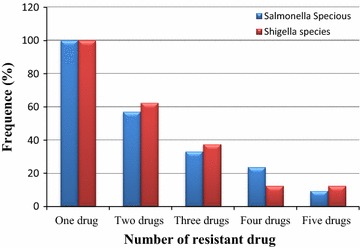
Results: A total of 167 under five children were included in the study. About 57% of participants were males with the mean age of 32 months. The overall prevalence of Salmonella and Shigella species infection was 17.45% with 12.6% Salmonella species. The isolates were resistant to common antibiotics such as Amoxicillin, Erythromycin, Chloramphenicol, Clindamycin, Norfloxacin, Ciprofloxacin, Cotrimoxazole, and Gentamycin. Urban resident [AOR = 7.11; 95% CI (2.3, 22.2)], month income < 1000 Ethiopian birr [AOR = 6.5; 95% CI (2.0, 21.4)], absence of waste disposal system [AOR = 3.3; 95% CI (1.2, 9.3)], poor hand washing habit [AOR = 6.0; 95% CI (2.0, 18.2)], untrimmed finger nail [AOR = 3.7; 95% CI (1.4, 10.6)], and use of napkin [AOR = 3.2; 95% CI (1.1, 9.3)] had significant association with Salmonella and Shigella infection.
Conclusion: Salmonella and Shigella species infections were higher as compared the national prevalence. This study also revealed that the enteric infection were significantly associated with finger nail status, residence, hand washing practice, month income of parents, usage of napkin after toilet, and absence of waste disposal system. Therefore, working on identified associated factors and regular drug susceptibility test is mandatory to reduce the problem.
Keywords: Antimicrobial activity; Diarrhea; Salmonella; Shigella; Under five children.
Figures
References
-
- World Health Organization. Diarrheal disease. 2015. http://www.who.int/mediacentre/factsheets/fs330/en/. Accessed 16 Aug 2017.
-
- UNICEF/WHO, diarrhea. Why children are still dying and what can be done. 2009. http://apps.who.int/iris/bitstream/10665/44174/1/9789241598415_eng.pdf. Accessed 16 Aug 2017.
-
- Guarino A, Albano F, Ashkenazi S, Gendrel D, Hoekstra JH, Shamir R, et al. European Society for Paediatric Gastroenterology, Hepatology, and Nutrition/European Society for Paediatric Infectious Diseases evidence-based guidelines for the management of acute gastroenteritis in children in Europe: executive summary. J Pediatr Gastroenterol Nutr. 2008;46(5):619–621. - PubMed
MeSH terms
Substances
LinkOut - more resources
Full Text Sources
Other Literature Sources
Medical
