


Natural vertical transmission of dengue virus in Aedes aegypti and Aedes albopictus: a systematic review
- PMID: 29391071
- PMCID: PMC5793400
- DOI: 10.1186/s13071-018-2643-9
Natural vertical transmission of dengue virus in Aedes aegypti and Aedes albopictus: a systematic review
Abstract
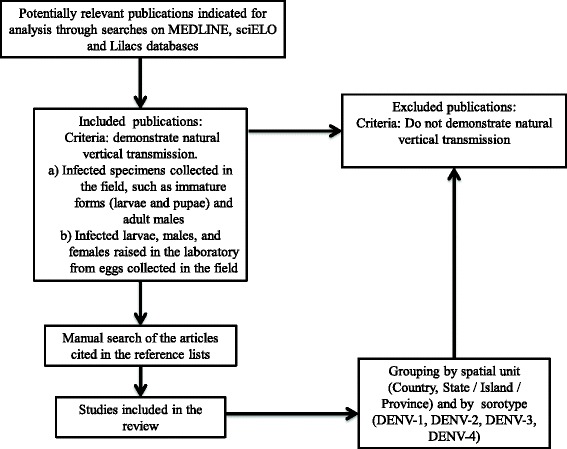
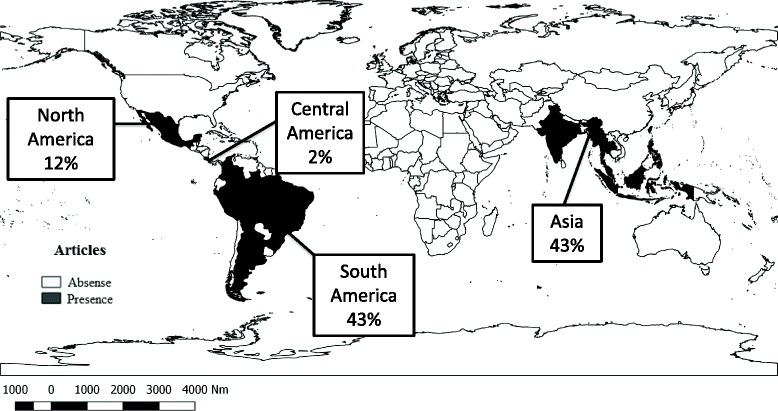
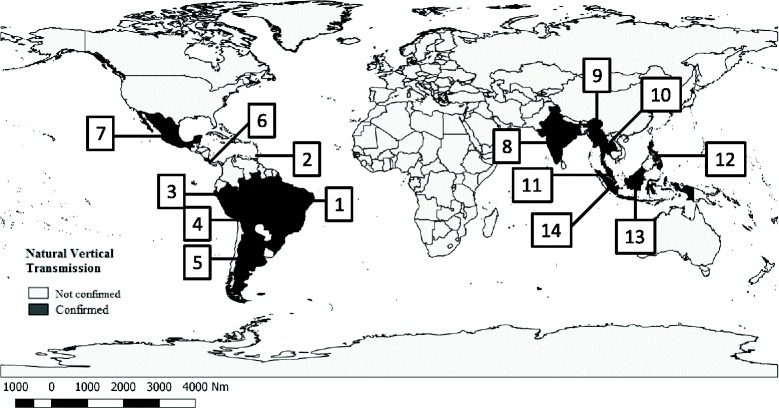
Dengue is of great concern in various parts of the world, especially in tropical and subtropical countries where the mosquito vectors Aedes aegypti and Aedes albopictus are present. The transmission of this virus to humans, by what is known as horizontal transmission, occurs through the bite of infected females of one or other of the two mosquito species. Furthermore, an infected female or male parent, by what is known as vertical transmission, can transfer this arbovirus to some part of their offspring. Considering that vertical transmission may represent an important strategy for maintaining the circulation of arboviruses in nature, the verification of this phenomenon worldwide is extremely important and necessary to better understand its dynamic. In the present study, we conducted a literature review of the presence of natural vertical transmission of dengue virus in Ae. aegypti and Ae. albopictus worldwide. Searches were conducted in MEDLINE, sciELO and Lilacs and all the studies published in Portuguese, English and Spanish were read, evaluated and organized by mosquito species, serotype and the location at which the samples were collected. Forty-two studies were included in accordance with the exclusion criteria and methodology. The presence of natural vertical transmission in Ae. aegypti and Ae. albopictus was most clearly evidenced by dengue virus in endemic countries, especially in those in South America and Asia. Despite several African countries being considered endemic for dengue, there is a lack of publications on this subject on that continent, which highlights the importance of conducting studies there. Furthermore, the finding of natural vertical transmission in Ae. albopictus in countries where this species is not yet incriminated as a vector is of great concern as it demonstrates the circulation of this virus in populations of Ae. albopictus and alerts to the possibility of some other mosquito species playing a role in the transmission dynamics of this arbovirus. Parallel to this, the small number of studies of natural vertical transmission of chikungunya and Zika virus in the world may be explained by the recent entry of these arboviruses into most of the countries concerned.
Keywords: Aedes; Chikungunya; Dengue; Vectors; Vertical transmission; Zika.
Conflict of interest statement
Ethics approval and consent to participate
Not applicable.
Consent for publication
Not applicable.
Competing interests
The authors declare that they have no competing interests.
Publisher’s Note
Springer Nature remains neutral with regard to jurisdictional claims in published maps and institutional affiliations.
Figures
References
-
- Westaway EG, Blok J. Taxonomy and evolutionary relationships of flaviviruses. In: Gubler DJ, Kuno G, editors. Dengue and dengue hemorrhagic fever. Wallingford: CAB International; 1997. pp. 147–173.
Publication types
MeSH terms
Grants and funding
LinkOut - more resources
Full Text Sources
Other Literature Sources
Medical
