. 2018 Feb 1;8(1):2137.
doi: 10.1038/s41598-018-20496-w.

The risk of cognitive impairment associated with hearing function in older adults: a pooled analysis of data from eleven studies

Affiliations

The risk of cognitive impairment associated with hearing function in older adults: a pooled analysis of data from eleven studies

Jing Yuan et al. Sci Rep. .

Abstract

Impaired hearing and cognition are disabling conditions among older adults. Research has presented inconsistent conclusions regarding hearing impairment posing a risk for cognitive impairment. We aimed to assess this from published evidence via searching PubMed and Embase, from the inception of the databases indexed to December 2, 2016. For those high-quality studies retrieved, relative risk (RR) and 95% confidence intervals (CIs) were combined to estimate the risk of cognitive impairment. Eleven cohort studies were included in the present study. Pooled results found that elderly people with disabled peripheral and central hearing function had a higher risk of cognitive impairment (for moderate/severe peripheral hearing impairment: RR = 1.29, 95% CI: 1.04-1.59 during a follow-up ≤6 years. RR = 1.57, 95% CI: 1.13-2.20 during a follow-up >6 years; for severe central hearing impairment, RR = 3.21, 95% CI: 1.19-8.69) compared to those with normal hearing function. We also recorded a dose-response trend for cognitive impairment as hearing thresholds rose. No evident bias from potential confounding factors was found with one exception: the length for clinical follow-up. Although results are preliminary because qualifying studies were few, statistical findings were consistent with older people identified as having greater levels of hearing loss, having a corresponding higher risk of cognitive impairment.


Conflict of interest statement

The authors declare that they have no competing interests.

Figures
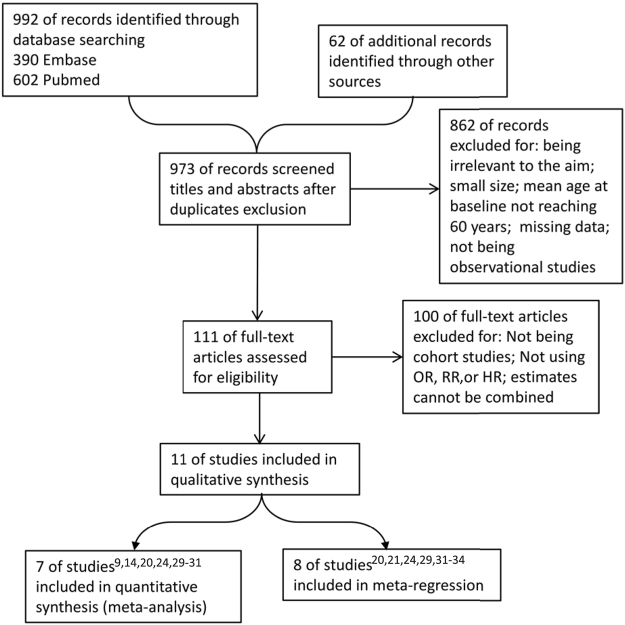
Figure 1
Figure 1
PRISMA flow chart of study selection. PRISMA = Preferred Reporting Items for Systematic Reviews and Meta-analyses. OR = odds ratio, RR = relative risk, HR = hazard ratio.
Figure 2
Figure 2
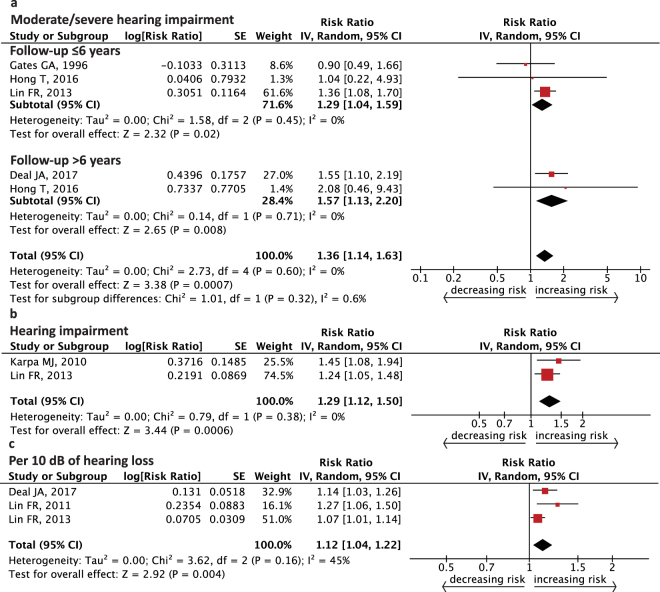
Forest plot showing the risk of incident cognitive impairment from peripheral auditory function. (a) Pooled relative risk from moderate/severe hearing impairment (PTA >40 dB HL). (b) Pooled relative risk from hearing impairment (PTA >25 dB HL). (c) Pooled relative risk per 10 dB of hearing loss. CI = confidence interval, dB HL = decibels hearing level, IV = inverse variance, PTA = pure-tone average, SE = standard error.
Figure 3
Figure 3
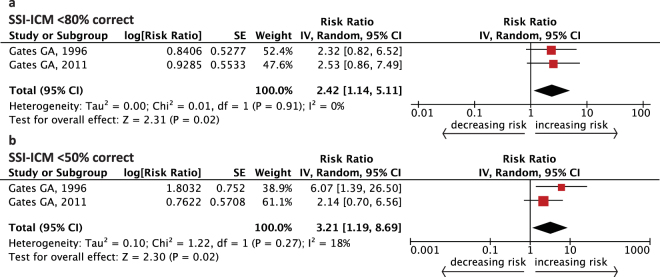
Forest plot showing the risk of incident cognitive impairment from one central auditory processing test. Combined relative risk from (a) moderate impaired central auditory processing (SSI-ICM <80% correct) and (b) severe impaired central auditory processing (SSI-ICM <50% correct). CI = confidence interval, IV = inverse variance, SE = standard error, SSI-ICM = Synthetic Sentence Identification with Ipsilateral Competing Message.
Figure 4
Figure 4
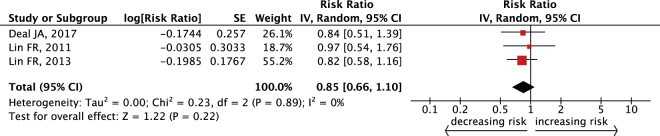
Forest plot showing the effect of hearing aid use on incident cognitive impairment. CI = confidence interval, IV = inverse variance, SE = standard error.

References

    1. Gates GA, Mills JH. Presbycusis. Lancet. 2005;366:1111–1120. doi: 10.1016/S0140-6736(05)67423-5. - DOI - PubMed
    1. Panza F, Solfrizzi V, Logroscino G. Age-related hearing impairment-a risk factor and frailty marker for dementia and AD. Nat Rev Neurol. 2015;11:166–175. doi: 10.1038/nrneurol.2015.12. - DOI - PubMed
    1. Swenor BK, Ramulu PY, Willis JR, Friedman D, Lin FR. The prevalence of concurrent hearing and vision impairment in the United States. JAMA Intern Med. 2013;173:312–313. doi: 10.1001/jamainternmed.2013.1880. - DOI - PMC - PubMed
    1. Lin FR, Thorpe R, Gordon-Salant S, Ferrucci L. Hearing loss prevalence and risk factors among older adults in the United States. J Gerontol A Biol Sci Med Sci. 2011;66:582–590. doi: 10.1093/gerona/glr002. - DOI - PMC - PubMed
    1. Chen H, et al. The contributions of diseases to disability burden among the elderly population in China. J Aging Health. 2014;26:261–282. doi: 10.1177/0898264313514442. - DOI - PMC - PubMed

Publication types