


Dry eye syndrome: developments and lifitegrast in perspective
- PMID: 29391773
- PMCID: PMC5774475
- DOI: 10.2147/OPTH.S126668
Dry eye syndrome: developments and lifitegrast in perspective
Abstract
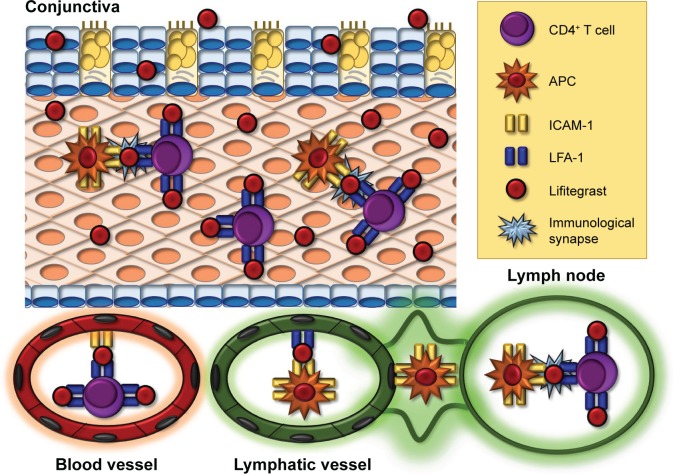
Dry eye (DE) is a chronic ocular condition with high prevalence and morbidity. It has a complex pathophysiology and is multifactorial in nature. Chronic ocular surface inflammation has emerged as a key component of DE that is capable of perpetuating ocular surface damage and leading to symptoms of ocular pain, discomfort, and visual phenomena. It begins with stress to the ocular surface leading to the production of proinflammatory mediators that induce maturation of resident antigen-presenting cells which then migrate to the lymph nodes to activate CD4 T cells. The specific antigen(s) targeted by these pathogenic CD4+ T cells remains unknown. Two emerging theories include self-antigens by autoreactive CD4 T cells or harmless exogenous antigens in the setting of mucosal immunotolerance loss. These CD4 T cells migrate to the ocular surface causing additional inflammation and damage. Lifitegrast is the second topical anti-inflammatory agent to be approved by the US Food and Drug Administration for the treatment of DE and the first to show improvement in DE symptoms. Lifitegrast works by blocking the interaction between intercellular adhesion molecule-1 and lymphocyte functional associated antigen-1, which has been shown to be critical for the migration of antigen-presenting cells to the lymph nodes as well as CD4+ T cell activation and migration to the ocular surface. In four large multicenter, randomized controlled trials, lifitegrast has proven to be effective in controlling both the signs and symptoms of DE with minimal side effects. Further research should include comparative and combination studies with other anti-inflammatory therapies used for DE.
Keywords: SAR1118; dry eye syndrome; inflammation; intercellular adhesion molecule 1; lifitegrast; lymphocyte function-associated antigen 1.
Conflict of interest statement
Disclosure The authors report no conflicts of interest in this work.
Figures
References
-
- The epidemiology of dry eye disease: report of the Epidemiology Subcommittee of the International Dry Eye WorkShop (2007) Ocul Surf. 2007;5(2):93–107. - PubMed
-
- Pouyeh B, Viteri E, Feuer W, et al. Impact of ocular surface symptoms on quality of life in a United States veterans affairs population. Am J Ophthalmol. 2012;153(6):1061.e3–1066.e3. - PubMed
-
- Craig JP, Nichols KK, Akpek EK, et al. TFOS DEWS II definition and classification report. Ocul Surf. 2017;15(3):276–283. - PubMed
Publication types
Grants and funding
LinkOut - more resources
Full Text Sources
Other Literature Sources
Research Materials
