


Preconditioning influences mesenchymal stem cell properties in vitro and in vivo
- PMID: 29392844
- PMCID: PMC5824372
- DOI: 10.1111/jcmm.13492
Preconditioning influences mesenchymal stem cell properties in vitro and in vivo
Abstract
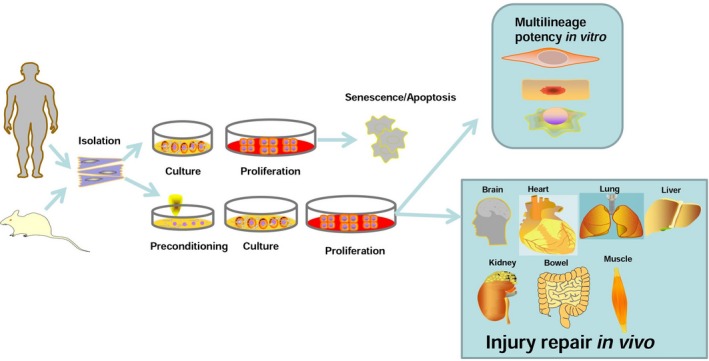
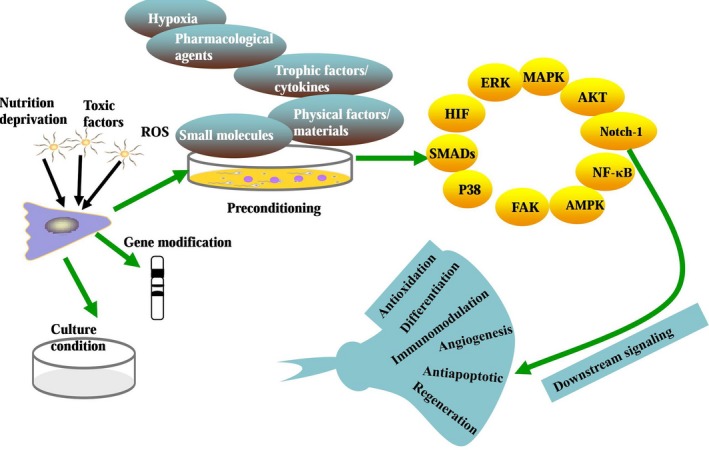
Various diseases and toxic factors easily impair cellular and organic functions in mammals. Organ transplantation is used to rescue organ function, but is limited by scarce resources. Mesenchymal stem cell (MSC)-based therapy carries promising potential in regenerative medicine because of the self-renewal and multilineage potency of MSCs; however, MSCs may lose biological functions after isolation and cultivation for a long time in vitro. Moreover, after they are injected in vivo and migrate into the damaged tissues or organs, they encounter a harsh environment coupled with death signals due to the inadequate tensegrity structure between the cells and matrix. Preconditioning, genetic modification and optimization of MSC culture conditions are key strategies to improve MSC functions in vitro and in vivo, and all of these procedures will contribute to improving MSC transplantation efficacy in tissue engineering and regenerative medicine. Preconditioning with various physical, chemical and biological factors is possible to preserve the stemness of MSCs for further application in studies and clinical tests. In this review, we mainly focus on preconditioning and the corresponding mechanisms for improving MSC activities in vitro and in vivo; we provide a glimpse into the promotion of MSC-based cell therapy development for regenerative medicine. As a promising consequence, MSC transplantation can be applied for the treatment of some terminal diseases and can prolong the survival time of patients in the near future.
Keywords: in vitro; in vivo; mesenchymal stem cell; preconditioning; stemness.
© 2018 The Authors. Journal of Cellular and Molecular Medicine published by John Wiley & Sons Ltd and Foundation for Cellular and Molecular Medicine.
Figures
References
-
- Thomson JA, Itskovitz‐Eldor J, Shapiro SS, et al Embryonic stem cell lines derived from human blastocysts. Science. 1998; 282: 1145–7. - PubMed
-
- Takahashi K, Yamanaka S. Induction of pluripotent stem cells from mouse embryonic and adult fibroblast cultures by defined factors. Cell. 2006; 126: 663–76. - PubMed
Publication types
MeSH terms
Substances
LinkOut - more resources
Full Text Sources
Other Literature Sources
Medical
Research Materials
