Review
. 2018 May;34(5):379-388.
doi: 10.1016/j.tig.2018.01.001. Epub 2018 Jan 24.

Time for Bed: Genetic Mechanisms Mediating the Circadian Regulation of Sleep

Affiliations
Review

Time for Bed: Genetic Mechanisms Mediating the Circadian Regulation of Sleep

Ian D Blum et al. Trends Genet. 2018 May.

Abstract

Sleep is an evolutionarily conserved behavior that is increasingly recognized as important for human health. While its precise function remains controversial, sleep has been suggested to play a key role in a variety of biological phenomena ranging from synaptic plasticity to metabolic clearance. Although it is clear that sleep is regulated by the circadian clock, how this occurs remains enigmatic. Here we examine the genetic mechanisms by which the circadian clock regulates sleep, drawing on recent work in fruit flies, zebrafish, mice, and humans. These studies reveal that central and local clocks utilize diverse mechanisms to regulate different aspects of sleep, and a better understanding of this multilayered regulation may lead to a better understanding of the functions of sleep.


Figures

Figure 1
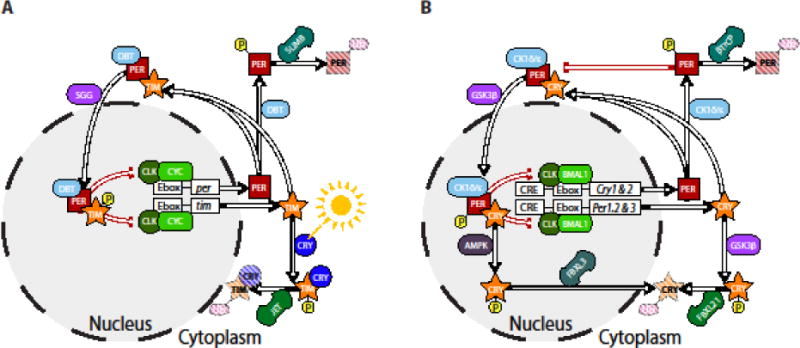
Figure 1. Conservation of canonical circadian clock from invertebrates (A) to vertebrates (B)
A) In a highly simplified model of the invertebrate circadian clock Clock and cycle genes drive transcription of period and timeless via enhancer boxes (Ebox) found upstream of the genes. PER and TIM proteins form heterodimers which translocate back to the nucleus to inhibit their own translation. While CRY-mediated ubiquitination and subsequent proteosomal degradation of TIM drives daily resetting by light, clock speed is controlled by the rate of degradation of PER proteins. B) Similar feedback and cycling occurs in mammals with the Cryptochrome genes substituting for timeless in the core oscillator. Cytosolic PER and CRY proteins are ubiquitinated by two separate mechanisms when not heterodimerized. PER is flagged for degradation by the doubletime orthologues CK1δ/ε leading to ubiquitination by βTrCP, while phase-resetting occurs via intracellular signaling pathways AMPK (Cry1) and GSK3β (Cry2) triggering FBXL3 ubiquitination and proteosomal degradation mediated intracellular signaling. In these figures, several accessory loops in both flies and mammals are omitted to focus on the balance of synthesis and degradation of clock proteins, which has been implicated in the circadian timing of sleep in humans. Indeed, all mammalian genes presented here, except Clk and Bmal1, have at least one allelic variant associated with a sleep-wake disorder. Abbreviations: AMPK - AMP-activated protein kinase; BMAL1 – Brain and muscle arntl-like protein 1; βTrCP – β-transducin repeat-containing protein; CK1δ/ε – Casein kinase 1 delta/epsilon; CLK – Clock; CRE – cAMP response element; CRY – Cryptochrome; CYC – Cycle; Ebox – promoter enhancer box; FBXL – F-box and leucine rich repeat protein ; GSK3β – Glycogen synthase kinase-3; PER – Period; SGG – Shaggy; TIM – Timeless; Ub – post-translational ubiquitination.

References

    1. Ibanez C. The 2017 Nobel Prize in Physiology or Medicine - Advanced Information: Discoveries of Molecular Mechanisms Controlling the Circadian Rhythm. Nobel Media AB; 2017. Nobelprize.org.
    1. Raizen DM, et al. Lethargus is a Caenorhabditis elegans sleep-like state. Nature. 2008;451(7178):569–572. - PubMed
    1. Nath RD, et al. The Jellyfish Cassiopea Exhibits a Sleep-like State. Curr Biol. 2017;27(19):2984–2990. - PMC - PubMed
    1. Vorster APA, et al. Characterization of sleep in Aplysia californica. Sleep. 2014;37(9):1453–1463. - PMC - PubMed
    1. Tisdale RK, et al. Sleep-Related Electrophysiology and Behavior of Tinamous (Eudromia elegans): Tinamous Do Not Sleep Like Ostriches. Brain Behav Evol. 2017;89(4):249–261. - PubMed

Publication types

LinkOut - more resources