


Telehealth Interventions Delivering Home-based Support Group Videoconferencing: Systematic Review
- PMID: 29396387
- PMCID: PMC5816261
- DOI: 10.2196/jmir.8090
Telehealth Interventions Delivering Home-based Support Group Videoconferencing: Systematic Review
Abstract
Background: Group therapy and education and support sessions are used within health care across a range of disciplines such as chronic disease self-management and psychotherapy interventions. However, there are barriers that constrain group attendance, such as mobility, time, and distance. Using videoconferencing may overcome known barriers and improve the accessibility of group-based interventions.
Objective: The aim of this study was to review the literature to determine the feasibility, acceptability, effectiveness, and implementation of health professional-led group videoconferencing to provide education or social support or both, into the home setting.
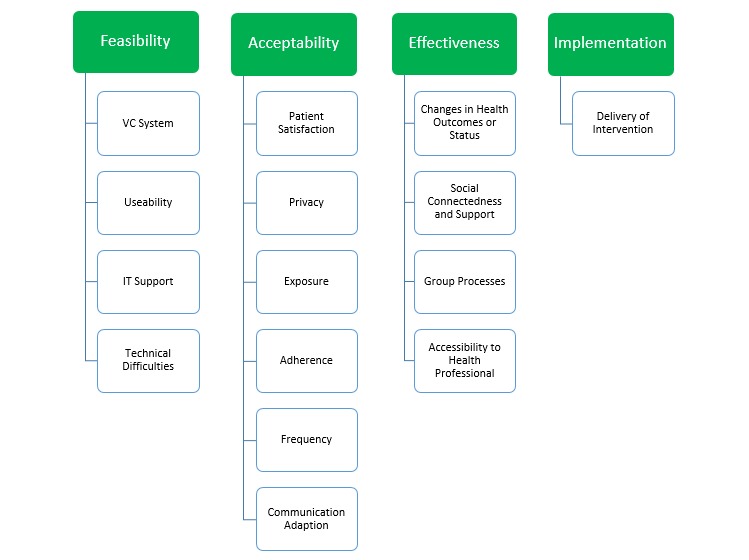
Methods: Electronic databases were searched using predefined search terms for primary interventions for patient education and/or social support. The quality of studies was assessed using the Mixed Methods Appraisal Tool. We developed an analysis framework using hierarchical terms feasibility, acceptability, effectiveness, and implementation, which were informed by subheadings.
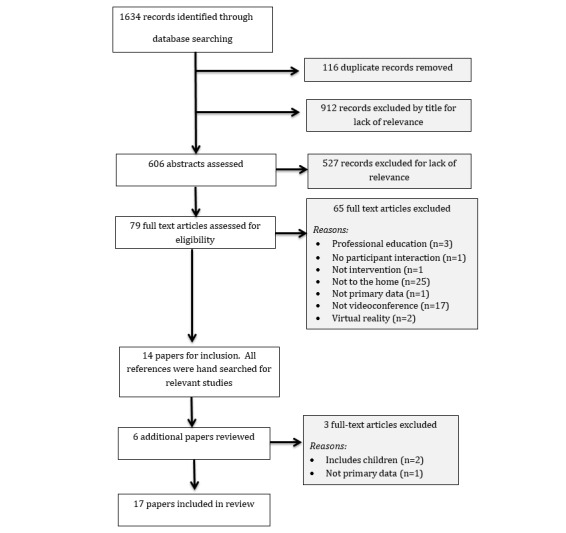
Results: Of the 1634 records identified, 17 were included in this review. Home-based groups by videoconferencing are feasible even for those with limited digital literacy. Overall acceptability was high with access from the home highly valued and little concern of privacy issues. Some participants reported preferring face-to-face groups. Good information technology (IT) support and training is required for facilitators and participants. Communication can be adapted for the Web environment and would be enhanced by clear communication strategies and protocols. A range of improved outcomes were reported but because of the heterogeneity of studies, comparison of these across studies was not possible. There was a trend for improvement in mental health outcomes. Benefits highlighted in the qualitative data included engaging with others with similar problems; improved accessibility to groups; and development of health knowledge, insights, and skills. Videoconference groups were able to replicate group processes such as bonding and cohesiveness. Similar outcomes were reported for those comparing face-to-face groups and videoconference groups.
Conclusions: Groups delivered by videoconference are feasible and potentially can improve the accessibility of group interventions. This may be particularly useful for those who live in rural areas, have limited mobility, are socially isolated, or fear meeting new people. Outcomes are similar to in-person groups, but future research on facilitation process in videoconferencing-mediated groups and large-scale studies are required to develop the evidence base.
Keywords: patient education as topic; review; social support; telemedicine; videoconferencing.
©Annie Banbury, Susan Nancarrow, Jared Dart, Leonard Gray, Lynne Parkinson. Originally published in the Journal of Medical Internet Research (http://www.jmir.org), 02.02.2018.
Conflict of interest statement
Conflicts of Interest: None declared.
Figures
References
-
- Yalom I, Leszcz M. The Theory and Practice of Group Therapy. New York: The Perseus Books Group; 2005.
-
- Galinsky MJ, Schopler JH, Abell MD. Connecting group members through telephone and computer groups. Health Soc Work. 1997 Aug;22(3):181–8. - PubMed
-
- Steinsbekk A, Rygg L, Lisulo M, Rise MB, Fretheim A. Group based diabetes self-management education compared to routine treatment for people with type 2 diabetes mellitus. A systematic review with meta-analysis. BMC Health Serv Res. 2012;12:213. doi: 10.1186/1472-6963-12-213. http://bmchealthservres.biomedcentral.com/articles/10.1186/1472-6963-12-213 - DOI - PMC - PubMed
-
- Eysenbach G, Powell J, Englesakis M, Rizo C, Stern A. Health related virtual communities and electronic support groups: systematic review of the effects of online peer to peer interactions. Br Med J. 2004 May 15;328(7449):1166. doi: 10.1136/bmj.328.7449.1166. http://europepmc.org/abstract/MED/15142921 - DOI - PMC - PubMed
Publication types
MeSH terms
LinkOut - more resources
Full Text Sources
Other Literature Sources
Medical
