. 2018 Feb 2;8(1):2220.
doi: 10.1038/s41598-018-20588-7.

Stationary gaze entropy predicts lane departure events in sleep-deprived drivers

Affiliations

Stationary gaze entropy predicts lane departure events in sleep-deprived drivers

Brook A Shiferaw et al. Sci Rep. .

Abstract

Performance decrement associated with sleep deprivation is a leading contributor to traffic accidents and fatalities. While current research has focused on eye blink parameters as physiological indicators of driver drowsiness, little is understood of how gaze behaviour alters as a result of sleep deprivation. In particular, the effect of sleep deprivation on gaze entropy has not been previously examined. In this randomised, repeated measures study, 9 (4 male, 5 female) healthy participants completed two driving sessions in a fully instrumented vehicle (1 after a night of sleep deprivation and 1 after normal sleep) on a closed track, during which eye movement activity and lane departure events were recorded. Following sleep deprivation, the rate of fixations reduced while blink rate and duration as well as saccade amplitude increased. In addition, stationary and transition entropy of gaze also increased following sleep deprivation as well as with amount of time driven. An increase in stationary gaze entropy in particular was associated with higher odds of a lane departure event occurrence. These results highlight how fatigue induced by sleep deprivation and time-on-task effects can impair drivers' visual awareness through disruption of gaze distribution and scanning patterns.


Conflict of interest statement

The authors declare that they have no competing interests.

Figures
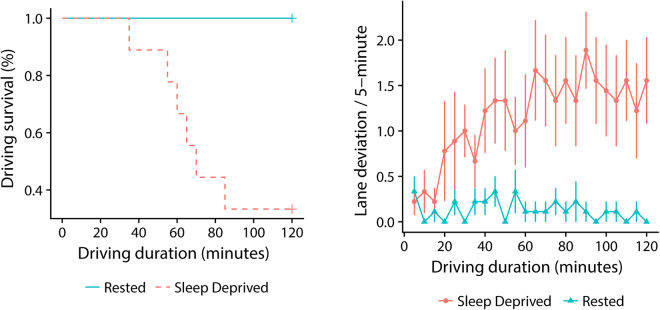
Figure 1
Figure 1
Kaplan-Meier survival curve for the six early terminations of driving in the sleep-deprived condition, depicted in red line (Left). Number of lane departure events per 5-minute blocks of driving duration with standard error for sleep-deprived and rested conditions (Right).
Figure 2
Figure 2
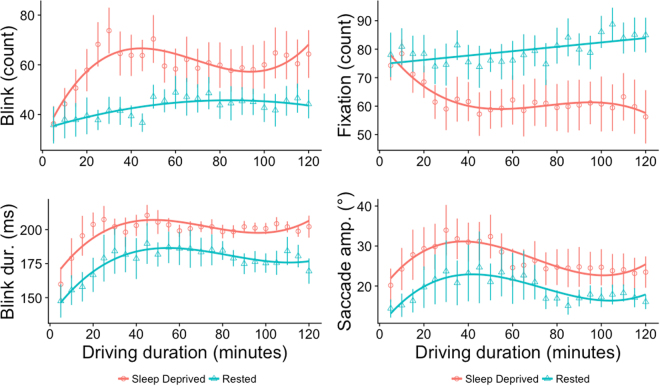
Mean and standard errors across driving duration by condition (red = sleep-deprived, green = rested) with curvilinear fits for blink rate -Top Left, sleep-deprived: (ŷ = 30.727 + 1.964x − 0.033x2 + 0.0002x3), rested: (ŷ = 41.780 + 0.277x − 0.002x2); blink duration-Bottom Left, sleep-deprived: (ŷ = 168.606 + 2.332x − 0.036x2 + 0.0002x3), rested: (ŷ = 136.400 + 2.332x − 0.030x2 + 0.0001x3), fixation rate - Top Right, sleep-deprived: (ŷ = 55.829 − 1.090x − 0.016x2 − 0.0001x3), rested: (ŷ = 63.081 + 0.077x); and saccade amplitude - Bottom Right, sleep-deprived: (ŷ = 33.462 + 0.769x − 0.014x2 − 0.0001x3), rested: (ŷ = 14.878 + 0.723x − 0.012x2 + 0.0001x3).
Figure 3
Figure 3
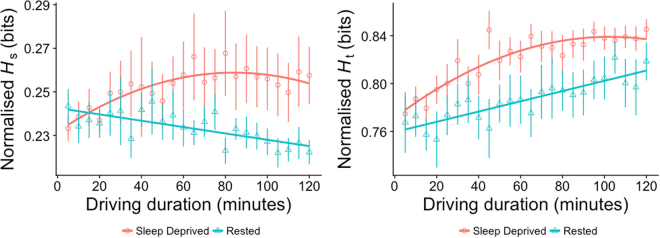
Mean and standard errors across driving duration by condition (red = sleep-deprived, green = rested) with curvilinear fits for stationary entropy - Left, sleep-deprived: (ŷ = 0.262 + 0.0001x − 0.000004x2), rested: (ŷ = 0.266 − 0.0001x), and gaze transition entropy - Right, sleep-deprived: (ŷ = 0.784 + 0.001x − 0.00001x2), rested: (ŷ = 0.826 + 0.0004x).
Figure 4
Figure 4
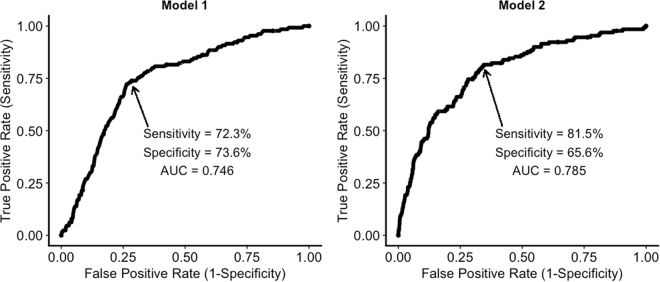
Receiver Operating Characteristic Curve for lane departure predictor model using the interaction between condition and driving duration alone (Left) and with addition of ocular and entropy variables (Right).
Figure 5
Figure 5
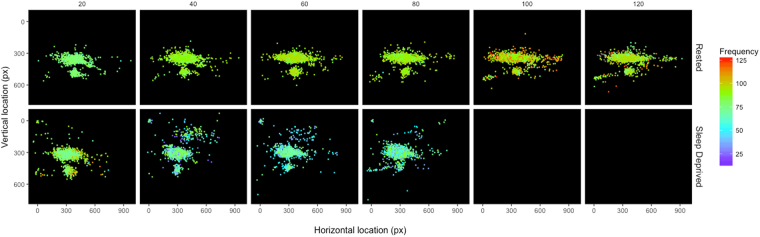
Fixation density plot for participant 6 in the rested (top row) and sleep-deprived (bottom row) conditions per 20-minute of the drive duration. Note: this participant elected to stop driving after 80 minutes in the sleep-deprived condition.

References

    1. Australian Transport Council. National Road Safety Strategy 2011–2020. 25 at http://roadsafety.gov.au/nrss/files/NRSS_2011_2020.pdf (2011).
    1. De Mello, M. T. et al. Sleep disorders as a cause of motor vehicle collisions. International Journal of Preventive Medicine4, 246–257 (2013). - PMC - PubMed
    1. Stutts JC, Wilkins JW, Osberg JS, Vaughn BV. Driver risk factors for sleep-related crashes. Accid. Anal. Prev. 2003;35:321–331. doi: 10.1016/S0001-4575(02)00007-6. - DOI - PubMed
    1. Boksem MaS, Tops M. Mental fatigue: costs and benefits. Brain Res. Rev. 2008;59:125–39. doi: 10.1016/j.brainresrev.2008.07.001. - DOI - PubMed
    1. Lal SKL, Craig A. A critical review of the psychophysiology of driver fatigue. Biol. Psychol. 2001;55:173–194. doi: 10.1016/S0301-0511(00)00085-5. - DOI - PubMed

Publication types