


Bisphosphonate use after clinical fracture and risk of new fracture
- PMID: 29397408
- PMCID: PMC5854733
- DOI: 10.1007/s00198-017-4367-7
Bisphosphonate use after clinical fracture and risk of new fracture
Abstract
Among older adults with a previous fracture, treatment for osteoporosis was initially associated with a higher risk of new fracture. However, the relative risk of new fracture decreased over time, a trend that is consistent with a beneficial effect, as treatment for osteoporosis is prescribed to reduce high fracture risks.
Introduction: The purpose of this study was to examine whether bisphosphonate use is associated with a lower risk of new fracture after a clinical fracture in older adults.
Methods: Data were available for 3,329,400 adults in Sweden who were aged ≥ 50 years between 2006 and 2011. During this period, 260,353 sustained a clinical fracture and were naïve to bisphosphonates at the time. Those who subsequently received a bisphosphonate were matched to up to three others on sex, year of birth, and type and year of initial fracture. The final cohort comprised 83,104 adults (26.3% bisphosphonate users).
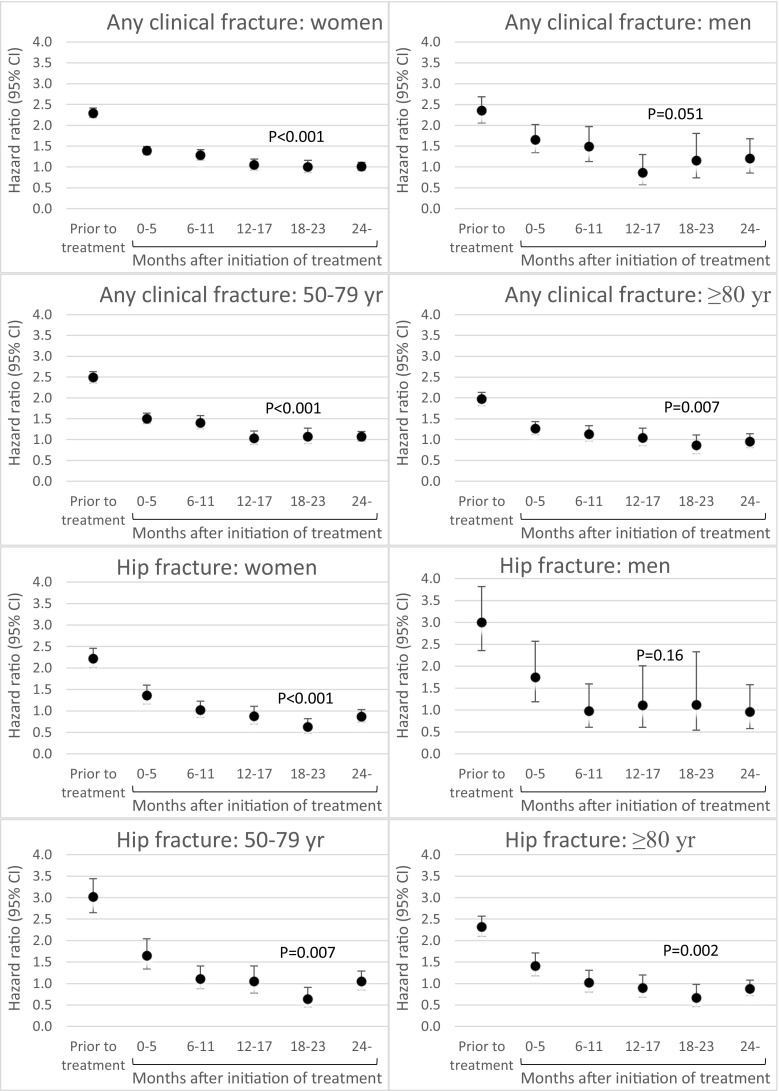
Results: During the period from initial fracture to initiation of bisphosphonate treatment, the incidence rate of any new clinical fracture was higher in those who later became bisphosphonate users than in those who remained nonusers (175.1 vs. 75.9 per 1000 person-years; hazard ratio 2.30, 95% confidence interval 2.19 to 2.41). Similarly, during the first 6 months of treatment, the incidence rate was higher in bisphosphonate users than in nonusers (128.8 vs. 90.2 per 1000 person-years; hazard ratio 1.41, 95% confidence interval 1.32 to 1.51). However, this difference decreased over time: by months 12 to 18, the incidence rate was similar in users and nonusers (59.3 vs. 55.3 per 1000 person-years; hazard ratio 1.03, 95% confidence interval 0.91 to 1.16).
Conclusions: There was a decrease in the relative risk of new fracture during bisphosphonate treatment, a trend that is consistent with a beneficial treatment effect, as bisphosphonates are prescribed to reduce high fracture risks.
Keywords: Elderly; Men; Nonvertebral; Older; Osteoporosis; Refracture.
Conflict of interest statement
None.
Figures

Comment in
-
Comments on Bergman et al.: Bisphosphonate use after clinical fracture and risk of new fracture.Osteoporos Int. 2018 Sep;29(9):2157. doi: 10.1007/s00198-018-4614-6. Epub 2018 Jul 5. Osteoporos Int. 2018. PMID: 29978255 No abstract available.
-
Bisphosphonate use after clinical fracture and risk of new fracture: response to comments by Wu et al.Osteoporos Int. 2018 Sep;29(9):2159-2160. doi: 10.1007/s00198-018-4615-5. Epub 2018 Jul 16. Osteoporos Int. 2018. PMID: 30014156 No abstract available.
References
MeSH terms
Substances
Grants and funding
LinkOut - more resources
Full Text Sources
Other Literature Sources
Medical
