


Mineralocorticoid receptor antagonists for heart failure: a real-life observational study
- PMID: 29397584
- PMCID: PMC5933965
- DOI: 10.1002/ehf2.12244
Mineralocorticoid receptor antagonists for heart failure: a real-life observational study
Abstract
Aims: Mineralocorticoid receptor antagonists (MRAs) have been demonstrated to improve outcomes in reduced ejection fraction heart failure (HFrEF) patients. However, MRAs added to conventional treatment may lead to worsening of renal function and hyperkalaemia. We investigated, in a population-based analysis, the long-term effects of MRA treatment in HFrEF patients.
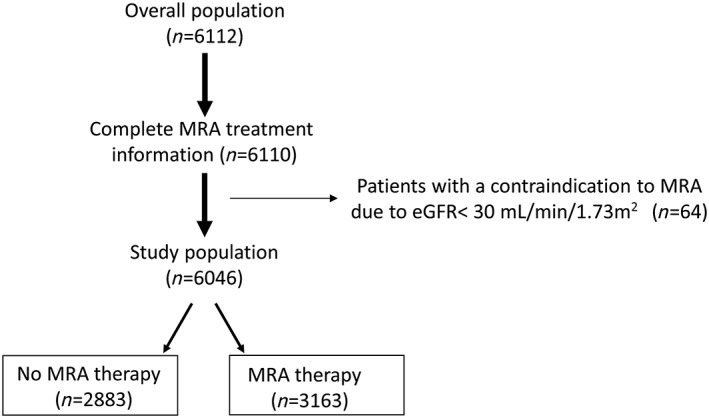
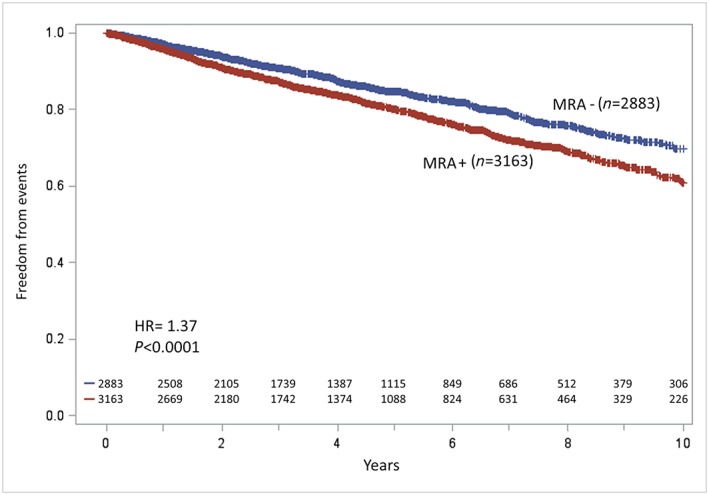
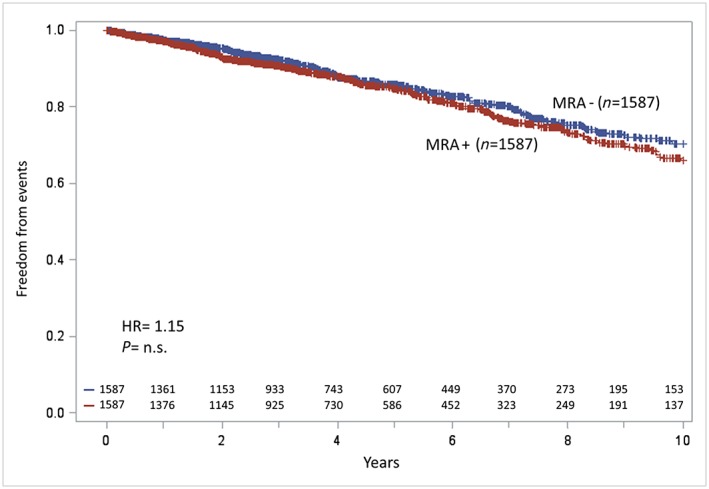
Methods and results: We analysed data of 6046 patients included in the Metabolic Exercise Cardiac Kidney Index score dataset. Analysis was performed in patients treated (n = 3163) and not treated (n = 2883) with MRA. The study endpoint was a composite of cardiovascular death, urgent heart transplantation, or left ventricular assist device implantation. Ten years' survival was analysed through Kaplan-Meier, compared by log-rank test and propensity score matching. At 10 years' follow-up, the MRA-untreated group had a significantly lower number of events than the MRA-treated group (P < 0.001). MRA-treated patients had more severe heart failure (higher New York Heart Association class and lower left ventricular ejection fraction, kidney function, and peak VO2 ). At a propensity-score-matching analysis performed on 1587 patients, MRA-treated and MRA-untreated patients showed similar study endpoint values.
Conclusions: In conclusion, MRA treatment does not affect the composite of cardiovascular death, urgent heart transplantation or left ventricular assist device implantation in a real-life setting. A meticulous patient follow-up, as performed in trials, is likely needed to match the positive MRA-related benefits observed in clinical trials.
Keywords: Heart failure; Hyperkalaemia; Mineralocorticoid receptor antagonists; Worsening renal function.
© 2018 The Authors. ESC Heart Failure published by John Wiley & Sons Ltd on behalf of the European Society of Cardiology.
Figures
References
-
- Weber KT. Aldosterone and spironolactone in heart failure. N Engl J Med 1999; 341: 753–755. - PubMed
-
- Pitt B, Zannad F, Remme WJ, Cody R, Castaigne A, Perez A, Palensky J, Wittes J. The effect of spironolactone on morbidity and mortality in patients with severe heart failure. Randomized Aldactone Evaluation Study Investigators. N Engl J Med 1999; 341: 709–717. - PubMed
-
- Pitt B, Remme W, Zannad F, Neaton J, Martinez F, Roniker B, Bittman R, Hurley S, Kleiman J, Gatlin M. Eplerenone, a selective aldosterone blocker, in patients with left ventricular dysfunction after myocardial infarction. N Engl J Med 2003; 348: 1309–1321. - PubMed
-
- Zannad F, McMurray JJ, Krum H, van Veldhuisen DJ, Swedberg K, Shi H, Vincent J, Pocock SJ, Pitt B. Eplerenone in patients with systolic heart failure and mild symptoms. N Engl J Med 2011; 364: 11–21. - PubMed
Publication types
MeSH terms
Substances
LinkOut - more resources
Full Text Sources
Other Literature Sources
Medical
