


Insufficient evidence for pathogenicity of SNCA His50Gln (H50Q) in Parkinson's disease
- PMID: 29398121
- PMCID: PMC5823280
- DOI: 10.1016/j.neurobiolaging.2017.12.012
Insufficient evidence for pathogenicity of SNCA His50Gln (H50Q) in Parkinson's disease
Abstract
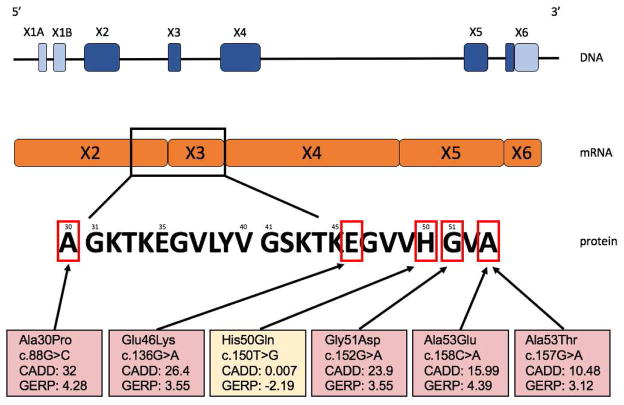
SNCA missense mutations are a rare cause of autosomal dominant Parkinson's disease (PD). To date, 6 missense mutations in SNCA have been nominated as causal. Here, we assess the frequency of these 6 mutations in public population databases and PD case-control data sets to determine their true pathogenicity. We found that 1 of the 6 reported SNCA mutations, His50Gln, was consistently identified in large population databases, and no enrichment was evident in PD cases compared to controls. These results suggest that His50Gln is probably not a pathogenic variant. This information is important to provide counseling for His50Gln carriers and has implications for the interpretation of His50Gln α-synuclein functional investigations.
Keywords: H50Q; His50Gln; Parkinson's disease; SNCA.
Published by Elsevier Inc.
Figures
References
-
- Alcalay RN, Levy OA, Waters CC, Fahn S, Ford B, Kuo SH, Mazzoni P, Pauciulo MW, Nichols WC, Gan-Or Z, Rouleau GA, Chung WK, Wolf P, Oliva P, Keutzer J, Marder K, Zhang X. Glucocerebrosidase activity in Parkinson’s disease with and without GBA mutations. Brain. 2015;138(Pt 9):2648–2658. - PMC - PubMed
-
- Appel-Cresswell S, Vilarino-Guell C, Encarnacion M, Sherman H, Yu I, Shah B, Weir D, Thompson C, Szu-Tu C, Trinh J, Aasly JO, Rajput A, Rajput AH, Jon Stoessl A, Farrer MJ. Alpha-synuclein p.H50Q, a novel pathogenic mutation for Parkinson’s disease. Mov Disord. 2013;28(6):811–813. - PubMed
-
- Elbaz A, Bower JH, Maraganore DM, McDonnell SK, Peterson BJ, Ahlskog JE, Schaid DJ, Rocca WA. Risk tables for parkinsonism and Parkinson’s disease. J Clin Epidemiol. 2002;55(1):25–31. - PubMed
-
- Gilks WP, Abou-Sleiman PM, Gandhi S, Jain S, Singleton A, Lees AJ, Shaw K, Bhatia KP, Bonifati V, Quinn NP, Lynch J, Healy DG, Holton JL, Revesz T, Wood NW. A common LRRK2 mutation in idiopathic Parkinson’s disease. Lancet. 2005;365(9457):415–416. - PubMed
Publication types
MeSH terms
Substances
Grants and funding
LinkOut - more resources
Full Text Sources
Other Literature Sources
Medical
Miscellaneous
