


The persistence and oscillations of submicroscopic Plasmodium falciparum and Plasmodium vivax infections over time in Vietnam: an open cohort study
- PMID: 29398388
- PMCID: PMC5910058
- DOI: 10.1016/S1473-3099(18)30046-X
The persistence and oscillations of submicroscopic Plasmodium falciparum and Plasmodium vivax infections over time in Vietnam: an open cohort study
Erratum in
-
Corrections.Lancet Infect Dis. 2018 May;18(5):492. doi: 10.1016/S1473-3099(18)30236-6. Lancet Infect Dis. 2018. PMID: 29695353 Free PMC article. No abstract available.
Abstract
Background: A substantial proportion of Plasmodium species infections are asymptomatic with densities too low to be detectable with standard diagnostic techniques. The importance of such asymptomatic plasmodium infections in malaria transmission is probably related to their duration and density. To explore the duration of asymptomatic plasmodium infections and changes in parasite densities over time, a cohort of participants who were infected with Plasmodium parasites was observed over a 2-year follow-up period.
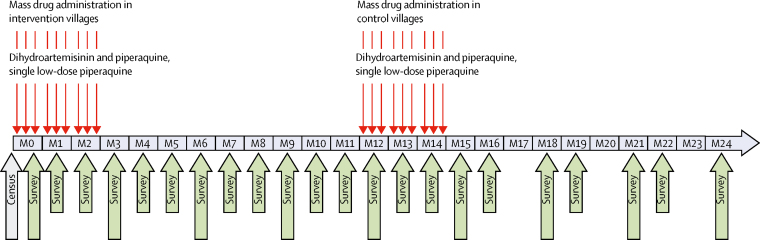
Methods: In this open cohort study, inhabitants of four villages in Vietnam were invited to participate in baseline and subsequent 3-monthly surveys up to 24 months, which included the collection of venous blood samples. Samples were batch-screened using ultra-sensitive (u)PCR (lower limit of detection of 22 parasites per mL). Participants found to be infected by uPCR during any of these surveys were invited to join a prospective cohort and provide monthly blood samples. We estimated the persistence of Plasmodium falciparum and Plasmodium vivax infections and changes in parasite densities over a study period of 24 months.
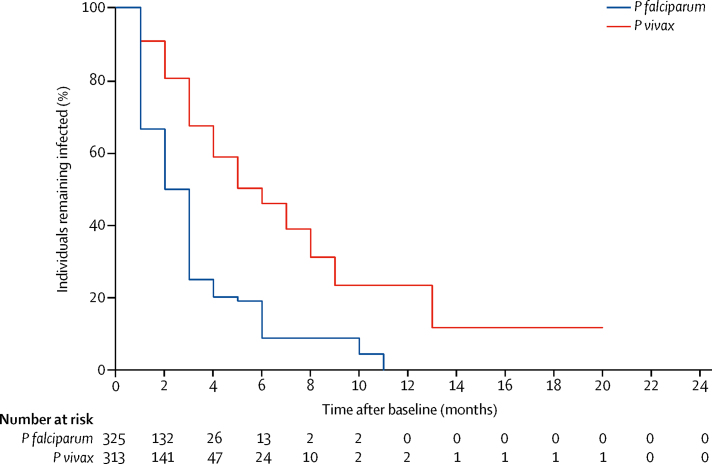
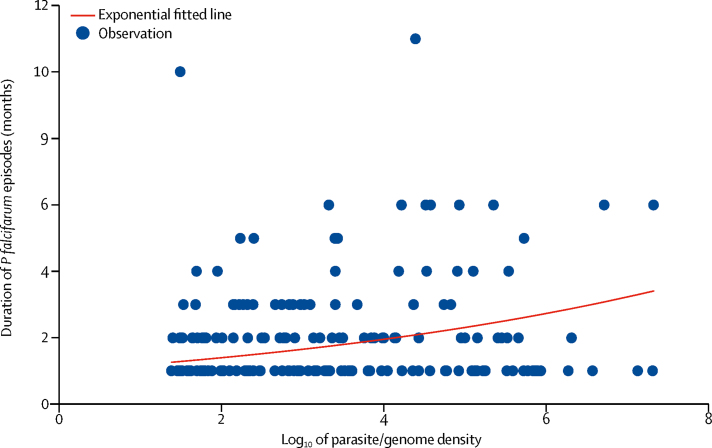
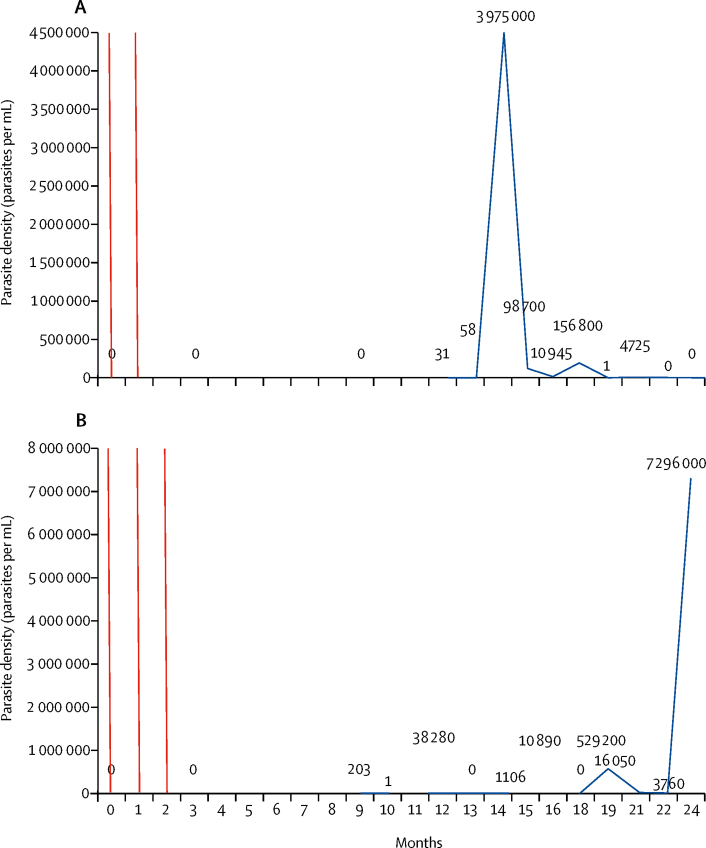
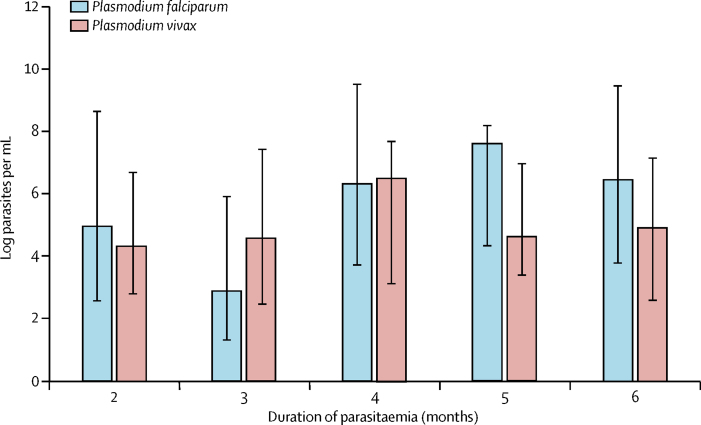
Findings: Between Dec 1, 2013, and Jan 8, 2016, 356 villagers participated in between one and 22 surveys. These study participants underwent 4248 uPCR evaluations (11·9 tests per participant). 1874 (32%) of 4248 uPCR tests indicated a plasmodium infection; 679 (36%) of 1874 tests were P falciparum monoinfections, 507 (27%) were P vivax monoinfections, 463 (25%) were co-infections with P falciparum and P vivax, and 225 (12%) were indeterminate species of Plasmodium. The median duration of P falciparum infection was 2 months (IQR 1-3); after accounting for censoring, participants had a 20% chance of having parasitaemia for 4 months or longer. The median duration of P vivax infection was 6 months (3-9), and participants had a 59% chance of having parasitaemia for 4 months or longer. The parasite densities of persistent infections oscillated; following ultralow-density infections, high-density infections developed frequently.
Interpretation: Persistent largely asymptomatic P vivax and P falciparum infections are common in this area of low seasonal malaria transmission. Infections with low-density parasitaemias can develop into much higher density infections at a later time, which are likely to sustain malaria endemicity.
Funding: The Wellcome Trust, Bill & Melinda Gates Foundation.
Copyright © 2018 The Author(s). Published by Elsevier Ltd. This is an Open Access article under the CC BY 4.0 license. Published by Elsevier Ltd.. All rights reserved.
Figures
Comment in
-
Asymptomatic low-density malaria infections: a parasite survival strategy?Lancet Infect Dis. 2018 May;18(5):485-486. doi: 10.1016/S1473-3099(18)30047-1. Epub 2018 Feb 2. Lancet Infect Dis. 2018. PMID: 29398387 No abstract available.
References
-
- Hamad AA, El Hassan IM, El Khalifa AA. Chronic Plasmodium falciparum infections in an area of low intensity malaria transmission in the Sudan. Parasitology. 2000;120:447–456. - PubMed
Publication types
MeSH terms
Grants and funding
LinkOut - more resources
Full Text Sources
Other Literature Sources
Medical
Research Materials
