


Subtypes of Benign Breast Disease as a Risk Factor for Breast Cancer: A Systematic Review and Meta-Analysis Protocol
- PMID: 29398746
- PMCID: PMC5775989
Subtypes of Benign Breast Disease as a Risk Factor for Breast Cancer: A Systematic Review and Meta-Analysis Protocol
Abstract
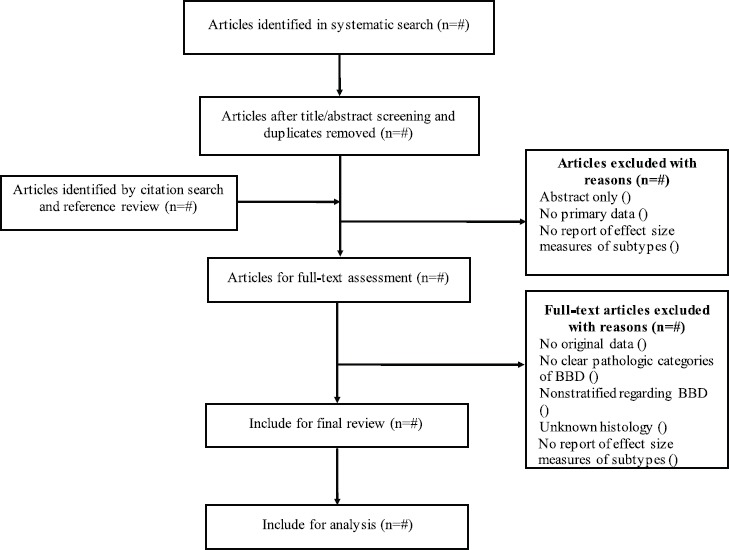
Breast cancer is a multifactorial disease. Benign breast disease (BBD) is one of the most important risk factors for breast cancer. The etiology of BBD is unknown. It is divided into nonproliferative and proliferative diseases. The selection of studies will be based on titles, abstract screening, inclusion and exclusion criteria, and quality assessment. Previous studies have shown that all types of BBD increase the risk of breast cancer, but the risk degree is different for each one. Accurate risk estimation of breast cancer in each category can be very important for proper clinical management. This systematic review and meta-analysis will be conducted on observational studies (traditional case control, nested case control, case cohort, and cohort) published in the Web of Science (ISI), PubMed (MEDLINE), Scopus, Google Scholar, and the key journals of this field such as Breast Cancer Research and Treatment and Cancer Research from January 2000 to June 2015. Reference lists and gray literature will be reviewed too. All the initial retrievals will be performed by 2 researchers independently. The data extraction form will consist of general information concerning the studies, study eligibility, method, risk of bias assessment, and results-including odds ratios, risk ratios, rate ratios, and hazard ratios. The PRISMA and MOOSE guidelines will be used to report our findings. Registration Details: PROSPERO-42016035243.
Keywords: Breast neoplasms; Fibrocystic breast disease; Mammary dysplasia; Risk factors; Systematic review.
Figures
References
-
- Mahouri K, Dehghani Zahedani M, Zare S. Breast cancer risk factors in south of Islamic Republic of Iran:A case-control study. East Mediterr Health J. 2007;13:1265–73. - PubMed
-
- Kotsopoulos J, Chen WY, Gates MA, Tworoger SS, Hankinson SE, Rosner BA. Risk factors for ductal and lobular breast cancer:Results from the nurses' health study. Breast Cancer Res. 2010;12:R106. doi: 10.1186/bcr2790. [ PMC Free Article] - DOI - PMC - PubMed
LinkOut - more resources
Full Text Sources