Review
. 2017 Dec;7(Suppl 3):S219-S227.
doi: 10.21037/cdt.2017.10.13.

Transplant artery thrombosis and outcomes

Affiliations
Review

Transplant artery thrombosis and outcomes

Mark D Sugi et al. Cardiovasc Diagn Ther. 2017 Dec.

Abstract

Post-transplantation allograft arterial thrombosis is a well-recognized complication associated with solid organ transplantation. Much of the literature is centered on liver and kidney transplantation, which will therefore serve as the principle basis for this review, with a brief discussion on pancreas transplantation and associated arterial complications. The number of solid organ transplants has been steadily increasing over the past decade in parallel with growing demand for organs and expansion of the transplantation criteria for both donors and recipients. This increase has been accompanied by a number of innovative medical advances and surgical techniques, as well as improved imaging that has allowed for thoughtful exploration of vascular anatomic variants and the possibilities for transplant with which they are associated. It has also been accompanied by a growing field of behavioral research, as potential recipients must weigh the risk of accepting certain organs based on perceived outcomes that may differ according to the quality of the underlying organ. Improvements in imaging technology have brought greater sensitivity to detecting arterial complications in post-operative surveillance examinations and have allowed for further development of tailored endovascular and surgical interventions for transplant-associated vascular complications. This review will focus on post-transplantation solid organ allograft artery thrombosis, including discussion of risk factors, diagnostic imaging, natural history, and therapeutic options.

Keywords: Transplant artery thrombosis; arterial anatomic variants; arterial revascularization; post-transplantation surveillance imaging; transplant outcomes.


Conflict of interest statement

Conflicts of Interest: The authors have no conflicts of interest to declare.

Figures
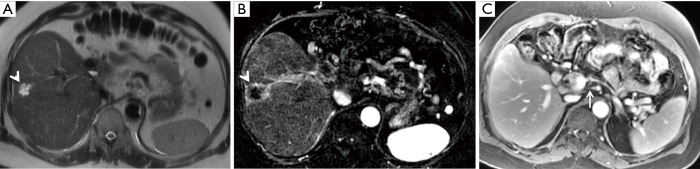
Figure 1
Figure 1
A 56-year-old male with transplant hepatic arterial thrombosis (HAT) complicated by right hepatic lobe abscess. (A) Axial T2 MR image shows a fluid collection in the right hepatic lobe (arrowhead) with (B) corresponding peripheral enhancement and central low attenuation on gadolinium contrast subtraction image, consistent with abscess; (C) contrast-enhanced axial fast spoiled gradient echo (FSPGR) MR image shows abrupt tapering and thrombosis of the transplant hepatic artery (white arrow).
Figure 2
Figure 2
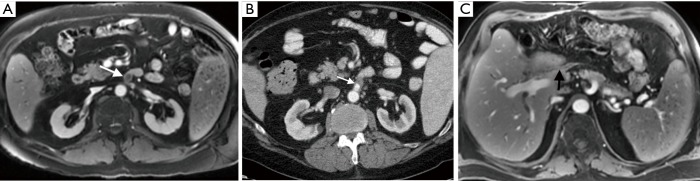
A 52-year-old male with thrombosis of an arterial graft between the recipient infrarenal abdominal aorta and donor hepatic artery. Contrast-enhanced fast spoiled gradient echo (FSPGR) MR image shows occlusion of the arterial graft at the junction of the infrarenal aorta (A, white arrow), also seen on contrast-enhanced axial CT (B, white arrow); arterial occlusion is present distally to the level of the porta hepatis (C, black arrow).
Figure 3
Figure 3
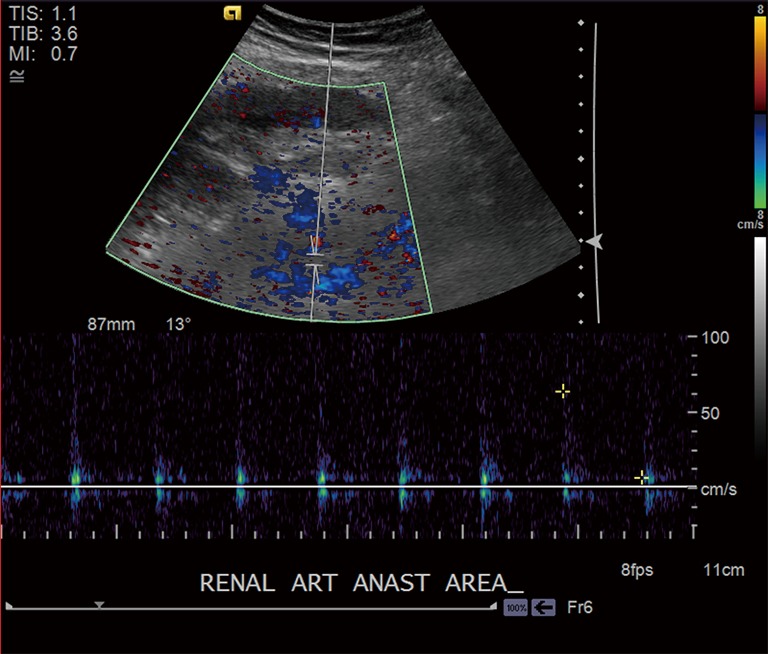
A 48-year-old female with transplant renal artery thrombosis. Immediate post-operative spectral Doppler ultrasound of the transplant kidney shows no convincing arterial flow at the expected area of the arterial anastomosis.

References

    1. Wald C, Russo MW, Heimbach JK, et al. New OPTN/UNOS policy for liver transplant allocation: standardization of liver imaging, diagnosis, classification, and reporting of hepatocellular carcinoma. Radiology 2013;266:376-82. 10.1148/radiol.12121698 - DOI - PubMed
    1. Legmann P, Costes V, Tudoret L, et al. Hepatic artery thrombosis after liver transplantation: diagnosis with spiral CT. AJR Am J Roentgenol 1995;164:97-101. 10.2214/ajr.164.1.7998578 - DOI - PubMed
    1. Duran C, Uraz S, Kantarci M, et al. Hepatic arterial mapping by multidetector computed tomographic angiography in living donor liver transplantation. J Comput Assist Tomogr 2009;33:618-25. 10.1097/RCT.0b013e31818d814b - DOI - PubMed
    1. Covey AM, Brody LA, Maluccio MA, et al. Variant hepatic arterial anatomy revisited: digital subtraction angiography performed in 600 patients. Radiology 2002;224:542-7. 10.1148/radiol.2242011283 - DOI - PubMed
    1. Makowka L, Stieber AC, Sher L, et al. Surgical technique of orthotopic liver transplantation. Gastroenterol Clin North Am 1988;17:33-51. - PMC - PubMed

LinkOut - more resources