Impact of an N-terminal Polyhistidine Tag on Protein Thermal Stability
- PMID: 29399652
- PMCID: PMC5793033
- DOI: 10.1021/acsomega.7b01598
Impact of an N-terminal Polyhistidine Tag on Protein Thermal Stability
Abstract
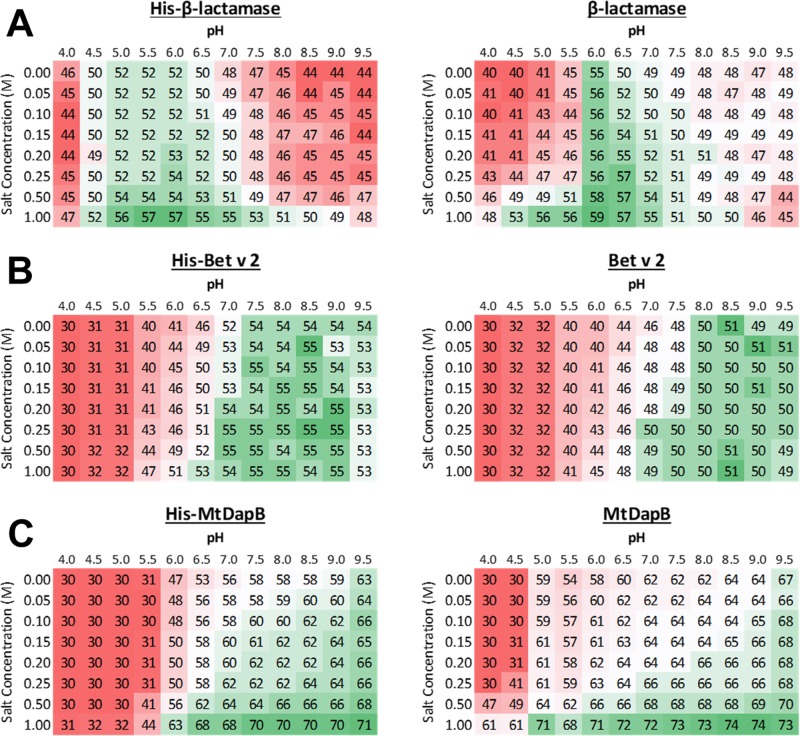
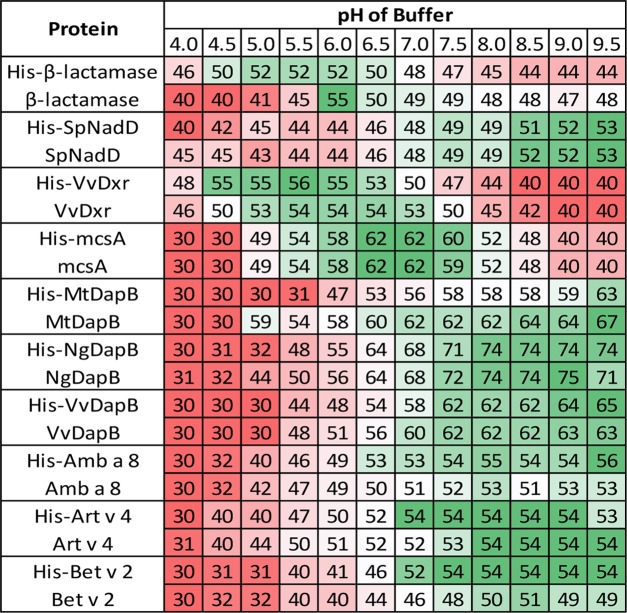
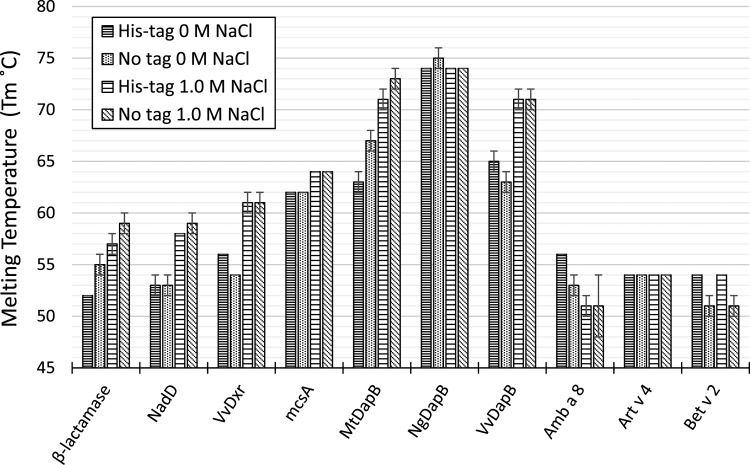
For years, the use of polyhistidine tags (His-tags) has been a staple in the isolation of recombinant proteins in immobilized metal affinity chromatography experiments. Their usage has been widely beneficial in increasing protein purity from crude cell lysates. For some recombinant proteins, a consequence of His-tag addition is that it can affect protein function and stability. Functional proteins are essential in the elucidation of their biological, kinetic, structural, and thermodynamic properties. In this study, we determine the effect of N-terminal His-tags on the thermal stability of select proteins using differential scanning fluorimetry and identify that the removal of the His-tag can have both beneficial and deleterious effects on their stability.
Conflict of interest statement
The authors declare no competing financial interest.
Figures
References
-
- Hopp T. P.; Prickett K. S.; Price V. L.; Libby R. T.; March C. J.; Cerretti D. P.; Urdal D. L.; Conlon P. J. A short polypeptide marker sequence useful for recombinant protein identification and purification. Nat. Biotechnol. 1988, 6, 1204–1210. 10.1038/nbt1088-1204. - DOI
-
- Gräslund S.; Nordlund P.; Weigelt J.; Hallberg B. M.; Bray J.; Gileadi O.; Knapp S.; Oppermann U.; Arrowsmith C.; Hui R.; Ming J.; dhe-Paganon S.; Park H. W.; Savchenko A.; Yee A.; Edwards A.; Vincentelli R.; Cambillau C.; Kim R.; Kim S. H.; Rao Z.; Shi Y.; Terwilliger T. C.; Kim C. Y.; Hung L. W.; Waldo G. S.; Peleg Y.; Albeck S.; Unger T.; Dym O.; Prilusky J.; Sussman J. L.; Stevens R. C.; Lesley S. A.; Wilson I. A.; Joachimiak A.; Collart F.; Dementieva I.; Donnelly M. I.; Eschenfeldt W. H.; Kim Y.; Stols L.; Wu R.; Zhou M.; Burley S. K.; Emtage J. S.; Sauder J. M.; Thompson D.; Bain K.; Luz J.; Gheyi T.; Zhang F.; Atwell S.; Almo S. C.; Bonanno J. B.; Fiser A.; Swaminathan S.; Studier F. W.; Chance M. R.; Sali A.; Acton T. B.; Xiao R.; Zhao L.; Ma L. C.; Hunt J. F.; Tong L.; Cunningham K.; Inouye M.; Anderson S.; Janjua H.; Shastry R.; Ho C. K.; Wang D.; Wang H.; Jiang M.; Montelione G. T.; Stuart D. I.; Owens R. J.; Daenke S.; Schutz A.; Heinemann U.; Yokoyama S.; Bussow K.; Gunsalus K. C. Protein production and purification. Nat. Methods 2008, 5, 135–146. 10.1038/nmeth.f.202. - DOI - PMC - PubMed
Grants and funding
LinkOut - more resources
Full Text Sources
Other Literature Sources