


Functional Relevance of Endocannabinoid-Dependent Synaptic Plasticity in the Central Nervous System
- PMID: 29400439
- PMCID: PMC6720113
- DOI: 10.1021/acschemneuro.7b00508
Functional Relevance of Endocannabinoid-Dependent Synaptic Plasticity in the Central Nervous System
Abstract
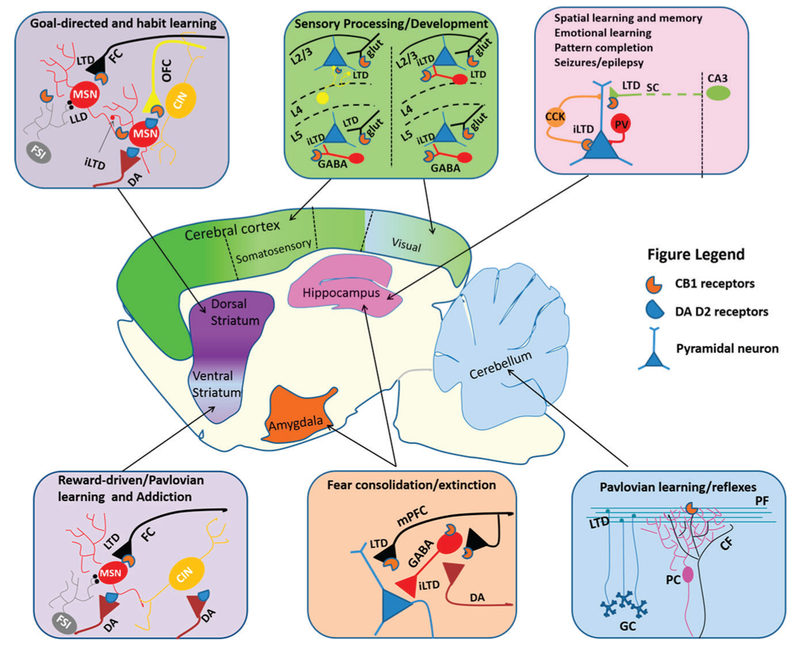
The endocannabinoid (eCB) signaling system plays a key role in short-term and long-term synaptic plasticity in brain regions involved in various neural functions ranging from action selection to appetite control. This review will explore the role of eCBs in shaping neural circuit function to regulate behaviors. In particular, we will discuss the behavioral consequences of eCB mediated long-term synaptic plasticity in different brain regions. This review brings together evidence from in vitro and ex vivo studies and points out the need for more in vivo studies.
Keywords: 2-arachidonoylglycerol; Arachidonoylethanolamine; cannabinoid receptors; depolarization-induced suppression of excitation; depolarization-induced suppression of inhibition; long-term depression; long-term potentiation.
Conflict of interest statement
Notes
The authors declare no competing financial interest.
Figures
References
-
- Matsuda LA, Lolait SJ, Brownstein M. j., Young AC, and Bonner TI (1990) Structure of a cannabinoid receptor and functional expression of the cloned cDNA Nature 346 (6284), 561–4. - PubMed
-
- Devane WA, Hanus L, Breuer A, Pertwee RG., Stevenson LA, Griffin G, Gibson D, Mandelbaum A, Etinger A, and Mechoulam R (1992) Isolation and structure of a brain constituent that binds to the cannabinoid receptor. Science 258 (5090), 1946–9. - PubMed
-
- Munro S, Thomas KL., and Abu-Shaar M (1993) Molecular characterization of a peripheral receptor for cannabinoids. Nature 365 (6441), 61–5. - PubMed
-
- Sugiura T, Kondo S, Sukagawa A, Nakane S, Shinoda A, Itoh K, Yamashita A, and Waku K (1995) 2-Arachidonoylglycerol: a possible endogenous cannabinoid receptor ligand in brain. Biochem. Biophys. Res. Commun 215 (1), 89–97. - PubMed
-
- Kreitzer AC, and Regehr WG (2001) Retrograde inhibition of presynaptic calcium influx by endogenous cannabinoids at excitatory synapses onto Purkinje cells. Neuron 29 (3), 717–27. - PubMed
Publication types
MeSH terms
Substances
Grants and funding
LinkOut - more resources
Full Text Sources
Other Literature Sources
