


In Vivo Characterization of Two 18F-Labeled PDE10A PET Radioligands in Nonhuman Primate Brains
- PMID: 29400443
- PMCID: PMC5955820
- DOI: 10.1021/acschemneuro.7b00458
In Vivo Characterization of Two 18F-Labeled PDE10A PET Radioligands in Nonhuman Primate Brains
Abstract
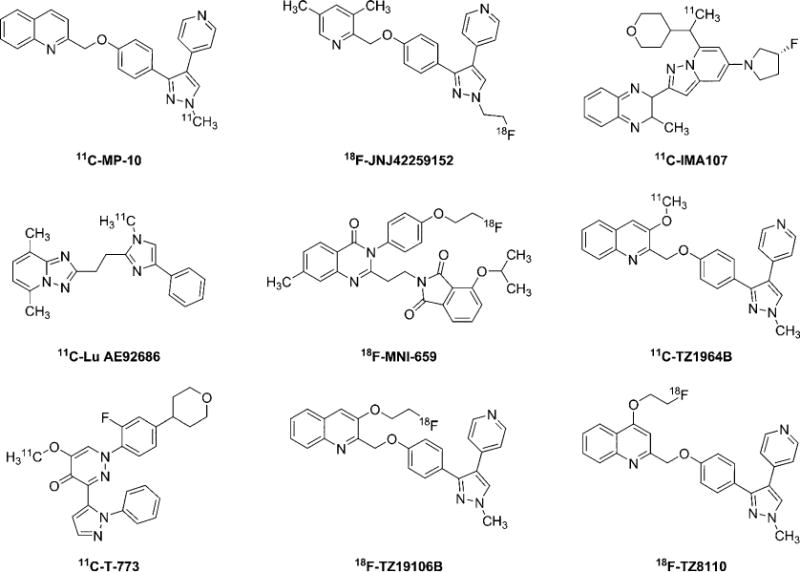
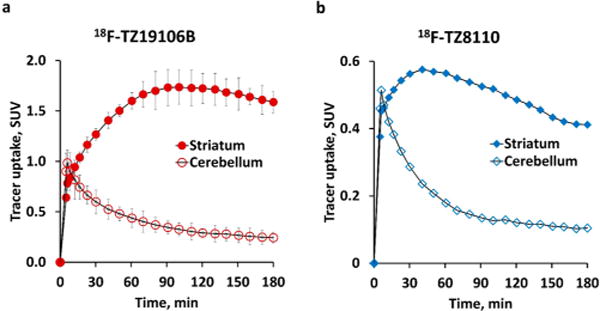
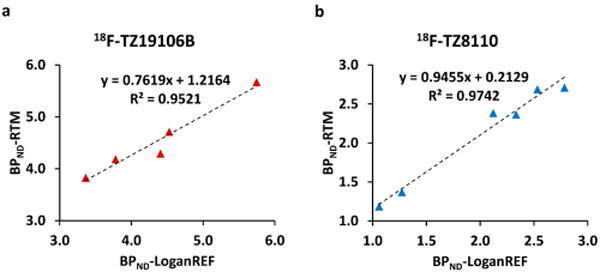
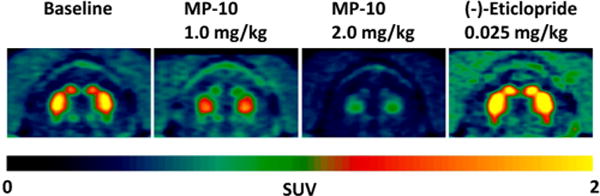
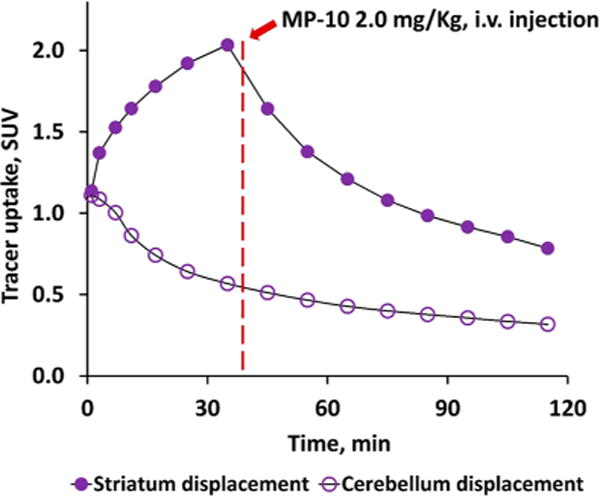
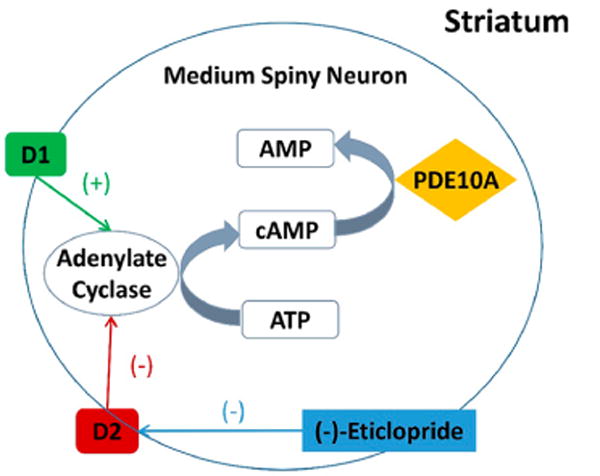
Positron emission tomography (PET) with phosphodiesterase 10A (PDE10A) specific radioligands provides a noninvasive and quantitative imaging tool to access the expression of this enzyme in vivo under normal and diseased conditions. We recently reported two potent 18F-labeled PDE10A radioligands (18F-TZ19106B and 18F-TZ8110); initial evaluation in rats and nonhuman primates indicated stable metabolic profiles and excellent target-to-nontarget ratio (striatum/cerebellum) for both tracers. Herein, we focused on in vivo characterization of 18F-TZ19106B and 18F-TZ8110 to identify a suitable radioligand for imaging PDE10A in vivo. We directly compared microPET studies of these two radiotracers in adult male Macaca fascicularis nonhuman primates (NHPs). 18F-TZ19106B had higher striatal uptake and tracer retention in NHP brains than 18F-TZ8110, quantified by either standardized uptake values (SUVs) or nondisplaceable binding potential (BPND) estimated using reference-based modeling analysis. Blocking and displacement studies using the PDE10A inhibitor MP-10 indicated the binding of 18F-TZ19106B to PDE10A was specific and reversible. We also demonstrated sensitivity of 18F-TZ19106B binding to varying number of specific binding sites using escalating doses of MP-10 blockade (0.3, 0.5, 1.0, 1.5, and 2.0 mg/kg). Pretreatment with a dopamine D2-like receptor antagonist enhanced the striatal uptake of 18F-TZ19106B. Our results indicate that 18F-TZ19106B is a promising radioligand candidate for imaging PDE10A in vivo and it may be used to determine target engagement of PDE10A inhibitors and serve as a tool to evaluate the effect of novel antipsychotic therapies.
Keywords: PET radioligands; Phosphodiesterase 10A; brain imaging; in vivo characterization; nonhuman primates; psychotic disorders.
Conflict of interest statement
The authors declare no competing financial interest.
Figures
References
-
- Kotera J, Fujishige K, Yuasa K, Omori K. Characterization and phosphorylation of PDE10A2, a novel alternative splice variant of human phosphodiesterase that hydrolyzes cAMP and cGMP. Biochem Biophys Res Commun. 1999;261:551–557. - PubMed
-
- Sano H, Nagai Y, Miyakawa T, Shigemoto R, Yokoi M. Increased social interaction in mice deficient of the striatal medium spiny neuron-specific phosphodiesterase 10A2. J Neurochem. 2008;105:546–556. - PubMed
-
- Kotera J, Sasaki T, Kobayashi T, Fujishige K, Yamashita Y, Omori K. Subcellular localization of cyclic nucleotide phosphodiesterase type 10A variants, and alteration of the localization by cAMP-dependent protein kinase-dependent phosphorylation. J Biol Chem. 2004;279:4366–4375. - PubMed
Publication types
MeSH terms
Substances
Grants and funding
LinkOut - more resources
Full Text Sources
Other Literature Sources
