


Review of Non-Respiratory, Non-Cancer Physical Health Conditions from Exposure to the World Trade Center Disaster
- PMID: 29401643
- PMCID: PMC5858322
- DOI: 10.3390/ijerph15020253
Review of Non-Respiratory, Non-Cancer Physical Health Conditions from Exposure to the World Trade Center Disaster
Abstract
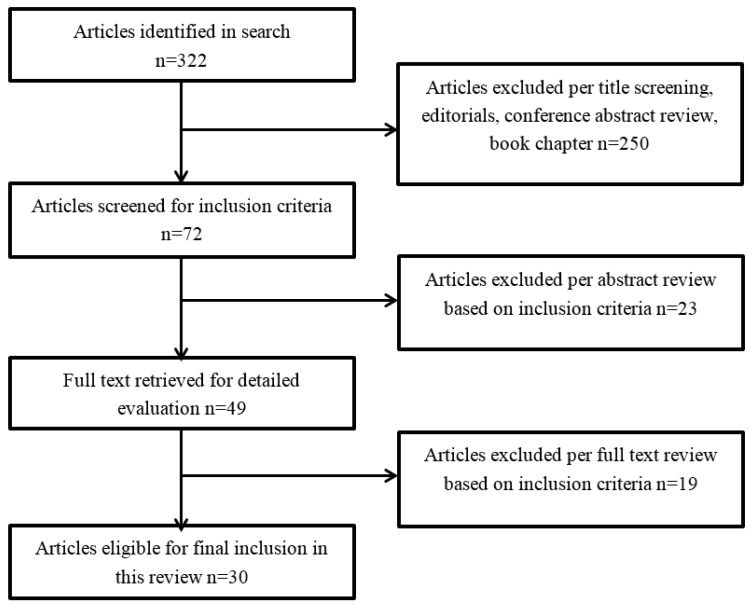
After the World Trade Center attacks on 11 September 2001 (9/11), multiple cohorts were developed to monitor the health outcomes of exposure. Respiratory and cancer effects have been covered at length. This current study sought to review the literature on other physical conditions associated with 9/11-exposure. Researchers searched seven databases for literature published in English from 2002 to October 2017, coded, and included articles for health condition outcome, population, 9/11-exposures, and comorbidity. Of the 322 titles and abstracts screened, 30 studies met inclusion criteria, and of these, 28 were from three cohorts: the World Trade Center Health Registry, Fire Department of New York, and World Trade Center Health Consortium. Most studies focused on rescue and recovery workers. While many of the findings were consistent across different populations and supported by objective measures, some of the less studied conditions need additional research to substantiate current findings. In the 16 years after 9/11, longitudinal cohorts have been essential in investigating the health consequences of 9/11-exposure. Longitudinal studies will be vital in furthering our understanding of these emerging conditions, as well as treatment effectiveness.
Keywords: 11 September; 2001; cohort; physical health; rescue and recovery workers.
Conflict of interest statement
The authors declare no conflict of interest.
References
-
- Lioy P.J., Weisel C.P., Millette J.R., Eisenreich S., Vallero D., Offenberg J., Buckley B., Turpin B., Zhong M., Cohen M.D., et al. Characterization of the dust/smoke aerosol that settled east of the World Trade Center (WTC) in lower Manhattan after the collapse of the WTC 11 September 2001. Environ. Health Perspect. 2002;110:703–714. doi: 10.1289/ehp.02110703. - DOI - PMC - PubMed
-
- McGee J.K., Chen L.C., Cohen M.D., Chee G.R., Prophete C.M., Haykal-Coates N., Wasson S.J., Conner T.L., Costa D.L., Gavett S.H. Chemical analysis of World Trade Center fine particulate matter for use in toxicologic assessment. Environ. Health Perspect. 2003;111:972–980. doi: 10.1289/ehp.5930. - DOI - PMC - PubMed
Publication types
MeSH terms
Grants and funding
LinkOut - more resources
Full Text Sources
Other Literature Sources
Medical
Miscellaneous
