. 2018 Feb 3;8(2):85.
doi: 10.3390/nano8020085.

Polymer-Based Nanocarriers for Co-Delivery and Combination of Diverse Therapies against Cancers

Affiliations

Polymer-Based Nanocarriers for Co-Delivery and Combination of Diverse Therapies against Cancers

Guowen Yan et al. Nanomaterials (Basel). .

Abstract

Cancer gives rise to an enormous number of deaths worldwide nowadays. Therefore, it is in urgent need to develop new therapies, among which combined therapies including photothermal therapy (PTT) and chemotherapy (CHT) using polymer-based nanocarriers have attracted enormous interest due to the significantly enhanced efficacy and great progress has been made so far. The preparation of such nanocarriers is a comprehensive task involving the cooperation of nanomaterial science and biomedicine science. In this review, we try to introduce and analyze the structure, preparation and synergistic therapeutic effect of various polymer-based nanocarriers composed of anti-tumor drugs, nano-sized photothermal materials and other possible parts. Our effort may bring benefit to future exploration and potential applications of similar nanocarriers.

Keywords: cancer; chemotherapy; combined therapy; nanocarrier; photothermal therapy; polymer.


Conflict of interest statement

The authors declare no conflict of interest.

Figures
Scheme 1
Scheme 1
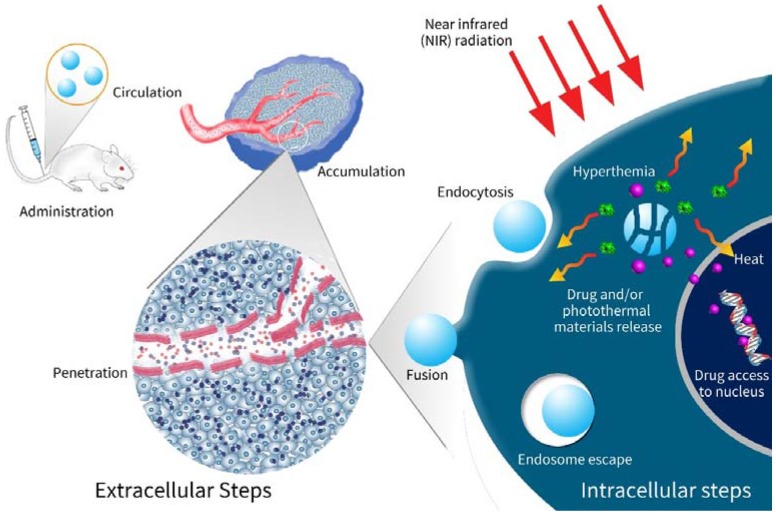
Schematic illustration of nanocarriers exerting therapeutic effects in vivo. After administration, the drug-loaded photothermal nanocarriers navigate to tumors through the blood circulation. Owing to the enhanced permeability and retention (EPR) effects, the nanocarriers penetrate tumor tissues across vessel walls of tumor vasculature, leading to accumulation within tumors. The nanocarriers then enter tumor cells via endocytosis. If targeting ligands exist, the endocytosis may be enhanced. After entrance into cells, the nanocarriers release drugs and emit heat under NIR radiation, leading to synergistic effects of CHT and PTT.
Figure 1
Figure 1
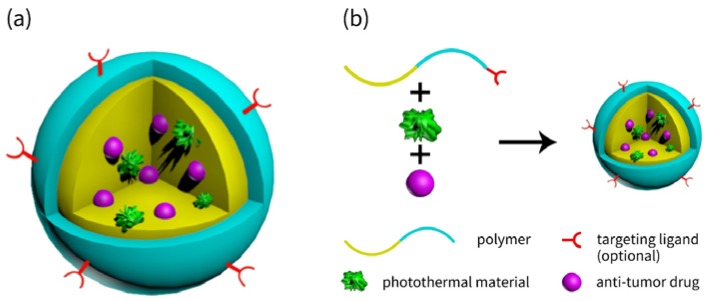
Schematic illustration of (a) the core-shell structured nanocarriers and (b) the preparation process of such nanocarriers.
Figure 2
Figure 2
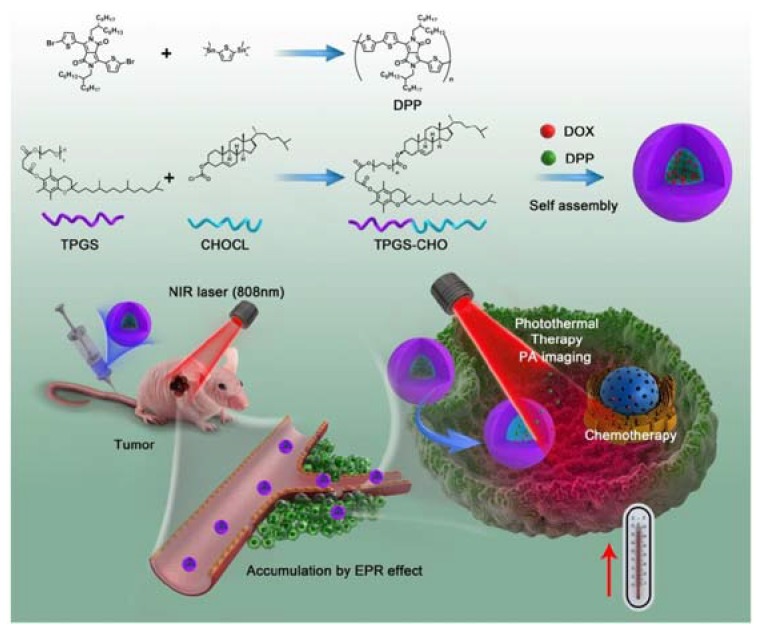
Schematic of the synthesis and photoacoustic imaging-guided photothermal/chemo combination therapy micelle. Reproduced with permission from [80]. The Royal Society of Chemistry, 2017.
Figure 3
Figure 3
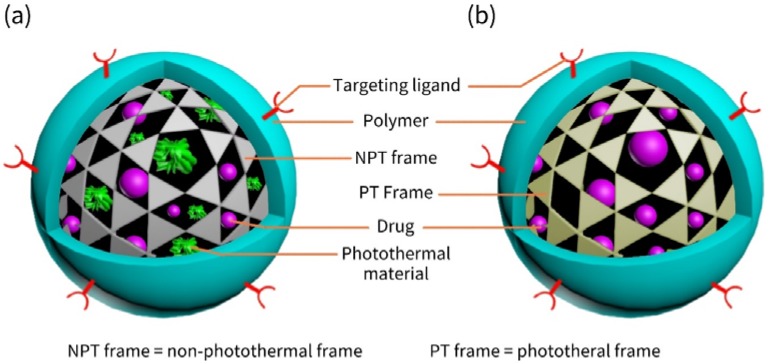
Schematic illustration of frame-coat structured nanocarriers. (a) Nanocarriers with a non-photothermal frame and photothermal materials; (b) Nanocarriers with a photothermal frame.
Figure 4
Figure 4
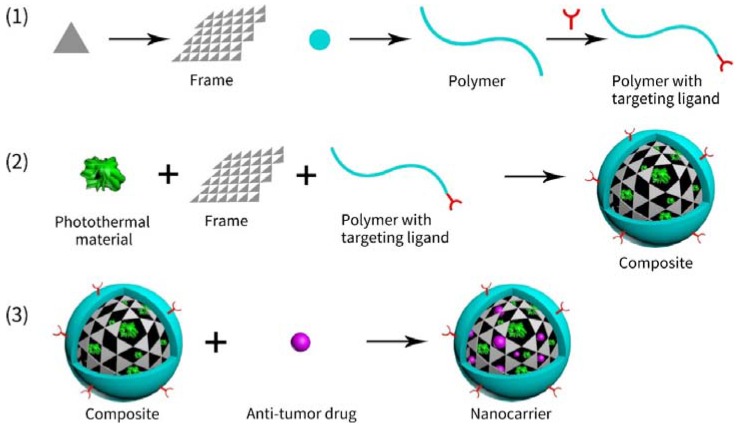
Schematic illustration of preparing frame-coat structured nanocarriers.
Figure 5
Figure 5
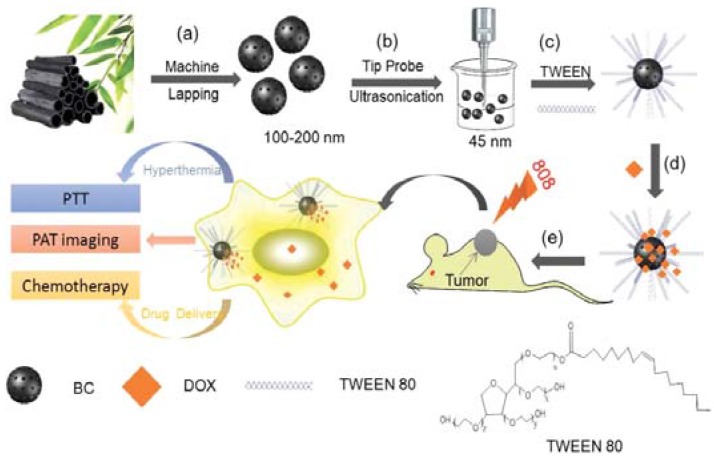
Schematic illustration of (a,b) experimental design for the synthesis of BCNPs; (c,d) BCNPs functionalized with TWEEN 80 for DOX loading; (e) BCNPs as a novel theranostic platform for PAT imaging-guided 808 nm NIR-laser-stimuli-responsive chemo-photothermal therapy of tumor. BCNP = bamboo charcoal nanoparticle. Reproduced with permission from [85]. Wiley, 2016.
Figure 6
Figure 6
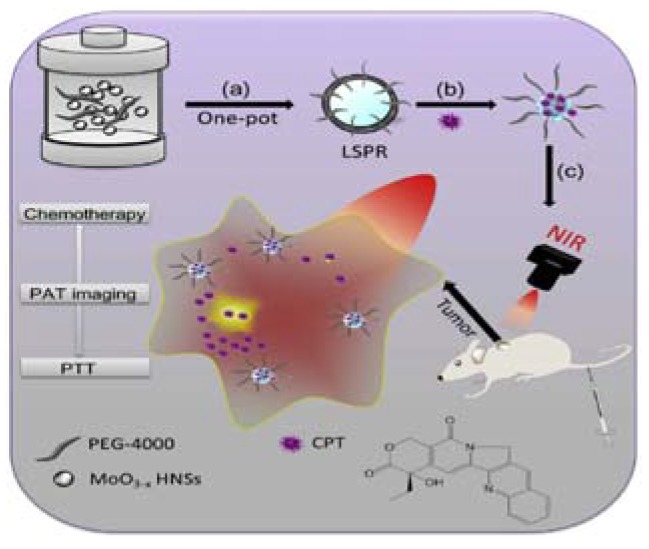
Schematic illustration of (a,b) the synthesis process of CPT loaded PEG-MoO3−x HNSs nanovehicle for (c) PAT imaging-guided combinational chemo-photothermal therapy of cancer. Reproduced with permission from [106]. Elsevier, 2016.
Figure 7
Figure 7
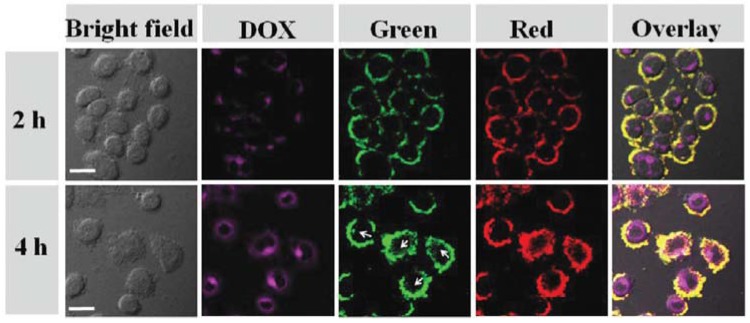
Confocal laser scanning microscopy (CLSM) images of HeLa cells after incubation with UCNPs@Au-DOX for 2 and 4 h, respectively; the rose red emission from DOX was collected at 550–700 nm under excitation of 488 nm; upconversion luminescence (UCL) emission was collected by a green UCL channel at 500–600 nm and a red channel at 600–700 nm, λex = 980 nm, 500 mW. UCNP = upconversion nanoparticle. UCNPs@Au-DOX is the name of a nanosized drug delivery system. Reproduced from [122] with permission from The Royal Society of Chemistry.
Figure 8
Figure 8
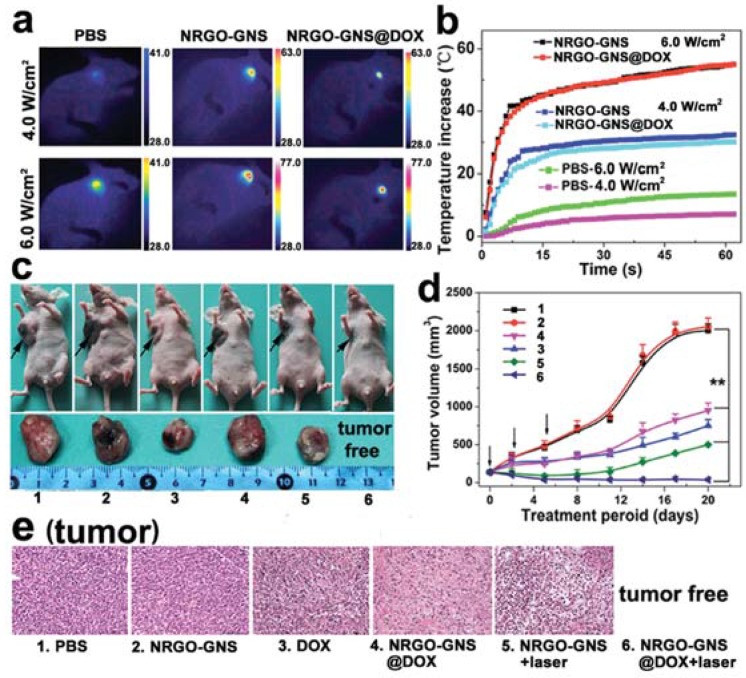
(a) IR thermal images of PBS-, NRGO-GNS-, or NRGO-GNS@DOX-injected 4T1 tumors after laser illumination; (b) Photothermal effect of PBS, NRGO-GNS, or NRGO-GNS@DOX in orthotopic 4T1 tumor-bearing mice in vivo; (c) Representative photographs of the tumor-bearing mice (top panel) and the tumor tissue (bottom panel) taken at the 20th day post the first treatment (the black arrows indicated the position of the primary tumors); (d) Tumor volume change examined during the therapeutic period (n = 6, ** p < 0.01, compared to PBS injected mouse controls); (e) H&E staining of the tumor sections at the end of antitumor study (200×). NRGO = nanosized reduced graphene oxide. GNS = gold nanostar. Reproduced with permission from [66]. Wiley, 2016.
Figure 9
Figure 9
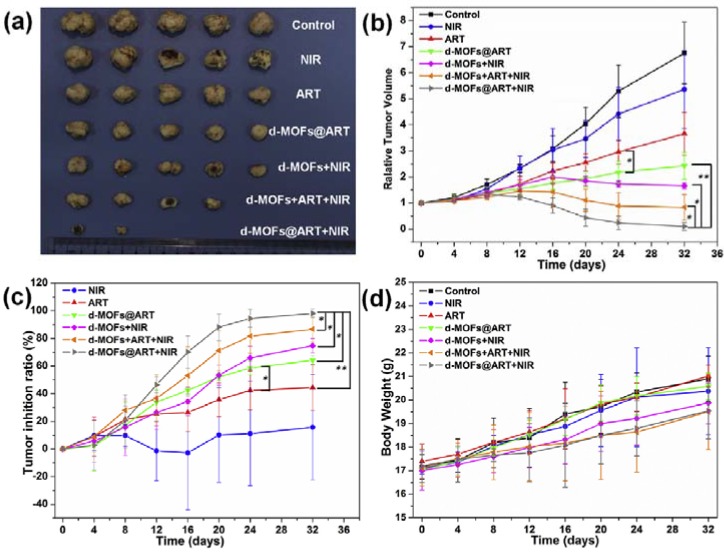
Antitumor ability of ART-loaded d-MOFs nanospheres in HeLa xenograft mice models. (a) The excised tumors from different mice groups treated with saline, NIR irradiation, free ART, d-MOFs@ART, d-MOFs + NIR, d-MOFs + ART + NIR (non-encapsulated) and d-MOFs@ART + NIR at 32nd day; (b) Tumor growth curves of mice after various treatments (mean ± SD., n = 5, * p < 0.05, ** p < 0.01); (c) Tumor inhibition ratio of the NIR irradiation, free ART, d-MOFs@ART and d-MOFs + NIR group and d-MOFs@ART + NIR tumor inhibition ratio of chemo-thermal therapy (mean ± SD., n = 5, * p < 0.05, ** p < 0.01); (d) Body weights of mice for varied time periods for 32 days after various treatments. ART = artemisinin. d-MOFs = dual metal organic frameworks. Reproduced with permission from [107]. Elsevier, 2016.

References

    1. Torre L.A., Bray F., Siegel R.L., Ferlay J., Lortet-Tieulent J., Jemal A. Global Cancer Statistics, 2012. CA Cancer J. Clin. 2015;65:87–108. doi: 10.3322/caac.21262. - DOI - PubMed
    1. Mallidi S., Watanabe K., Timerman D., Schoenfeld D., Hasan T. Prediction of Tumor Recurrence and Therapy Monitoring Using Ultrasound-Guided Photoacoustic Imaging. Theranostics. 2015;5:289–301. doi: 10.7150/thno.10155. - DOI - PMC - PubMed
    1. Li H., Wang K., Yang X., Zhou Y., Ping Q., Oupicky D., Sun M. Dual-Function Nanostructured Lipid Carriers to Deliver IR780 for Breast Cancer Treatment: Anti-Metastatic and Photothermal Anti-Tumor Therapy. Acta Biomater. 2017;53:399–413. doi: 10.1016/j.actbio.2017.01.070. - DOI - PubMed
    1. Boisgerault N., Kottke T., Pulido J., Thompson J., Diaz R.M., Rommelfanger-Konkol D., Embry A., Saenz D., Poeschla E., Pandha H., et al. Functional Cloning of Recurrence-Specific Antigens Identifies Molecular Targets to Treat Tumor Relapse. Mol. Ther. 2013;21:1507–1516. doi: 10.1038/mt.2013.116. - DOI - PMC - PubMed
    1. Kamiyama T., Nakanishi K., Yokoo H., Kamachi H., Tahara M., Kakisaka T., Tsuruga Y., Todo S., Taketomi A. Analysis of the Risk Factors for Early Death Due to Disease Recurrence or Progression within 1 Year After Hepatectomy in Patients with Hepatocellular Carcinoma. World J. Surg. Oncol. 2012;10:107. doi: 10.1186/1477-7819-10-107. - DOI - PMC - PubMed

LinkOut - more resources