Comment
doi: 10.7554/eLife.34756.
Evolution: Oxygen and early animals
Affiliations
- PMID: 29402380
- PMCID: PMC5800841
- DOI: 10.7554/eLife.34756
Item in Clipboard
Comment
Evolution: Oxygen and early animals
Elife.
.
Abstract
The biology of sponges provides clues about how early animals may have dealt with low levels of oxygen.
Keywords: Ctenophora; Porifera; Tethya wilhelma; early animal evolution; evolutionary biology; genomics; hypoxia-inducible factor; oxygen sensing.
© 2018, Rytkönen.
Conflict of interest statement
KR No competing interests declared
Figures
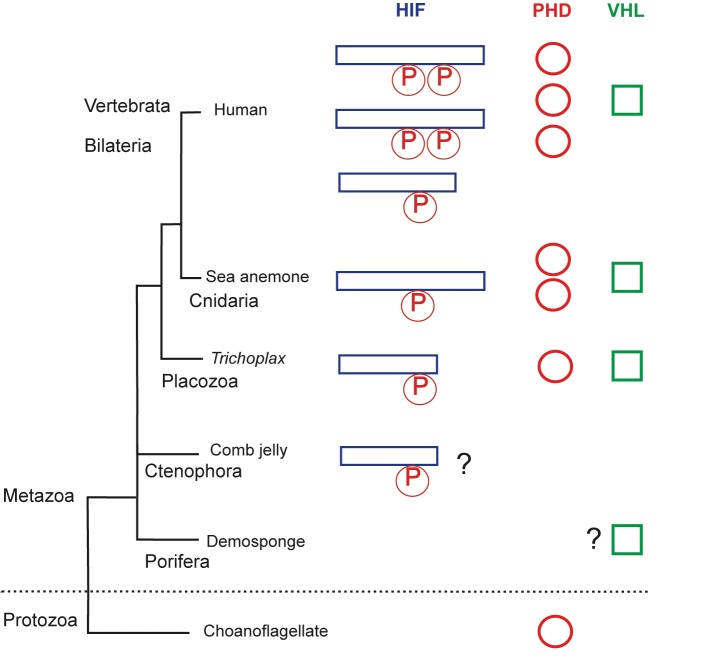
Animals probably began to diverge from a common ancestor around 800 million years ago, when oxygen levels were still scarce. Modern animals use a set of molecules called the HIF (hypoxia-inducible factor) pathway, the enzyme prolyl hydroxylase (PHD) and the von Hippel-Lindau protein (VHL) to regulate gene activity in the cells when oxygen is limited. The HIF protein contains a proline motif (P) that is targeted by PHD. It is unclear when the HIF pathway evolved. Choanoflagellates are simple, single-celled Protozoans that live in aquatic environments. They are the closest known relatives of animals and may be an evolutionary link to early animal life. Choanoflagellates do have PHD, but lack all other components of the HIF pathway. The sponges (Porifera) and comb jellies (Ctenophora) are the earliest animals to have split from a common animal ancestor, but it is debated which diverged first (King and Rokas, 2017). The sponges and comb jellies analyzed by Mills et al. lack key components of the HIF pathway, which suggests that the HIF pathway was not established in the common ancestor of modern animals (Metazoa), and can first be found in the Placozoan Trichoplax adhaerens. However, one comb jelly (Eulopkamis dunlapae) has an HIF with a proline motif that potentially could be targeted by PHDs (indicated by ?), but lacks PHD and VHL. For simplicity, Vertebrata (Human) are shown, but other bilaterian lineages are omitted. Two whole genome duplications in early vertebrates may be responsible for the multiple HIF and PHD genes found in human genome.
Comment on
-
The last common ancestor of animals lacked the HIF pathway and respired in low-oxygen environments.Elife. 2018 Feb 6;7:e31176. doi: 10.7554/eLife.31176. Elife. 2018. PMID: 29402379 Free PMC article.
References
Publication types
MeSH terms
Substances
LinkOut - more resources
Full Text Sources
Other Literature Sources