. 2018 Feb 5;9(1):486.
doi: 10.1038/s41467-017-02606-w.

Gs- versus Golf-dependent functional selectivity mediated by the dopamine D1 receptor

Affiliations

Gs- versus Golf-dependent functional selectivity mediated by the dopamine D1 receptor

Hideaki Yano et al. Nat Commun. .

Abstract

The two highly homologous subtypes of stimulatory G proteins Gαs (Gs) and Gαolf (Golf) display contrasting expression patterns in the brain. Golf is predominant in the striatum, while Gs is predominant in the cortex. Yet, little is known about their functional distinctions. The dopamine D1 receptor (D1R) couples to Gs/olf and is highly expressed in cortical and striatal areas, making it an important therapeutic target for neuropsychiatric disorders. Using novel drug screening methods that allow analysis of specific G-protein subtype coupling, we found that, relative to dopamine, dihydrexidine and N-propyl-apomorphine behave as full D1R agonists when coupled to Gs, but as partial D1R agonists when coupled to Golf. The Gs/Golf-dependent biased agonism by dihydrexidine was consistently observed at the levels of cellular signaling, neuronal function, and behavior. Our findings of Gs/Golf-dependent functional selectivity in D1R ligands open a new avenue for the treatment of cortex-specific or striatum-specific neuropsychiatric dysfunction.


Conflict of interest statement

The authors declare no competing financial interests.

Figures
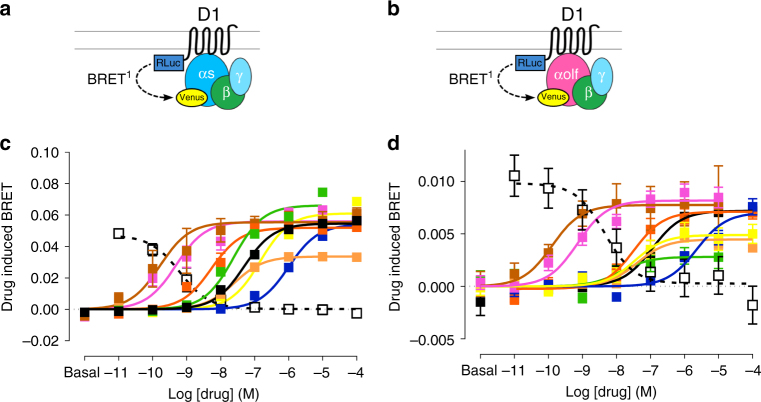
Fig. 1
Fig. 1
a Scheme for the engagement BRET between D1R-Rluc and Gs-Venus. b Scheme for the engagement BRET between D1R-Rluc and Golf-Venus. c Dose-response curves of drug-induced BRET between D1R-Rluc and Gs-Venus (black dopamine, blue norepinephrine, light orange SKF38393, dark orange SKF81297, brown SKF82958, yellow NPA, green DHX, magenta A77636, black open SCH23390 + 10−6 SKF81297). d Dose-response curves of BRET between D1R-Rluc and Golf-Venus (same color scheme). The error bars represent S.E.M
Fig. 2
Fig. 2
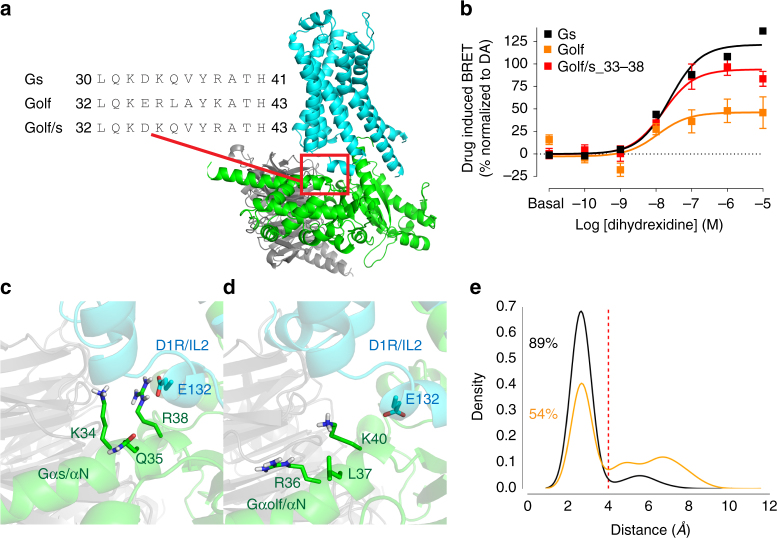
a Homology modeling of Gs (green) coupling to D1R (cyan) based on β2AR-Gs crystal structure (PDB: 3SN6) with the amino acid alignment among Gs (top row), Golf (middle row), and Golf/s_33–38 chimera (bottom row). b Dose-response curves of DHX-induced BRET between D1R-Rluc and Gs-Venus, Golf-Venus, or Golf/s_33–38-Venus (black, orange, and red respectively). BRET values are normalized to Emax values obtained by DA with corresponding Gα-Venus constructs. c, d Close-up views of the simulated interface between D1R and Gs (c) or D1R and Golf (d) at the intracellular loop 2 (IL2) of D1R and N-terminal α-helix (αN) of Gα subunit. e Frequency density distribution plot of 50 ns simulation for D1R-Gs (black) and D1R-Golf (orange). Proportions of salt bridge occurance (<4 Å) in the simulation are shown in percentage. The error bars represent S.E.M.
Fig. 3
Fig. 3
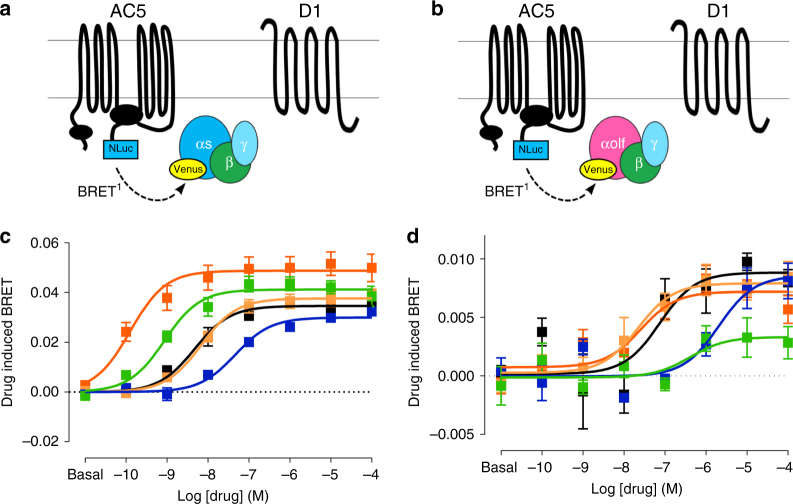
a. Scheme for the drug-induced interaction BRET between AC5-Nluc and Gs-Venus. b Scheme for the drug-induced interaction BRET between AC5-Nluc and Golf-Venus. c Dose-response curves of drug-induced BRET between AC5-Nluc and Gs-Venus (black DA, blue norepinephrine, light orange SKF38393, dark orange SKF81297, green DHX, black open SCH23390 + 106 SKF81297). d Dose-response curves of drug-induced BRET between AC5-Nluc and Golf-Venus (same color scheme). The error bars represent S.E.M.
Fig. 4
Fig. 4
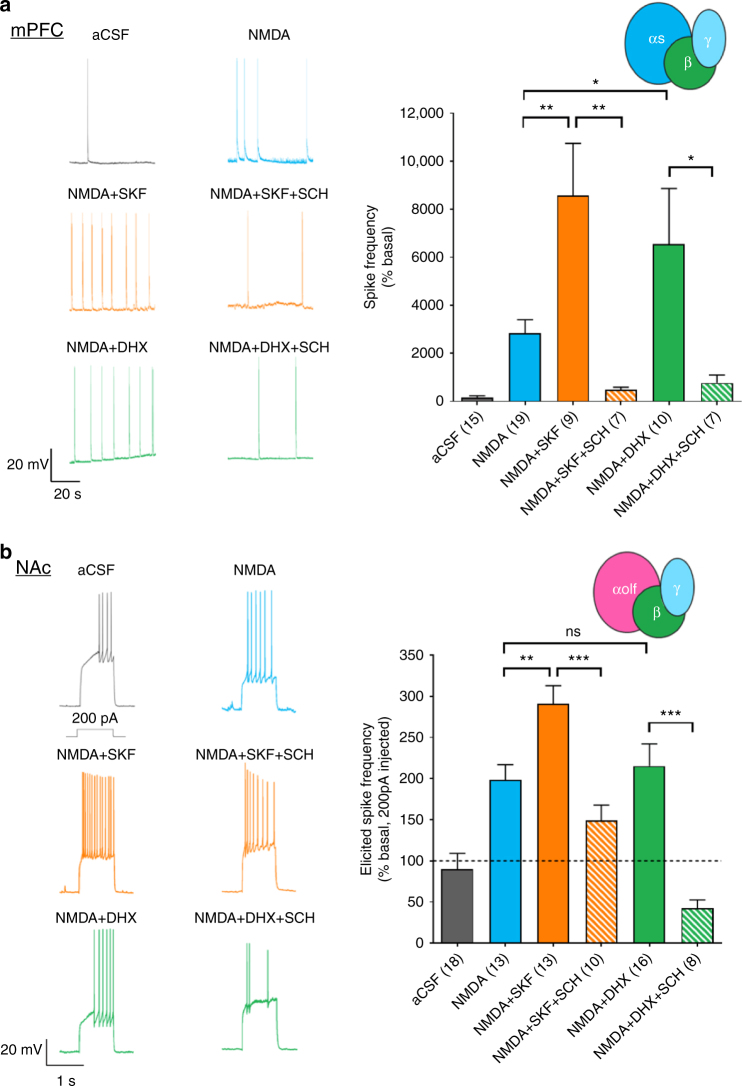
Current clamp recording of drug-induced firing events for D1R-expressing pyramidal neurons in mPFC (a) and medium spiny neurons in NAc (b). Bar graph shows compiled data for spike frequency over 10 min drug treatment (all 10 µM). For + SCH23390 condition, the antagonist is added in the aCSF and drug shown in the x-axis to ensure antagonist binding prior to the other drug’s effect. Example traces are shown on the left. Elicited spike frequency (200 pA injection via recording pipet) is shown for the NAc b. Number of cells recorded for each condition is shown in parenthesis. Values were statistically analyzed by one-way analysis of variance (ANOVA) repeated measure followed by Newman–Keuls post hoc test. p-values are as indicated: *p < 0.05, **p < 0.01, or ***p < 0.001; NS for not significant. The error bars represent S.E.M.
Fig. 5
Fig. 5
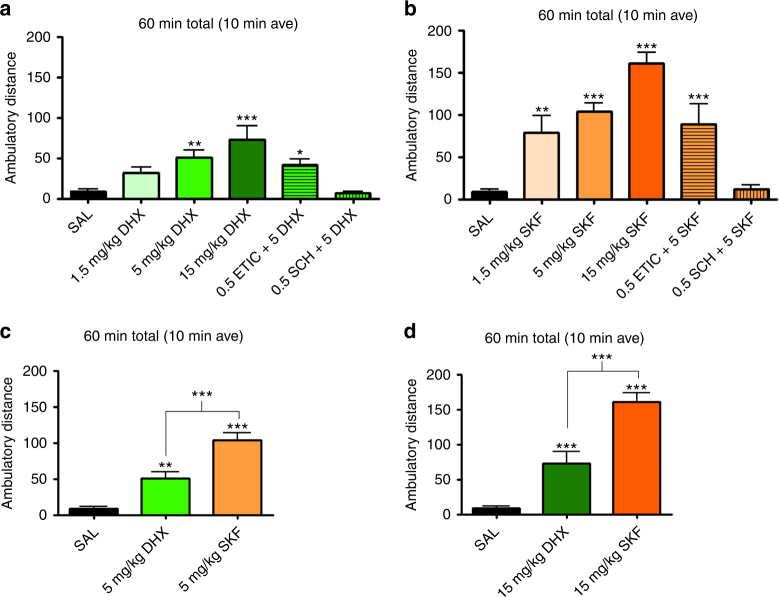
a, b Effect of D1R agonists on locomotion induced in reserpine-treated mice for DHX (a) and SKF81297 (b). Six bar group represents saline injection, 1.5 mg/kg, 5 mg/kg, 15 mg/kg, 5 mg/kg + 0.5 mg/kg eticlopride, 5 mg/kg + 0.5 mg/kg SCH23390 (left to right). c, d Comparison of the ambulatory distance between DHX and SKF81298 at 5 mg/kg (c) and 15 mg/kg (d). Values were statistically analyzed by one-way analysis of variance (ANOVA) followed by Newman-Keuls post hoc test. p-values are as indicated: *p < 0.05, **p < 0.01 or ***p < 0.001. The error bars represent S.E.M

References

    1. Kenakin T. New concepts in pharmacological efficacy at 7TM receptors: IUPHAR review 2. Br. J. Pharmacol. 2013;168:554–575. doi: 10.1111/j.1476-5381.2012.02223.x. - DOI - PMC - PubMed
    1. Urban JD, et al. Functional selectivity and classical concepts of quantitative pharmacology. J. Pharmacol. Exp. Ther. 2007;320:1–13. doi: 10.1124/jpet.106.104463. - DOI - PubMed
    1. van der Westhuizen ET, Valant C, Sexton PM, Christopoulos A. Endogenous allosteric modulators of G protein-coupled receptors. J. Pharmacol. Exp. Ther. 2015;353:246–260. doi: 10.1124/jpet.114.221606. - DOI - PubMed
    1. Ritter SL, Hall RA. Fine-tuning of GPCR activity by receptor-interacting proteins. Nat. Rev. Mol. Cell. Biol. 2009;10:819–830. doi: 10.1038/nrm2803. - DOI - PMC - PubMed
    1. Violin JD, Crombie AL, Soergel DG, Lark MW. Biased ligands at G-protein-coupled receptors: promise and progress. Trends Pharmacol. Sci. 2014;35:308–316. doi: 10.1016/j.tips.2014.04.007. - DOI - PubMed

Publication types

MeSH terms

Substances

LinkOut - more resources