. 2018 Feb 5;8(1):2411.
doi: 10.1038/s41598-018-20912-1.

Histone H5 is a potent Antimicrobial Agent and a template for novel Antimicrobial Peptides

Affiliations

Histone H5 is a potent Antimicrobial Agent and a template for novel Antimicrobial Peptides

Joelle Jodoin et al. Sci Rep. .

Abstract

Modern medicine is challenged continuously by the increasing prevalence of antibiotic resistant bacteria. Cationic antimicrobial peptides and their derivatives are interesting potential alternatives to antibiotics due to their rapid action, broad-spectrum of antimicrobial activity and limited emergence of bacterial resistance. This study reports the novel antimicrobial properties of histone H5, purified from chicken erythrocytes, and histone H5-derived synthetic peptides. Broth microdilution assays revealed that histone H5 has potent broad-spectrum antimicrobial activity against Gram-positive and Gram-negative planktonic bacteria (MIC range: 1.9 ± 1.8 to 4.9 ± 1.5 µg/mL), including vancomycin-resistant Enterococcus (VRE) and methicillin-resistant Staphylococcus aureus (MRSA). Moreover, histone H5 displayed anti-biofilm activity against established Listeria monocytogenes and Pseudomonas aeruginosa biofilms. Scanning electron microscopy demonstrated bacterial membrane damage after histone H5 treatment, while a hemolytic assay revealed that histone H5 is non-toxic towards mammalian erythrocytes, even at a concentration of 1 mg/mL. Although the predicted H5-derived antimicrobial peptides tested in this study were located within the antimicrobial domain of histone H5, their synthetic versions did not possess more potent antimicrobial activity than the full length protein. Overall, this study demonstrates that histone H5 is a potent antimicrobial and therefore a promising template for the development of novel histone H5-derived antimicrobial peptides.


Conflict of interest statement

The authors declare that they have no competing interests.

Figures
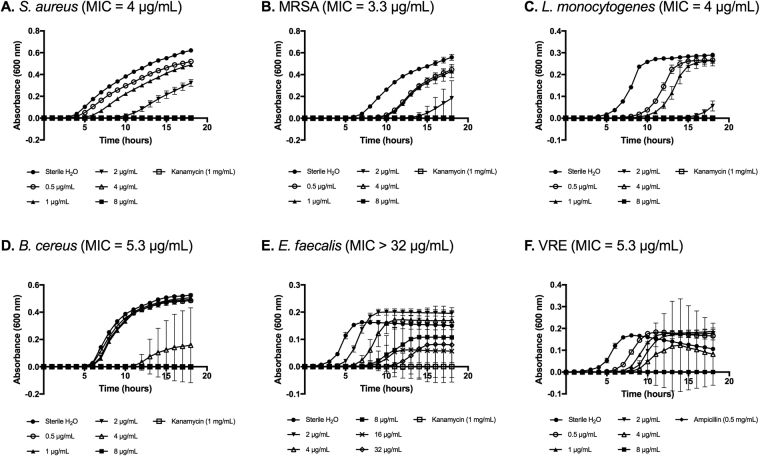
Figure 1
Figure 1
Dose-dependent growth inhibition of Gram-positive bacteria by histone H5. Minimum inhibitory concentrations (MICs) of histone H5 versus S. aureus (A), MRSA (B), L. monocytogenes (C), B. cereus (D), E. faecalis (E) and VRE (F) were determined by broth microdilution assays. Sterile ddH2O, pH 7.4, was the negative control for inhibition. Kanamycin (1 mg/mL) or ampicillin (0.5 mg/mL) was the positive control for inhibition. Results are representative of three independent trials, each performed in triplicate (n = 3).
Figure 2
Figure 2
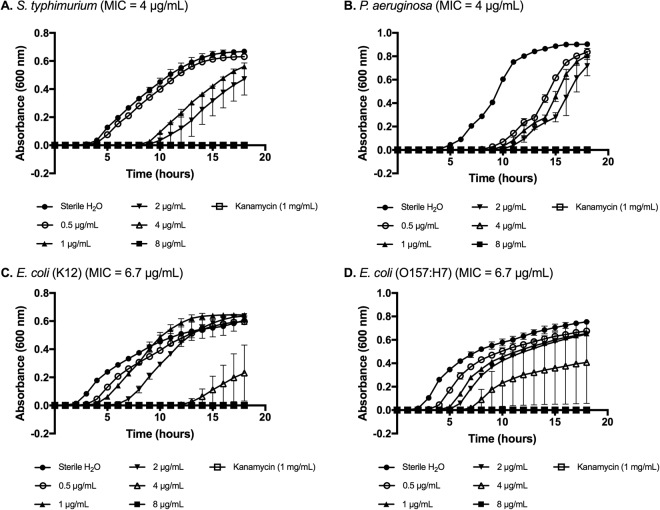
Dose-dependent growth inhibition of Gram-negative bacteria by histone H5. Minimum inhibitory concentrations (MICs) of histone H5 versus S. typhimurium (A), P. aeruginosa (B), E. coli (K12) (C) and E. coli (O157:H7) (D) were determined by broth microdilution assays. Sterile ddH2O, pH 7.4, was the negative control for inhibition. Kanamycin (1 mg/mL) was the positive control for inhibition. Results are representative of three independent trials, each performed in triplicate (n = 3).
Figure 3
Figure 3
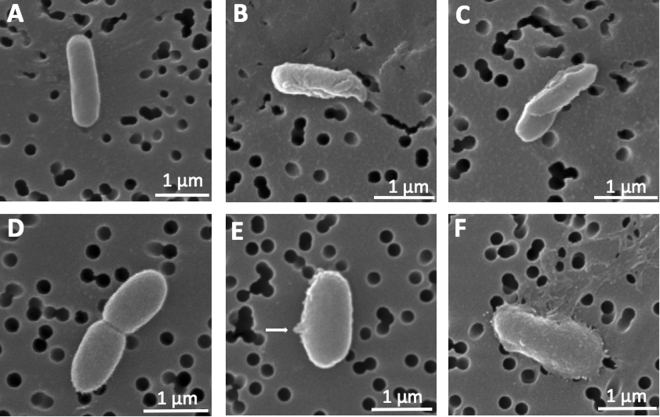
Scanning electron microscopy (SEM) of histone H5-treated Listeria monocytogenes and Pseudomonas aeruginosa planktonic cells. (A) L. monocytogenes treated with ddH2O (untreated control cells); (B) and (C) L. monocytogenes treated with 4 µg/mL of histone H5; (D) P. aeruginosa treated with ddH2O (untreated control cells); (E) and (F) P. aeruginosa treated with 4 µg/mL of histone H5. Pore formation is indicated by the white arrow (E). Results are representative of three independent trials (n = 3). All at 30,000X magnification.
Figure 4
Figure 4
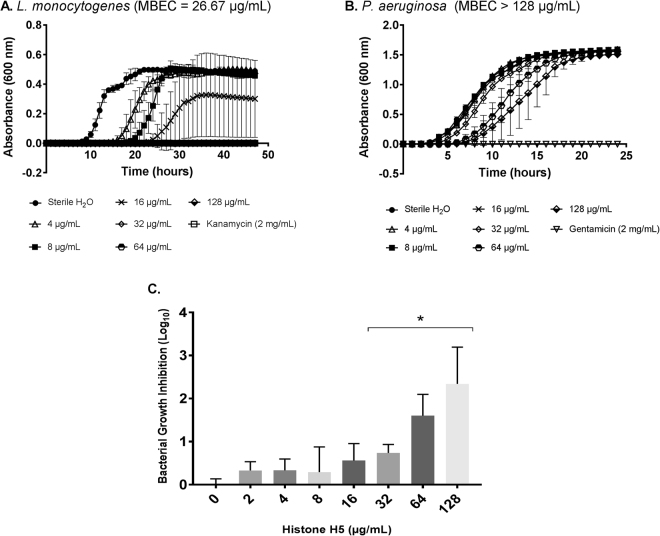
Dose-dependent growth inhibition of Gram-positive and Gram-negative bacterial biofilms by histone H5. Minimum biofilm eradication concentrations (MBECs) of purified histone H5 versus L. monocytogenes (A) and P. aeruginosa (B). Sterile ddH2O, pH 7.4, was the negative control for inhibition. Kanamycin (2 mg/mL) or gentamicin (2 mg/mL) was the positive control for inhibition. Results are representative of three independent trials, each performed in triplicate (n = 3). (C) Dose-dependent logarithmic growth inhibition of P. aeruginosa bacterial biofilms by histone H5. Results are a summary of three independent trials, each performed in triplicate (n = 3). Statistical analysis was done by Student’s T-Test; (*) indicates P ≤ 0.04 compared with the control (0 µg/mL of histone H5).
Figure 5
Figure 5
Alignment of histone H5 with six histone H5-derived peptides possessing predicted antimicrobial activity. Alignment of the peptide sequences with the first 120 amino acid residues of the full-length histone H5 protein (full length histone H5: 190 amino acids). All predicted active sequences are within amino acid positions 15 to 100, potentially representing the active antimicrobial domain(s) of histone H5.
Figure 6
Figure 6
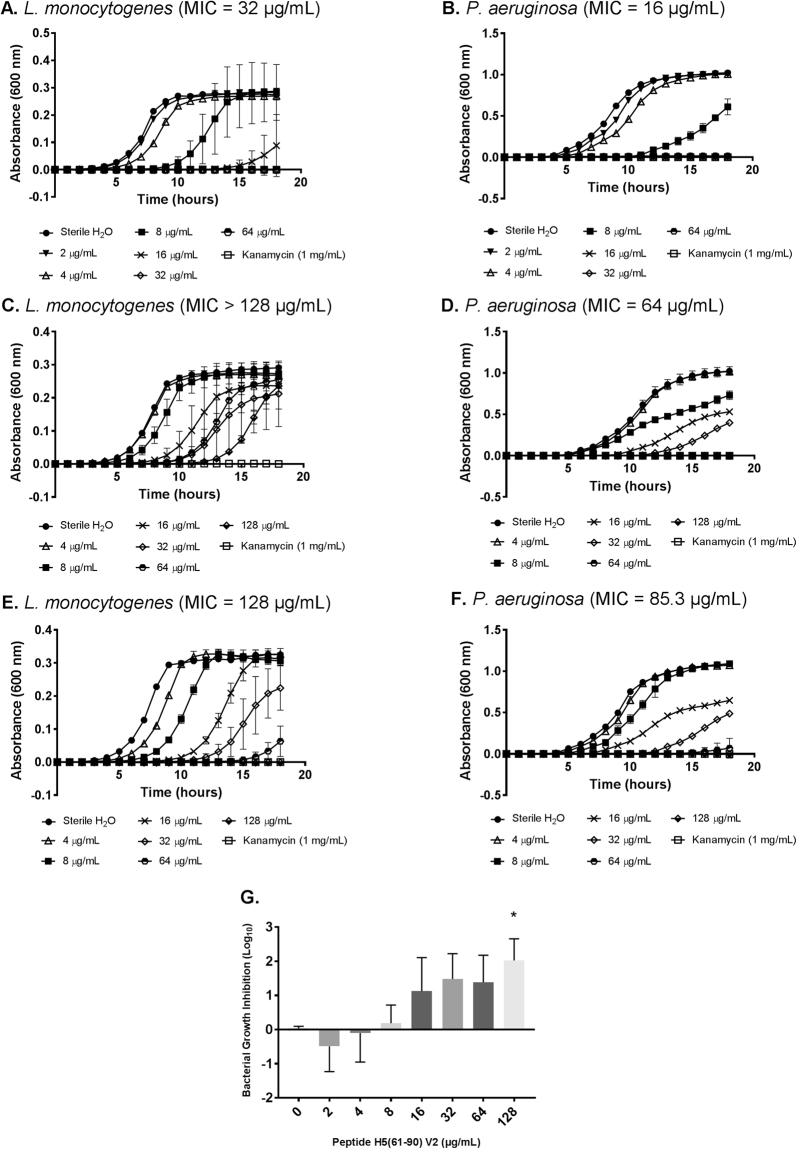
Dose-dependent growth inhibition of Gram-positive and Gram-negative planktonic bacteria by histone H5-derived peptides H5(61–90) V1-V3. MICs of peptide H5(61–90) V1 versus L. monocytogenes (A) and P. aeruginosa (B), of peptide H5(61–90) V2 versus L. monocytogenes (C) and P. aeruginosa (D) and of peptide H5(61–90) V3 versus L. monocytogenes (E) and P. aeruginosa (F) determined by broth microdilution assays. Sterile ddH2O, pH 7.4, was the negative control for inhibition. Kanamycin (1 mg/mL) was the positive control for inhibition. Results are representative of three independent trials, each performed in triplicate (n = 3). (G) Dose-dependent logarithmic growth inhibition of Listeria monocytogenes planktonic bacteria by peptide H5(61–90) V2. Results are a summary of three independent trials, each performed in triplicate (n = 3). Statistical analysis was done by Student’s T-Test, (*) indicates P ≤ 0.03 compared with the control (0 μg/mL of peptide H5(61–90) V2).
Figure 7
Figure 7
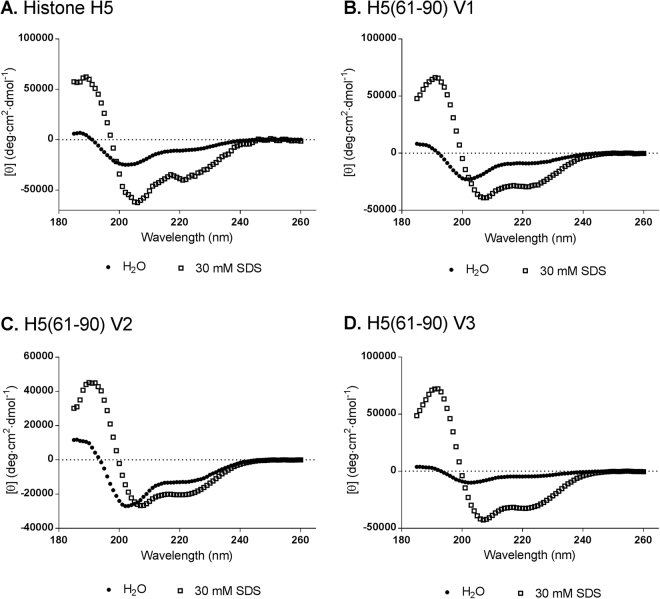
CD spectra of histone H5 and histone H5-derived peptides. CD spectra of histone H5 and histone H5-derived peptides dissolved in sterile ddH2O pH 7.4 (●) or 30 mM SDS (□), recorded at room temperature.

References

    1. Ventola CL. The Antibiotic ResistanceCrisis: Part 1: Causes and Threats. Pharm. Ther. 2015;40:277–283. - PMC - PubMed
    1. Cars O, Hedin A, Heddini A. The global need for effective antibiotics—Moving towards concerted action. Drug Resist. Updat. 2011;14:68–69. doi: 10.1016/j.drup.2011.02.006. - DOI - PubMed
    1. Phillips I, et al. Does the use of antibiotics in food animals pose a risk to human health? A critical review of published data. J. Antimicrob. Chemother. 2004;53:28–52. doi: 10.1093/jac/dkg483. - DOI - PubMed
    1. Economou V, Gousia P. Agriculture and food animals as a source of antimicrobial-resistant bacteria. Infect. Drug Resist. 2015;8:49–61. doi: 10.2147/IDR.S55778. - DOI - PMC - PubMed
    1. O’Neill, J. Antimicrobial Resistance: Tackling a crisis for the health and wealth of nations. Rev. Antimicrob. Resist. 1–16 (2014).

MeSH terms

LinkOut - more resources